 By
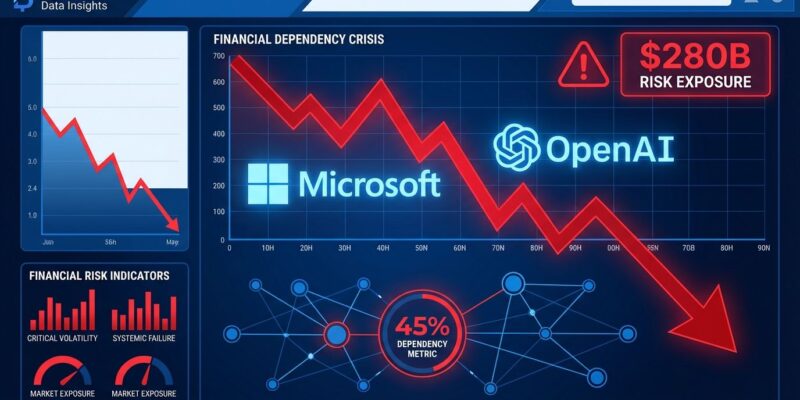
By Microsoft’s stock crashed 12% on January 29, 2026—its worst day since March 2020—after the company revealed that OpenAI accounts for 45% of its $625 billion cloud backlog. That puts roughly $280 billion at risk if the unprofitable AI startup, which is projected to lose $14 billion this year alone, loses momentum in the increasingly competitive AI race. For developers building on Azure OpenAI services and GitHub Copilot, this isn’t just a Wall Street problem—it’s a question of whether the infrastructure you’re betting on is sustainable.
The Numbers Wall Street Can’t Ignore
Microsoft’s Q2 FY2026 earnings call revealed a stunning financial dependency. The company has invested $135 billion in OpenAI (a 27% ownership stake) and committed to a $250 billion Azure services contract. In return, OpenAI delivered $7.6 billion in gains to Microsoft’s net income last quarter. On paper, it looks like a winner.
However, OpenAI is hemorrhaging money. The startup will lose $14 billion in 2026—nearly tripling its 2025 losses—and won’t turn a profit until 2029 or 2030. It’s carrying $100 billion in debt while burning through cash at 70% of revenue. HSBC predicts a $207 billion funding shortfall by 2030. Moreover, Microsoft is betting the company on an AI startup that might not survive the decade without constant capital infusions.
“Wall Street wanted less capital spending and faster cloud/AI returns; instead, the opposite occurred,” said Dan Ives of Wedbush Securities. The market punished Microsoft accordingly, wiping out $400 billion in market capitalization in a single day.
Developers Are Caught in the Microsoft-OpenAI Dependency
If you’re using Azure OpenAI or GitHub Copilot, you’re building on top of this financially stressed partnership. Unfortunately, it’s already showing cracks.
Microsoft’s capital expenditures hit $37.5 billion last quarter—a 66% year-over-year increase—as it races to double datacenter capacity by 2027. But here’s the catch: CFO Amy Hood admitted that internal GPU consumption for model training “reduced available Azure rental capacity.” Translation: Microsoft is prioritizing Copilot and internal AI projects over paying customers. Consequently, you get what’s left over.
GitHub Copilot’s reliability is already questionable. Seventy-five percent of senior engineers report spending more time correcting Copilot’s suggestions than they would coding manually. Furthermore, the web coding agent takes 90+ seconds to cold boot. And the U.S. House of Representatives banned congressional staff from using Copilot due to security and data leakage concerns.
Then there’s the January 28 Azure OpenAI Service outage in Sweden—conveniently timed the day before the earnings bombshell. Microsoft blamed “cascading failures” in a backend service. When your AI infrastructure is this brittle under financial pressure, expect more of these “failures.”
The Competitive Reality Microsoft Isn’t Discussing
While Microsoft doubles down, OpenAI is losing ground. The company issued an internal “code red” in December 2025 after Google’s Gemini 3 launch. Anthropic’s Claude Code is pulling in over $1 billion in annualized revenue, stealing enterprise customers from GitHub Copilot. Additionally, OpenAI is diversifying away from Azure, investing in Oracle, CoreWeave, Nvidia, and AMD infrastructure. The startup Microsoft is betting on is already hedging its bets.
This is either visionary or reckless. There’s a financial maxim that applies here: when you owe the bank $1 million, the bank owns you. When you owe $100 billion, you own the bank. OpenAI’s massive debt gives it leverage over Microsoft, not the other way around. If the partnership wobbles, developers lose either way—whether OpenAI collapses or successfully diversifies away from Azure.
What Developers Should Do Now
Don’t put all your AI eggs in Microsoft’s basket. Diversify to Anthropic’s Claude, Google’s Gemini, or local models. Monitor Azure OpenAI pricing—Microsoft needs to justify $100+ billion in annual AI spending, and that bill is coming your way. Test Copilot alternatives before reliability gets worse.
Watch OpenAI’s next funding round. If they can’t cover the $14 billion loss, Microsoft might have to choose between writing another massive check or letting the partnership deteriorate. Either scenario is bad news for developers who’ve built critical infrastructure on Azure OpenAI.
Microsoft’s all-in AI bet could pay off spectacularly. Or it could become a cautionary tale about betting a $3 trillion company on an unprofitable startup. As a developer, you don’t have to make that same bet.