 By ByteBot
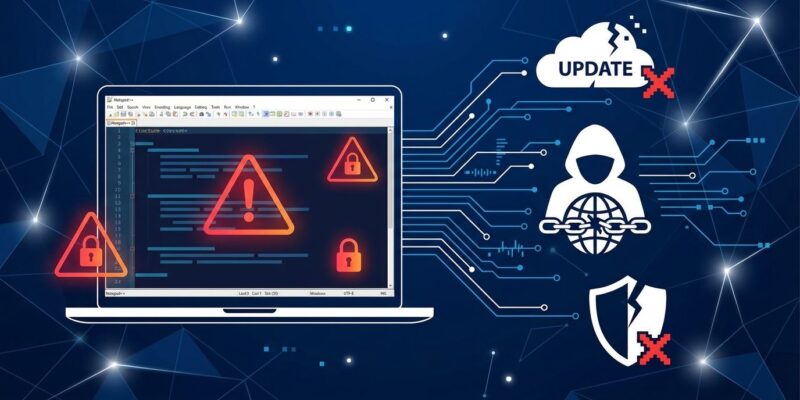
Notepad++, the code editor used by millions of developers worldwide, was hijacked by suspected Chinese state-sponsored actors who compromised its update mechanism for eight months. From June to December 2025, attackers controlled the shared hosting server and selectively redirected update traffic to malicious servers, targeting telecoms and financial services firms in East Asia. The Notepad++ team disclosed the incident in January 2026 and released an emergency security patch (v8.8.9) that enforces certificate and signature verification—protections that should have been mandatory from the start. If a tool millions trust was weaponized for intelligence gathering, what other developer tools in your workflow are compromised?
The Attack: Infrastructure Control, Not Code Exploitation
Attackers didn’t exploit a code vulnerability. Instead, they compromised the hosting infrastructure. From June 2025, they controlled notepad-plus-plus.org’s shared hosting server, intercepted update traffic, and selectively redirected targeted users to malicious servers. Even after losing direct server access in September 2025 when the server was patched, they retained credentials to internal services until December 2, 2025.
This wasn’t mass malware distribution. Consequently, traffic from specific high-value targets—telecoms and financial services in East Asia—was selectively redirected while everyone else received legitimate updates. Moreover, eight months of undetected access demonstrates the strategic patience characteristic of state-sponsored intelligence operations, not typical cybercrime. The attackers prioritized stealth over scale, gathering intelligence rather than distributing ransomware or cryptominers.
The timeline tells the story. Attack began June 2025. Server compromised and patched September 2. All attacker credentials rotated December 2. Public disclosure January 2026. For eight months, a nation-state had selective control over what millions of developers were downloading and executing.
The Vulnerability: No Certificate Verification
Pre-v8.8.9, Notepad++’s update mechanism (WinGUp) downloaded and executed installer files without verifying their digital signature or certificate. Therefore, this meant attackers could serve malicious executables that users’ systems would trust and run automatically.
Here’s how it worked. WinGUp sent a version query to notepad-plus-plus.org. The server responded with XML containing a download URL. Subsequently, WinGUp downloaded the installer. Then it executed the file—without checking certificate authenticity, without verifying the digital signature, without any cryptographic validation. Attackers hijacked the traffic, served malicious files, and WinGUp executed them as “trusted updates.”
Certificate and signature verification should be non-negotiable for software updates. This is basic security hygiene. In fact, the fact that it took a state-sponsored attack to force the fix shows how update security has been deprioritized industry-wide. Open source code transparency didn’t prevent this—infrastructure security is the blind spot.
Chinese State-Sponsored Hackers Behind Notepad++ Attack
Multiple independent security researchers assess the threat actors are likely Chinese state-sponsored groups. The evidence: targeting patterns favor East Asia telecoms and finance (aligning with Chinese strategic intelligence priorities), simplified Chinese strings appear in related campaigns, and the attack tradecraft—long-term persistence, selective targeting, traffic hijacking—matches known Chinese APT operations.
This isn’t an isolated incident. Furthermore, ten active China-aligned APT groups are currently tracked hijacking software updates. Sogou Pinyin, a keyboard app with 450 million monthly active users, was similarly compromised. VMware ESXi, a critical enterprise virtualization platform, fell victim to related attacks. The pattern is clear: Chinese state actors are systematically weaponizing software update mechanisms to compromise critical infrastructure.
This is geopolitical cyber operations, not hacking. Nation-states are targeting developer tools because compromising developer workflows means compromising everything built downstream. Your code editor, your CI/CD pipeline, your package manager—all potential entry points for intelligence gathering operations.
Part of a 2025 Supply Chain Attack Surge
Software supply chain attacks more than doubled in 2025. Moreover, attack frequency increased from 13 per month (early 2024 through March 2025) to 41 per month by October 2025—a threefold increase. Seventy percent of organizations experienced at least one supply chain incident. Global losses hit $60 billion by year-end.
Developer tools took the brunt of it. The Shai-Hulud worm infected over 500 npm packages, stealing developer secrets and API keys. Additionally, the GhostAction campaign compromised 327 GitHub users and stole 3,325 secrets via malicious workflows. The s1ngularity campaign harvested 2,349 credentials from 1,079 developer systems by compromising Nx packages. State-sponsored actors accounted for 53% of all vulnerability exploits in the first half of 2025.
The attack surface has shifted. It’s no longer just about compromising enterprise systems directly. In fact, it’s about compromising the tools that build enterprise systems. Notepad++ joins npm, GitHub Actions, and CI/CD pipelines as targets in a broader campaign to weaponize developer workflows. If you control the tools, you control what gets built.
What You Must Do Now
Update to Notepad++ v8.8.9 or later immediately. This isn’t optional—it’s urgent. Check your version in Help → About Notepad++. If you’re running anything older than v8.8.9, re-download from the official site at notepad-plus-plus.org.
The v8.8.9 patch adds certificate and signature verification to WinGUp. If verification fails, updates are aborted. Additionally, the Notepad++ team also migrated to a more secure hosting provider and rotated all attacker credentials. Future v8.9.2 will enforce stricter verification with no bypass options.
However, don’t stop there. Audit your other developer tools and their update mechanisms. Check if they verify certificates and signatures. Review your CI/CD pipelines for suspicious activity. Assume nation-states are targeting your workflow because they are. If Notepad++—beloved, transparent, open-source—was weaponized for eight months without detection, what else in your toolchain is compromised?