 By
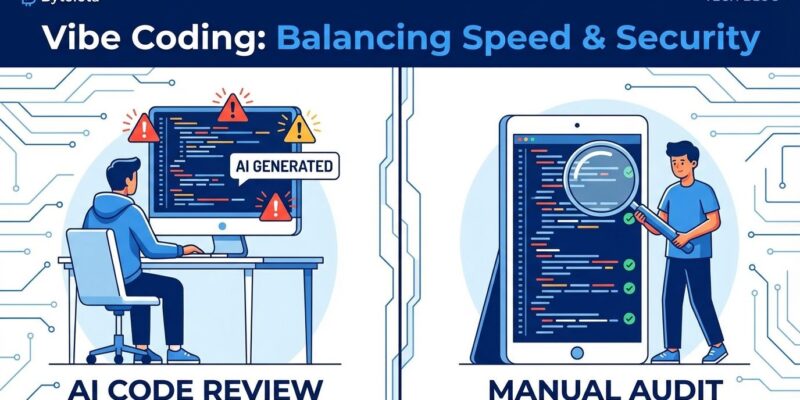
By A non-technical writer at Stack Overflow wanted to test “vibe coding”—the AI trend where you describe an app in natural language and tools like Bolt generate working code instantly. They built a bathroom review app without writing a single line of code. Success, right? Not quite. When they showed it to actual developers, the verdict was harsh: “messy and nearly impossible to understand,” with security holes that left all user data exposed. The irony? For a technology supposedly making junior developers obsolete, it needed a lot of help from junior developers to identify the problems.
What Is Vibe Coding and Why Everyone’s Talking About It
Vibe coding is AI-assisted development where you describe what you want in plain English, and large language models generate the code. Andrej Karpathy—OpenAI co-founder and former Tesla AI lead—coined the term in February 2025. By 2026, Collins Dictionary named it Word of the Year.
The promise sounds incredible: anyone can build software now. No coding bootcamp, no CS degree, just tell Bolt.new or Lovable.dev what you want and watch it materialize. Furthermore, startups are shipping 95% of their code via AI. Non-technical founders, designers, and writers are building full-stack apps in hours.
However, there’s just one catch. The key characteristic of vibe coding, as programmer Simon Willison noted, is that users accept AI-generated code without fully understanding it. If you reviewed, tested, and understood everything, you’re using an LLM as a typing assistant. Vibe coding means trusting the black box.
The Stack Overflow Reality Check: When Vibe Coding Meets Junior Developers
Back to that bathroom review app. The non-technical creator thought they’d cracked the code—literally. Built a working app in minutes using Bolt, deployed it, felt like a developer.
Then actual developers looked at it. The assessment was brutal:
- Zero authentication. “No security features present to stop someone from accessing any of the data it was storing.” Anyone could grab all user data.
- Architectural mess. Disorganized file structure, inlined styling cluttering components, oversized modules crying for refactoring.
- No tests. Not a single unit test. Ship and pray.
Moreover, the creator couldn’t identify any of this. They needed junior developers—the very people vibe coding supposedly replaces—to spot the security holes, explain the architecture problems, and point out what “production-ready” actually means.
This isn’t unique. Stack Overflow’s survey found 66% of developers experience a “productivity tax” from AI tools: code that’s “almost—but not quite—right,” requiring manual fixes. Consequently, the time spent debugging AI output often exceeds the time saved generating it.
The Security Nightmare Nobody Talks About
Security teams analyzed over 5,600 publicly available vibe-coded applications. The results are alarming: 2,000+ vulnerabilities, 400+ exposed secrets (API keys, credentials), and 175 instances of leaked personal information including medical records and financial data.
Veracode reports that roughly 45% of AI-generated code contains security issues—SQL injection, XSS vulnerabilities, client-side authentication that’s trivially bypassed, hardcoded passwords sitting in plain text.
Consider Enrichlead, a startup whose founder boasted on social media that “100% of his platform’s code was written by Cursor AI, with zero hand-written code.” Days after launch, security researchers found it full of newbie-level flaws. The company needed experienced developers to audit and fix everything.
Clearly, the pattern is evident: non-coders can’t identify security holes they didn’t know existed. AI doesn’t inherently understand that client-side authentication is a disaster, or why hardcoded API keys are a breach waiting to happen. These are taught skills. Junior developer skills.
Why Vibe Coding Validates Junior Developers, Not Threatens Them
Here’s what the “coding is dead” crowd misses: vibe coding can generate syntax, but it can’t generate judgment.
The Stack Overflow bathroom app proves this perfectly. The AI produced working code. Nevertheless, what junior developers brought to the table—the skills that identified every single problem—are exactly what vibe coding lacks:
Code review. Spotting security holes, recognizing bad patterns, understanding when architecture is unsustainable. The non-technical creator saw a functional app. Junior developers saw a liability.
Security awareness. Knowing that missing authentication means anyone can access your database. Understanding why “no security features” is a catastrophic sentence. Recognizing that data protection isn’t optional.
Architecture knowledge. Understanding why oversized components are technical debt. Knowing that inlined styling makes code unmaintainable. Recognizing when file structure signals deeper problems.
Testing mindset. Understanding that “it works on my machine” isn’t enough. Knowing what to test and why. Writing meaningful test cases that catch edge cases AI didn’t consider.
A Hacker News developer predicted “an entire new industry of people who vibed 1,000 lines of MVP and now are stuck with something they can’t debug.” That industry is emerging. Developers are increasingly hired to fix LLM-generated code—security audits, refactoring messy architecture, adding test coverage, cleaning up technical debt.
Interestingly, entry-level job postings dropped 67% between 2023 and 2024. Yet educators report “demand grows for engineers who can debug AI-generated code.” The paradox reveals the truth: companies say junior roles aren’t needed, but vibe coding proves they absolutely are.
What Developers Should Actually Know
For junior developers: You’re more valuable, not less. Your code review skills are what vibe coders desperately need. Position yourself as the AI-native junior who can audit generated code, spot security issues, and clean up architectural messes. Use AI as a learning tool—check its output, understand why it works, build the judgment AI lacks.
For senior developers: Prepare for the productivity tax. Learn to shape prompts effectively, but review AI code with the same rigor you’d apply to human contributions. The 66% who report frustration aren’t wrong—”almost right” code is often harder to fix than writing from scratch.
For companies: Vibe coding is a prototyping tool, not a development team. It’s excellent for rapid MVPs, throwaway weekend projects, generating boilerplate. It’s catastrophic for production applications handling user data. Non-technical stakeholders shouldn’t make architectural decisions just because AI can generate code.
The real threat isn’t junior developers being replaced. It’s companies trying to ship vibe-coded apps to production without review, creating security breaches and maintenance nightmares. That hasn’t happened at scale yet. The Stack Overflow bathroom app stayed a demo. Enrichlead got fixed. But the risks are clear.
Ultimately, vibe coding doesn’t eliminate the need for junior developers. It proves they’re essential. The tools designed to replace them can’t survive without them.