 By ByteBot
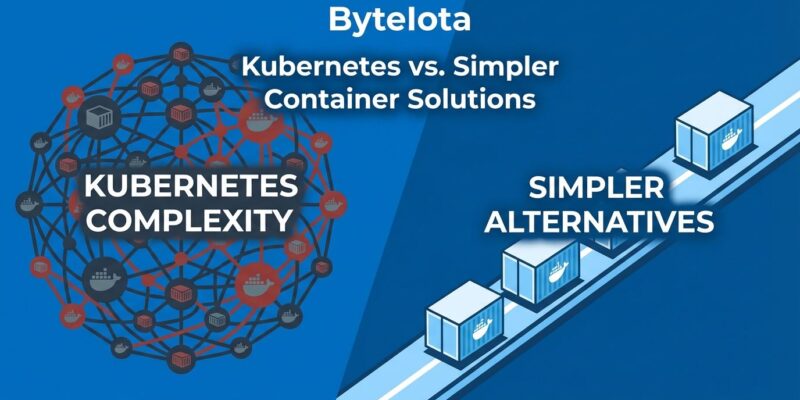
Kubernetes has become the assumed default for container orchestration. Mention containers at a tech conference, and K8s is the reflexive answer. But here’s an uncomfortable truth most teams won’t admit: you probably don’t need it.
The stats tell a damning story. While 93% of organizations run Kubernetes, nearly 80% of K8s incidents stem from operational complexity rather than infrastructure failures. Think about that: your orchestration platform is creating more problems than it solves. For most teams, Kubernetes isn’t eliminating complexity—it’s the source of it.
Meanwhile, simpler alternatives like Docker Swarm, HashiCorp Nomad, and cloud-native serverless platforms deliver 80% of Kubernetes’ benefits with 20% of its complexity. The question isn’t whether Kubernetes is powerful. It’s whether you’re paying a massive complexity tax for features you’ll never use.
You’re Not Just Wasting Time—You’re Wasting Money
A January 2026 study analyzing 3,042 production clusters across 600+ companies revealed something shocking: 68% of pods request 3 to 8 times more memory than they actually use. Cloud providers bill for requested resources, not used resources. Request 2GiB and use 400MiB? You’re paying for 2GiB.
It gets worse. Only 13% of requested CPU gets utilized on average. Between 20-45% of requested resources actually power workloads, meaning 55-80% is pure waste. McKinsey research suggests $120 billion in potential savings through better resource management. That’s not a rounding error—that’s the annual revenue of a Fortune 500 company evaporating into overprovisioned pods.
This isn’t theoretical waste. It’s hitting your AWS bill this month. Kubernetes’ complexity makes it nearly impossible to right-size resources, so teams overprovision out of fear. The platform designed to optimize infrastructure utilization has become a black hole for cloud spending.
Why Everyone Copied Netflix (And Shouldn’t Have)
Kubernetes is one of the most common examples of cargo culting in tech. Teams adopt it because “Big Tech does it,” not because they need it. Ex-Netflix engineers join startups and immediately push for K8s, microservices, and sophisticated service meshes—without considering whether a 50-person company faces the same problems as Netflix’s thousands of engineers managing thousands of services.
This is cargo culting at its finest: copying the solution without understanding the problem. Netflix built Kubernetes-level orchestration because they operate at Netflix scale. You probably don’t. Unless you’re managing hundreds of services across thousands of nodes, you’re importing complexity designed for problems you don’t have.
The brutal truth: “Unless you’re absolutely sure that you need k8s, you probably don’t need it.” But admitting you don’t need Kubernetes feels like admitting you’re not serious about infrastructure. So teams waste months climbing the learning curve and burning budget on dedicated K8s teams—all to solve problems that Docker Swarm would handle in an afternoon.
Simpler Tools Deliver More with Less
The good news: simpler alternatives exist that actually work at real-world scale.
Docker Swarm initializes with a single command: docker swarm init. It integrates natively with Docker CLI and Docker Engine, so your existing knowledge transfers immediately. For smaller workloads and teams just starting with containers, Swarm delivers core orchestration without Kubernetes’ operational overhead. In 2026, it thrives in simpler container setups and edge use cases where resource efficiency matters.
HashiCorp Nomad runs as a single binary with zero external dependencies. It scales to 10,000+ nodes in production while handling containers, VMs, and legacy applications in one system. Where Kubernetes demands complexity, Nomad prioritizes pragmatism: “a simple, powerful workload orchestrator” focused on operational efficiency. If you’re in the HashiCorp ecosystem with Terraform, Consul, and Vault, Nomad integrates seamlessly.
Cloud-native serverless platforms abstract containers entirely. AWS Fargate offers the lowest compute prices with granular resource control. Google Cloud Run delivers the simplest deployment, scaling services in seconds. Azure Container Instances excels at burst processing and batch jobs. All three eliminate the “manage Kubernetes clusters” problem by making it someone else’s problem.
The 2026 trend is clear: “simplicity wins.” Developer-first platforms like Northflank, Portainer, and Fly.io abstract Kubernetes complexity while maintaining deployment power. Teams are realizing that shipping software shouldn’t require a dedicated platform engineering team just to keep containers running.
When Kubernetes Is Actually Justified
Kubernetes has legitimate use cases. They’re just rarer than the tech industry pretends.
You actually need Kubernetes if you’re running 500+ nodes and 150,000+ pods. If you have a dedicated platform team of 3+ engineers who can independently debug K8s production issues. If you’re managing complex multi-cloud, hybrid, or edge deployments with sophisticated networking and security requirements. If you operate at genuine Big Tech scale—Google, Netflix, Uber level—where Kubernetes was designed to solve.
Test yourself honestly:
- Do we have 3+ engineers who can independently solve Kubernetes production issues?
- Are we running hundreds of services at massive scale?
- Is our complexity driven by technical requirements, or are we imitating Big Tech?
- Could Docker Swarm or Nomad solve 80% of our needs with 20% of Kubernetes’ complexity?
If you answered “no” to the first two questions, you’re probably paying the Kubernetes tax for features you don’t need. If you answered “yes” to the last question, you already know the simpler path exists—you’re just afraid to take it.
The hardest part isn’t choosing the right tool. It’s admitting that the industry-standard tool is the wrong tool for you. Most teams waste time and money on Kubernetes they don’t need because they’re optimizing for resume padding and conference cred instead of solving actual problems.
Choose simplicity unless complexity is justified. Your cloud bill—and your sanity—will thank you.