 By ByteBot
Within five days in early January 2026, the two leading AI companies launched competing healthcare platforms. OpenAI announced ChatGPT Health on January 7, connecting medical records directly to its chatbot. Days later on January 12, Anthropic countered with Claude for Healthcare, targeting providers and payers with HIPAA-ready infrastructure and FHIR development tools. The race is on for a healthcare AI market projected to hit $110 billion by 2030.
This isn’t just about healthcare. It signals a fundamental shift from horizontal AI platforms to vertical, industry-specific solutions—and developers need to choose sides.
OpenAI vs Anthropic: Different Healthcare AI Strategies
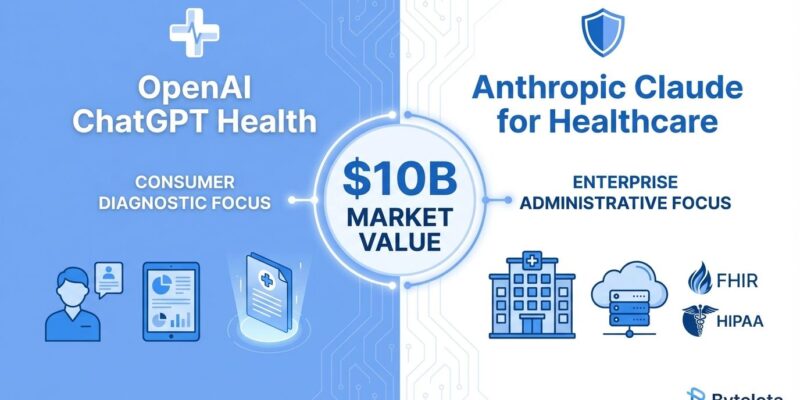
OpenAI and Anthropic are chasing the same $110 billion prize, but they’re taking fundamentally different paths. OpenAI positions itself as the “Clinical Brain”—consumer-facing tools for diagnostics and patient interaction. Its GPT-5.2 model, fine-tuned on the proprietary “HealthBench” dataset, synthesizes 3D medical imaging, pathology reports, and fragmented EHR data. Early hospital partners include Cedars-Sinai, HCA Healthcare, and Boston Children’s Hospital. The acquisition of Torch Health for “medical memory” engines underscores the diagnostic focus.
Anthropic takes the enterprise route. Claude for Healthcare targets providers and payers with administrative workflows—prior authorization, billing, claims processing. The platform includes two new Agent Skills: FHIR development (HL7 FHIR R4) and prior authorization review templates. Native integrations to the CMS Coverage Database, ICD-10 codes, and PubMed’s 35 million articles make it an “Operational Engine” for healthcare’s bureaucracy. Partners like Banner Health, Sanofi, and Novo Nordisk signal serious enterprise adoption.
The strategic difference is clear. If you’re building patient-facing health tools, OpenAI’s 230 million weekly health question users make sense. For enterprise administrative automation ahead of the 2027 federal FHIR Prior Authorization API deadline, Anthropic is positioned better. Platform lock-in is real—choose wisely.
Privacy Concerns and the MIT Memorization Study
The market opportunity is massive: $21.66 billion in 2025 growing to $110.61 billion by 2030 at 38.6% CAGR. ROI is proven—$3.20 return for every dollar invested, realized within 14 months. Yet trust remains the bottleneck.
MIT researchers published findings in January 2026 showing that AI models trained on de-identified health records can memorize patient-specific information. Patients with unique conditions are especially vulnerable to re-identification. Both OpenAI and Anthropic promise health data won’t be used for training and is stored separately. But promises aren’t enough for hospitals burned by past data breaches.
The privacy challenge goes beyond technical safeguards. Healthcare institutions operate in a risk-averse culture where one incident can destroy years of patient trust. The bar isn’t “probably secure”—it’s “provably compliant and auditable.” AI companies must earn credibility, not assert it.
HIPAA Compliance Just Got More Complex
For developers, building on these platforms means navigating a regulatory maze. HIPAA Notice of Privacy Practices must be updated by February 16, 2026, with new reproductive health protections. State-level AI regulations are now active in Indiana, Kentucky, and Rhode Island, adding transparency and data protection requirements on top of federal rules. HIPAA sets the floor; states are raising the ceiling.
Both platforms offer HIPAA-ready infrastructure, but that’s table stakes. Proposed Security Rule changes include mandatory encryption of ePHI and mandatory MFA for critical systems. Anthropic’s FHIR development skill addresses the 2027 deadline, but developers still need compliance expertise that goes beyond API documentation. This isn’t plug-and-play integration—it’s a specialized vertical requiring legal, security, and regulatory knowledge.
The compliance complexity isn’t accidental. Healthcare is testing whether AI companies can meet the standards of highly regulated industries. Finance, legal, and government are watching. Success here validates vertical AI; failure sets the playbook back years.
The Gap Between Hype and Hospital Reality
Despite the hype, adoption faces real barriers. Implementation costs run $500K to $5M. Vetting a single algorithm costs $300K to $500K—out of reach for many hospitals operating on thin margins. There’s no official AI standard for healthcare, leaving institutions paralyzed by uncertainty. Should they deploy now or wait for regulatory clarity?
Physician skepticism is the elephant in the room. Already overwhelmed by technology that hinders workflows more than it helps, doctors resist additional “solutions” that promise efficiency but deliver complexity. Healthcare executives cite immature AI tools as the biggest adoption barrier (77%), followed by financial concerns (47%) and regulatory uncertainty (40%).
The disconnect is stark: vendors promise transformational ROI while hospitals struggle with change management basics. The top deployment priority isn’t revenue or efficiency—it’s reducing caregiver burden (72%). AI that adds to physician workload, no matter how “intelligent,” will fail.
Key Takeaways
- OpenAI and Anthropic are competing for healthcare AI dominance with fundamentally different strategies—consumer/diagnostic (OpenAI) versus enterprise/administrative (Anthropic). Developers building healthcare applications must choose which ecosystem aligns with their target market.
- The $110B market opportunity is real, but privacy concerns are the bottleneck. MIT research showing AI can memorize de-identified patient data underscores trust challenges that technical promises alone won’t solve.
- Regulatory complexity is higher than typical API integration. Federal HIPAA requirements plus state AI laws create a compliance maze requiring legal and security expertise, not just engineering skills.
- Adoption barriers are underestimated. Implementation costs ($500K-$5M), physician skepticism, and lack of official standards create a gap between vendor hype and hospital reality that won’t close quickly.
- Healthcare is the testing ground for vertical AI. Success here validates AI in other regulated industries (finance, legal, government). The patterns established now will shape platform strategies for years.
The healthcare AI race isn’t about who ships features fastest. It’s about who earns trust from institutions that can’t afford mistakes. That’s a competition neither company has won yet.