 By ByteBot
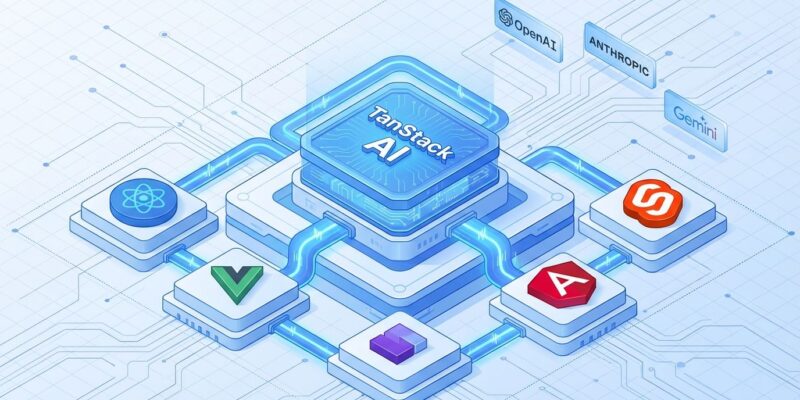
TanStack AI launched in alpha on December 3, 2025, bringing framework-agnostic, type-safe AI integration to developers who refuse to accept vendor lock-in. Built by the team behind TanStack Query, Router, and Table, the SDK supports React, Vue, Solid, Angular, and Svelte with a unified interface for OpenAI, Anthropic, Gemini, Ollama, and other providers. No service layer, no platform fees, pure open source. The AI SDK market is dominated by platform-specific solutions (Vercel AI SDK for Next.js, LangChain for Python-heavy workflows) that force architectural choices on teams. TanStack AI positions itself as “the Switzerland of AI tooling”—neutral, flexible, and designed for long-term maintainability over quick wins.
The Isomorphic Tool Advantage: Write Once, Deploy Anywhere
Here’s the killer feature: TanStack AI uses `toolDefinition()` to write tools once and deploy them with `.server()` or `.client()`. Vercel AI SDK forces you to define tools twice—once for server LLM execution, once for client UI display. The architectural difference cuts code in half: 300 lines for 10 tools vs 600 in Vercel AI SDK.
LogRocket’s analysis nails it: “The difference between TanStack AI and Vercel AI SDK largely comes down to where tools are defined and how many times they must be implemented. In Vercel AI SDK, tools are split across environments, introducing extra surface area for drift. With Vercel AI SDK, you’re at 600 lines for ten tools, while with TanStack AI, you’re at 300 lines.”
Here’s what isomorphic tool definition looks like in practice:
const weatherToolDef = toolDefinition({
name: 'getWeather',
inputSchema: z.object({
location: z.string().describe('The city and state'),
}),
outputSchema: z.object({
temp: z.number(),
condition: z.string(),
}),
})
// Implement server-side
const weatherTool = weatherToolDef.server(async ({ location }) => {
return { temp: 72, condition: 'sunny' }
})
For teams building 10+ AI tools, this is 300 lines of code saved. Fewer bugs, faster iterations, cleaner architecture. Server-client drift disappears when there’s only one definition.
The Ecosystem Play: From Query to Full-Stack Infrastructure
TanStack AI isn’t another standalone SDK. It’s part of a strategic expansion from data management (Query) to complete full-stack platform: Query + Router + Form + Store + AI + Start. This positions TanStack as the “Swiss Army Knife of Frontend Development,” competing with Redux, Zustand, and platform-specific SDKs.
Tanner Linsley, TanStack founder, explained on Reddit why they built their own instead of contributing to Vercel AI SDK: “We saw enough improvement space on Vercel’s solution that we wanted to build our own. One that is as close to our [product tenets] as possible. So far, that’s resulted in better type-safety, better patterns around isomorphism, and honestly just the freedom to move in the direction we want without being beholden to another team.”
For teams already using TanStack Query (widely adopted for data fetching), AI integrates seamlessly. Shared types, automatic cache invalidation, consistent patterns across the stack. Code With Seb’s analysis captures the trajectory: “TanStack is clearly heading toward being a complete frontend platform, with Start reaching 1.0 and new tools like DB and AI in development making 2026 interesting.”
TypeScript Beats Python as #1 Language on GitHub in 2026
Type Safety & Provider Flexibility: The Developer Freedom Bet
TanStack AI delivers per-model type safety through TypeScript and Zod schemas. The compiler auto-completes model names, validates provider options, and surfaces type errors when you mix incompatible models and flags. Provider switching requires one line of code—swap from OpenAI to Anthropic without architectural rewrites.
This matters because AI costs are real. Being able to A/B test models, switch to cheaper providers for simple queries, or fall back when your primary provider is down provides operational flexibility that platform-locked SDKs can’t match. Here’s cost optimization in practice:
// Use cheap local model for simple queries, premium for complex
const cheapAdapter = ollamaText() // Free, local
const premiumAdapter = openaiText() // GPT-4o, paid
const adapter = query.complexity > 7 ? premiumAdapter : cheapAdapter
Better Stack’s guide confirms the type safety extends to runtime: “Per-model type safety features ensure your code remains type-safe when switching between different AI models at runtime. TypeScript auto-completes OpenAI models, validates provider options, and surfaces type errors when you mix models with incompatible flags.” Type safety ensures these switches don’t break production.
Alpha Reality Check: Matt Pocock’s Balanced Critique
TypeScript expert Matt Pocock praised TanStack AI’s isomorphic tools and tool approval flows but delivered a reality check: “The pure number of providers from the AI SDK is way beyond what TanStack can offer right now. Don’t adopt just yet. It’s got a long way to go to catch up to the AI SDK’s feature set. Duh, it’s an alpha.”
His full assessment balances enthusiasm with caution. The positives: “I really like that TanStack AI ships with tool approvals built in” and “the isomorphic tool definitions are a nice upgrade on the AI SDK’s.” The limitations: “The AI SDK gives more control over the stream with custom data parts than TanStack AI.” His verdict: “It’s an impressive launch. If they can nail the type safe streaming DX better than the AI SDK (I do think there’s headroom here) it’ll be hard to top.”
Alpha status means real limitations. TanStack AI supports ~10 providers vs Vercel AI SDK’s 25+ or LangChain’s 50+. Python and PHP SDKs are advertised but not yet released. Version 0.3.0 introduced breaking changes to AG-UI protocol events. The team is small and volunteer-based.
Don’t build mission-critical customer-facing AI features on alpha software. But for internal tools, experiments, and teams willing to handle breaking changes, TanStack AI offers a compelling vision of vendor-neutral AI development.
Decision Matrix: When to Choose TanStack AI vs Alternatives
Choose TanStack AI if you value architectural flexibility, vendor neutrality, and long-term maintainability. Choose Vercel AI SDK if you need immediate Next.js productivity and proven stability. Choose LangChain for complex agent workflows and extensive provider options.
LogRocket’s comparison cuts through the noise: “If minimizing duplication, preserving architectural flexibility, and reducing long-term maintenance risk are central concerns, TanStack AI is the stronger choice, while if immediate productivity, ecosystem integration, and proven stability within Next.js matter more than portability, Vercel AI SDK is likely the better fit.”
TanStack AI shines in specific scenarios. Teams already using TanStack Query or Router get familiar patterns and seamless integration. Multi-framework projects (React + Vue in the same org) benefit from framework agnosticism. Cost-sensitive operations requiring provider switching gain flexibility. Internal tools can tolerate alpha stability. Long-term projects prioritizing vendor independence make a strategic bet.
Vercel AI SDK remains the right choice for Next.js-first teams that want battle-tested stability and immediate productivity. LangChain still dominates complex agent workflows requiring extensive orchestration. TanStack AI targets the gap: teams that refuse to accept vendor lock-in but don’t need LangChain’s complexity.
AI Engineers Write Zero Code at Anthropic, OpenAI
Getting Started: Alpha Experiments, Not Production Deployments
Installation is straightforward for early adopters willing to handle breaking changes:
npm install @tanstack/ai @tanstack/ai-react @tanstack/ai-openaiThe official quick start guide walks through creating a chat application with streaming responses and tool calling. TanStack’s documentation is developer-friendly, though Matt Pocock notes it’s “more skewed towards agents than workflows” compared to Vercel AI SDK’s balanced coverage.
GitHub shows active development: 2.2k stars, 116 forks, recent commits from January 2026. The team actively seeks community contributions for provider adapters and framework integrations. If you want to help build adapters or work on Python/PHP support, they welcome contributors.
InfoQ’s January 2026 coverage signals enterprise interest in framework-agnostic AI tooling. The vision is clear: vendor-neutral AI development with strong type safety and architectural flexibility. Execution is early but promising.
Key Takeaways
- TanStack AI is alpha (December 2025) but architecturally compelling: isomorphic tools cut code 50% vs Vercel AI SDK
- Part of TanStack ecosystem expansion (Query → Router → Form → Store → AI → Start) positioning as full-stack infrastructure
- Framework-agnostic (React, Vue, Solid, Angular, Svelte) with type-safe provider switching (OpenAI, Anthropic, Gemini, Ollama)
- Alpha limitations are real: ~10 providers vs Vercel’s 25+, breaking changes expected, volunteer team, Python/PHP SDKs not yet released
- Choose TanStack AI for vendor neutrality and long-term flexibility, Vercel AI SDK for Next.js productivity, LangChain for complex agents