 By ByteBot
Raquel Urtasun left Uber in 2020 to build a competing autonomous vehicle startup. Five years later, Uber just became her exclusive robotaxi partner with a $1 billion bet on Waabi, the largest Canadian tech fundraise ever.
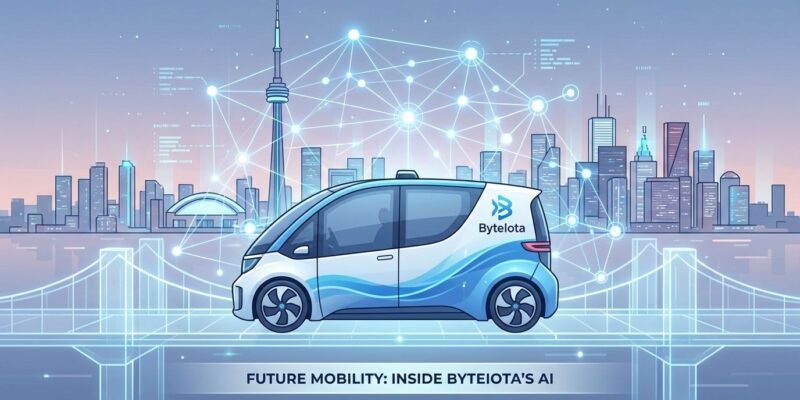
Waabi, the Toronto-based autonomous driving AI company, secured $1 billion in combined funding—$750 million in a Series C led by Khosla Ventures and G2 Venture Partners, plus $250 million in milestone-based investment from Uber. The partnership will deploy at least 25,000 Waabi-powered robotaxis on Uber’s platform, announced January 28, 2026.
The irony is hard to miss. Urtasun led Uber’s Advanced Technologies Group, focused on self-driving vehicles, from 2017 to 2020. She left to found Waabi in 2021, raising $83.5 million in seed funding—one of the largest Canadian seed rounds ever. Now Uber is betting hundreds of millions on her company as their exclusive robotaxi provider, picking Waabi over Waymo, the current leader with 2,500 vehicles.
Physical AI Strikes Back
The timing couldn’t be more pointed. Just three days before Waabi’s announcement, NVIDIA and OpenAI’s $100 billion deal collapsed, and Microsoft lost $357 billion in market cap as Wall Street questioned AI spending without clear returns. Software AI is facing its “prove monetization” reckoning.
Physical AI, meanwhile, is raising record funding. Waabi’s $1 billion validates what Uber CEO Dara Khosrowshahi calls a “$1 trillion market opportunity”—autonomous vehicles that move people, not just generate text. This is AI with edge computing requirements, real-time decision-making, and tangible real-world impact.
At CES 2026, “Physical AI” dominated conversations. NVIDIA carved out three categories: agentic AI (knowledge robots), generalist robots (including humanoids), and transportation (autonomous vehicles). Companies like BMW deployed Figure humanoid robots on assembly lines, and UBTECH began mass-producing Walker S2 humanoids targeting 10,000 units annually by 2027.
Waabi positions itself at the center of this shift. Their “Physical AI Revolution” framing might sound like marketing spin, but the deployment numbers tell a different story.
25,000 vs 3,500: Audacious Scale
Waabi’s target of 25,000 robotaxis is seven times larger than Waymo’s 2026 fleet goal of 3,500 vehicles. For context, Waymo operates about 2,500 autonomous vehicles today, completing 450,000 rides per week across Phoenix, Los Angeles, Austin, and Atlanta. They’re expanding to five new cities in 2026 and targeting one million rides per week by year’s end.
Waabi, by contrast, has zero commercial robotaxis deployed. They’re starting from scratch, with Urtasun promising deployment “super fast. Much faster than anybody can think.”
The audacity lies in Waabi’s AI-first approach. Instead of logging billions of real-world miles like Waymo, Waabi built “Waabi World,” a proprietary simulator using generative AI for virtual testing. Their Waabi Driver uses a single end-to-end AI model for perception, navigation, and action—contrasting with Waymo’s multiple specialized models and hand-coded rules.
Vinod Khosla, whose firm led Waabi’s Series C, framed it as capital efficiency: “What predecessors in the autonomous vehicle industry achieved with thousands of engineers and billions of dollars, Waabi can do for a fraction.”
That’s the bet. Simulation over real-world miles. Generative AI over rule-based systems. A smaller, faster team over Waymo’s decade of operations.
But 25,000 robotaxis is still just a target. The deployment timeline is “over time”—vague at best. Uber’s $250 million investment is milestone-based, meaning Waabi needs to hit benchmarks to unlock the capital. And just one day before Waabi’s announcement, Waymo hit a child at a school drop-off, prompting dual federal probes. The safety bar for autonomous vehicles remains high.
Why Waabi Over Waymo?
Uber’s exclusive partnership with Waabi is a strategic tell. After selling its own autonomous vehicle division to Aurora in 2020 and pivoting to a platform play, Uber has partnered with multiple AV companies—Wayve, Nuro, Lucid—but none exclusively.
Why Waabi? Three likely reasons:
Urtasun’s connection. Uber knows her work intimately. She led their autonomous research for three years. That insider knowledge cuts both ways—she understands Uber’s platform needs, and Uber trusts her technical judgment.
Capital efficiency. Waabi raised $1 billion total to date. Waymo has burned through tens of billions of Alphabet’s capital. If Waabi can deliver comparable technology for a fraction of the cost, Uber gets better economics.
Exclusivity. Waymo serves its own customers, not just Uber. Waabi’s exclusive partnership aligns incentives—they succeed only if Uber succeeds.
The risk, of course, is that Waabi has no commercial deployments yet. Uber is betting on potential over proven scale. If Waabi’s simulation-first approach works, Uber wins big. If not, they’ve locked themselves out of Waymo, the industry leader.
Toronto vs Silicon Valley
Waabi’s $1 billion raise is the largest Canadian tech fundraise in history, surpassing Cohere’s $683 million Series D in 2024. Toronto’s AI ecosystem now boasts 273 firms with $5.41 billion in total funding, ranking 22nd globally for startup ecosystems.
Urtasun co-founded the Vector Institute and holds a professorship at the University of Toronto, maintaining dual roles as academic and entrepreneur. Her success validates Toronto as a legitimate AI hub, not just a Silicon Valley satellite.
The investor list reflects global confidence: Khosla Ventures (US), G2 Venture Partners (US), NVIDIA’s NVentures (US), Volvo (Sweden), Porsche (Germany), BlackRock (US), and an Abu Dhabi Investment Authority subsidiary. Canadian AI talent is competing—and winning—on the global stage.
What’s Next
Waabi’s deployment timeline remains opaque. “Super fast” is not a roadmap. Milestone-based funding from Uber means progress determines capital availability. The 25,000 robotaxi target is ambitious, but “over time” could mean 2027, 2030, or beyond.
The broader trend is clear: Physical AI is rising while software AI faces ROI scrutiny. Autonomous vehicles, humanoid robots, and edge computing represent AI’s next phase—systems that perceive, reason, and act in three-dimensional space.
Urtasun’s journey from Uber employee to competitor to exclusive partner encapsulates this shift. She left Uber when they couldn’t execute on autonomous vehicles. She built Waabi with a radically different approach. Now Uber is betting their autonomous future on her vision.
If Waabi delivers, it validates simulation-first AI, capital-efficient development, and Toronto’s place in the global AI race. If not, it becomes another cautionary tale in the autonomous vehicle graveyard alongside Cruise’s $10 billion failure.
The $1 trillion market is real. The question is whether Waabi’s $1 billion bet can capture it.