 By
By On Wednesday, January 29, engineers at Anthropic and OpenAI revealed they no longer write code manually. Boris Cherny, Head of Claude Code at Anthropic, disclosed he shipped 49 pull requests in two days—all 100% AI-generated. “I don’t even make [code],” he stated. Roon, an OpenAI researcher, echoed: “I don’t write code anymore.” This isn’t a future vision or pilot program. It’s the current operational reality at the companies building the world’s most advanced AI.
Anthropic reports 70-90% of its entire codebase is AI-generated, with Claude Code itself being 90% self-written. The contrast with the rest of the industry is stark: Microsoft and Salesforce hover around 30%, and most enterprises sit at 20-40%. Anthropic CEO Dario Amodei predicts the industry is just 6-12 months from this becoming universal. For 28 million developers worldwide, this is career-defining information.
The Numbers: AI Companies at 70-100%, Everyone Else at 20-40%
The gap is massive. Individual engineers at Anthropic and OpenAI operate at 100% AI-generated code—zero manual coding. Cherny shipped 22 PRs one day and 27 the next, each entirely written by Claude. Company-wide, Anthropic sits at 70-90%, according to an official spokesperson. Claude Code has written 90% of its own codebase, creating a recursive loop where AI improves AI.
Compare this to the broader market: GitHub Copilot has 15 million users and 90% adoption among Fortune 100 companies, but its average acceptance rate is just 30%. Microsoft and Salesforce report roughly 30% AI-generated code. Most enterprises land in the 20-40% range. The question: Is this a lag that will close in months, or is there something unique about AI companies building AI with AI?
Anthropic’s Cowork product, a file management agent for non-coders, was built in roughly 1.5 weeks “almost entirely with Code,” per Amodei. That’s not assistance—that’s full automation at production scale.
The Timeline: Six Months or Six Years?
Dario Amodei made a bold prediction at the World Economic Forum in January 2026: “I think we might be 6 to 12 months away from when the model is doing most, maybe all of what SWEs [software engineers] do end-to-end.” This comes from the CEO of a company already operating at 70-90% AI-generated code, so it’s not speculation—it’s extrapolation from current reality.
But Amodei himself hedged: “It’s easy to see how this could take a few years,” citing constraints like chip manufacturing capacity and model training time. The gap between AI companies (70-100%) and everyone else (20-40%) suggests caution. Either enterprises will close this gap rapidly, or what works exceptionally well for Anthropic and OpenAI—AI companies using AI to build AI—won’t generalize to banks, healthcare systems, or embedded software.
The timeline matters. If Amodei is right, every software engineering role fundamentally changes within a year. If not, developers have more time to adapt. The data doesn’t yet tell us which scenario is correct.
The Reality Check: Trust at 29% and Falling
Here’s the uncomfortable truth: Only 29% of developers trust the accuracy of AI-generated code, down from 40% in prior years. Yet adoption is high. Engineers are shipping code they don’t fully trust.
A recent Anthropic study found developers using AI tools score 17% lower on comprehension tests compared to those coding manually. That’s skill degradation in real time. Meanwhile, a METR study of experienced developers in mature codebases found AI tools made them 19% slower, not faster. The productivity narrative isn’t as clean as vendors claim.
Code quality metrics add to the concern: 4x increase in code cloning, less refactoring, more short-lived code. The patterns suggest declining maintainability. What happens in five years when entire codebases are 100% AI-generated and no one on the team deeply understands the implementation?
The job market is already responding. Entry-level coding positions declined 13% according to a Stanford study. U.S. software developer job listings fell 70% from Q1 2023 to Q1 2025. The junior-to-senior career path—historically built on years of writing code—may be breaking.
What This Means for Developers
Anthropic has made a decisive shift: the company now prioritizes generalists over specialists. Traditional deep coding skills matter less when AI handles implementation. The company looks for engineers with strong architectural thinking, product sense, and high-level reasoning rather than mastery of specific frameworks.
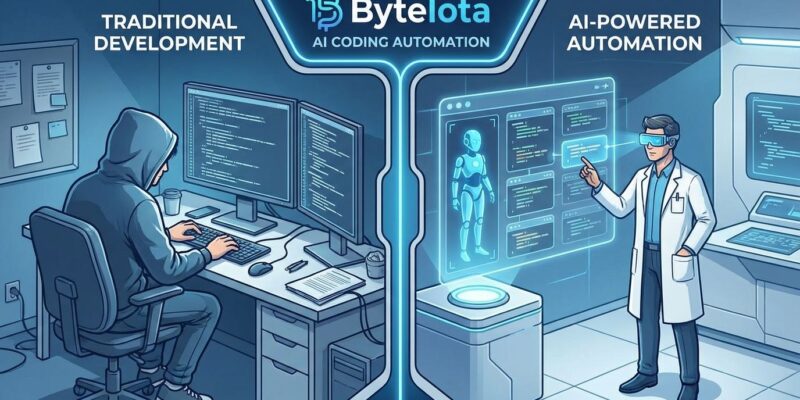
The engineer’s role has transformed from “writer” to “director.” You specify what to build, review AI output, make architectural decisions. Cherny said engineers feel “unshackled” from tedious work. The output numbers support this: 22-27 PRs per day versus the typical 1-5 when coding manually.
But this creates tension. If juniors never write code, how do they develop the deep understanding needed to become senior engineers? If specialists matter less, what happens to the expertise built over decades? If implementation skills atrophy, can engineers still effectively review AI-generated code?
The answers aren’t clear. What’s clear is that Anthropic—a company at the AI frontier—has made its bet on generalists and directors over implementers.
Key Takeaways
Five things developers need to know:
- The gap is real: AI companies operate at 70-100% AI-generated code while most enterprises sit at 20-40%. Whether that gap closes or persists will define the next year.
- Trust is low despite high usage: Only 29% trust AI code accuracy, yet engineers at Anthropic and OpenAI operate at 100%. This tension can’t persist indefinitely.
- Skills are degrading: 17% lower comprehension scores for AI-reliant developers. If you stop writing code, can you still deeply understand it?
- The junior path is breaking: Entry-level jobs down 13%, listings down 70%. The traditional progression from junior to senior may not survive this transition.
- Role transformation is happening now: Anthropic prioritizes generalists over specialists. The value is shifting from implementation to architecture and direction.
This isn’t a story about the future—it’s a story about what’s already happening at the companies defining AI’s direction. Whether it spreads industry-wide in 6-12 months or takes years, developers need to understand what changed on January 29, 2026: Engineers at the frontier stopped writing code.