 By ByteBot
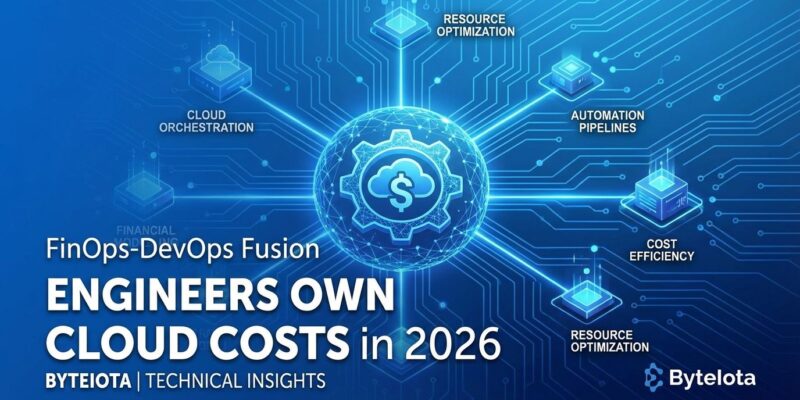
Engineers are now blocking pull requests based on cloud costs, not just code quality. Flexera’s acquisition of ProsperOps and Chaos Genius on January 6, 2026 signals a fundamental shift: FinOps is merging with DevOps, transforming cost from a finance afterthought into an engineering KPI tracked alongside latency and uptime. Cost metrics now pulse through CI/CD pipelines, alerting teams to overruns before they hit production.
This isn’t aspirational—75% of enterprises are projected to adopt FinOps automation by year’s end. The message is clear: if you’re building cloud infrastructure, you own the bill.
The $1 Trillion Problem Finance Teams Can’t Solve
Cloud spending crossed $1 trillion in 2026, and enterprises are bleeding 30-35% of it on idle resources and overprovisioned infrastructure. That’s hundreds of billions wasted globally. The FinOps market ballooned from $14.88 billion in 2025 to a projected $26.91 billion by 2030, yet traditional finance-led cost management can’t keep up.
The reason is structural: finance teams review costs quarterly, but engineers make architectural decisions that lock in 80% of costs daily. By the time finance spots the problem, it’s baked into production. Meanwhile, FinOps adoption grew 46% in 2025, and 70% of large enterprises now staff dedicated cloud economics teams—yet waste persists.
However, the solution isn’t more finance oversight. Instead, it’s shifting accountability to the people who actually control the spend: developers.
Cost Gates in CI/CD: FinOps DevOps Fusion in Action
Tools like Infracost and CloudZero embed cost estimates directly into pull requests, transforming cost from reactive cleanup to proactive design constraint. Here’s how it works:
When you push Terraform changes, Infracost parses your infrastructure-as-code and displays projected spend: “$427/month → $1,203/month (+$776/month).” The cost diff appears in your PR alongside code review comments. If you’re about to triple your bill by switching to memory-optimized instances, your team sees it before merge approval—not when finance sends the monthly bill.
CloudZero takes this further by mapping every dollar to real-world constructs: cost per customer, cost per API call, cost per feature. Teams track unit economics the same way they track latency. When costs spike, anomaly detection alerts fire before overruns hit production, not after.
The cultural shift is profound. As one industry analysis puts it: “FinOps meeting DevOps means cost stops being something reviewed after deployment.” Engineers now debate whether a $800/month increase is justified for a performance gain, the same way they’d debate adding a new dependency.
Autonomous AI Agents: From Recommendations to Actions
Flexera’s dual acquisition brings agentic AI that doesn’t just suggest optimizations—it implements them without human intervention. ProsperOps autonomously manages $6 billion in annual cloud usage across AWS, GCP, and Azure, generating $3 billion in lifetime savings while growing 90% year-over-year. Chaos Genius delivered up to 30% cost reductions for Fortune 500 companies by autonomously optimizing Snowflake and Databricks workloads.
This represents the controversial leap: multi-agent systems now handle forecasting, anomaly detection, and remediation autonomously. Forecasting agents predict future spend from historical patterns. Anomaly-detection agents identify cost spikes before they hit bills. Furthermore, remediation agents clean up wasteful resources without approval queues.
Nevertheless, the trust question looms large. Can AI be trusted to make financial decisions autonomously? What happens when automated optimization cuts resources that affect performance? Who’s accountable when autonomous agents get it wrong? These aren’t theoretical concerns—they’re guardrail decisions organizations face now.
30% Reductions Are Now Table Stakes
The business case for FinOps automation is settled. Case studies show a consistent pattern: a retail company cut 30% through right-sizing and automation. A global financial services firm reduced costs 30% over one year despite increased consumption. A fintech startup slashed CI/CD costs 30% by optimizing Docker caching and moving non-critical jobs to preemptible VMs.
That 30% figure isn’t cherry-picked—it appears across industries, workloads, and implementation approaches. Organizations implementing structured FinOps programs report 10-20x ROI, slashing waste from the 28-35% baseline down to single digits. Deloitte estimates mature adopters saved $21 billion in 2025, with potential cuts reaching 40%.
Notably, 81% of teams with engineering-led cost ownership report costs “about where they should be,” compared to significantly lower satisfaction from finance-led approaches. The data suggests engineers make better cost decisions when given visibility and accountability.
The Scope Creep Debate Nobody’s Winning
Here’s the uncomfortable truth: 81% of developers already suffer from burnout. Adding financial accountability to existing workloads isn’t empowerment if it’s just offloading finance team responsibilities without additional resources or adjusted expectations.
Proponents argue engineers are best positioned to optimize—they make the architectural decisions that drive costs, and real-time visibility enables better trade-offs. In contrast, critics counter that scope creep hits junior developers hardest, piling on yet another metric to stress about alongside velocity, quality, and uptime.
Accordingly, the Hacker News community remains divided. One January 2025 thread debated who should be accountable when costs spike: engineers who write code, platform teams who manage infrastructure, or product managers who set priorities. The emerging consensus: “Each application team should view total service costs and be held accountable,” but without resolving the resource and burnout questions.
Organizations adopting FinOps-DevOps fusion need to answer: Are we giving engineers the tools and authority to optimize, or are we just adding to their plate?
What This Means for Engineering Teams
Cost is now a feature requirement, not a finance metric. Consequently, platform teams build cost observability into developer workflows, surfacing spend where engineers work rather than requiring separate dashboards. This creates demand for new skills: cloud economics, unit economics, Kubernetes cost attribution, and increasingly, setting guardrails for autonomous AI optimization.
Moreover, the FinOps engineer role is exploding—job postings grew 75% annually since 2020, and salaries jumped 15-20% in two years. But the bigger shift is that all platform engineers now need FinOps fluency. Understanding how architectural decisions translate to monthly spend isn’t optional expertise anymore; it’s core to the job.
Ultimately, FinOps is dissolving as a separate discipline, becoming embedded in DevOps the same way security shifted left in the 2010s. Whether that’s empowerment or scope creep depends on how organizations handle the transition—and whether they adjust resources and expectations accordingly.