 By ByteBot
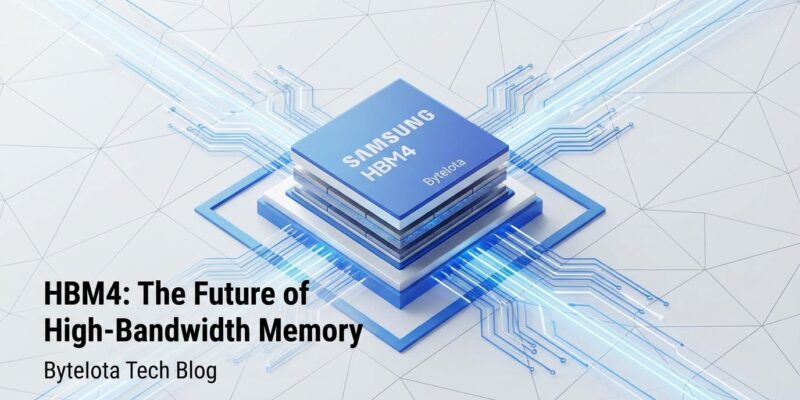
Samsung Electronics begins mass production of HBM4 memory chips this February at its Pyeongtaek campus, securing certification from Nvidia for its Rubin GPU platform launching later this year. This marks Samsung’s return to AI memory leadership after two years trailing SK Hynix, with 90% logic chip yields and plans to scale production 50% by year-end. For developers planning AI infrastructure, the timeline matters: Rubin availability starts Q3-Q4 2026, but HBM capacity is already sold out through 2026.
From Zero to Production in 12 Months
The breakthrough required overcoming brutal yield challenges. Samsung’s 1c DRAM process—the sixth generation of its 10nm-class technology—went from near 0% yield just 12 months ago to 50% under cold testing and 60-70% under hot testing today. The logic chip yield hit 90%, exceeding internal targets. This isn’t vaporware or a press release promise. Samsung’s 1c process delivers a 40% energy efficiency improvement over competing 1b-based modules, and the company is betting its AI memory future on it.
The rapid improvement from nothing to production-ready in a single year shows what’s possible when hardware vendors face existential competitive pressure. SK Hynix dominated HBM3 supply for Nvidia’s H100 and H200 platforms. Samsung couldn’t afford another generation on the sidelines.
HBM4 Powers Nvidia’s Most Complex Platform
This production capacity powers Nvidia’s Rubin architecture, the company’s most ambitious AI platform to date. HBM4 doubles the interface width to 2048 bits, delivering up to 2.56 TB/s bandwidth per memory device. Each Rubin GPU packs 288 GB of HBM4 across eight 12-layer stacks, providing roughly 13 TB/s of aggregate memory bandwidth per accelerator.
But Nvidia isn’t settling for JEDEC’s standard 6.4-9.6 Gbps speeds. The company reportedly demands speeds exceeding 11 Gbps, with some configurations targeting 13 Gbps. This pushed Samsung and SK Hynix to redesign HBM4 implementations mid-development, one reason why mass production slipped to early 2026 instead of late 2025.
Memory bandwidth determines everything in AI inference workloads. The time to load model weights from memory dominates actual computation time. Rubin’s 13 TB/s per GPU matters more than the FLOPS number in the marketing deck.
Samsung Challenges SK Hynix Dominance
Samsung’s timing puts it head-to-head with SK Hynix for Nvidia’s Rubin orders. Both companies target February 2026 mass production. SK Hynix currently holds 70% projected market share for HBM4 in Rubin platforms, with Samsung targeting 30%+. The total HBM market reaches an estimated $54.6 billion in 2026, up 58% year-over-year.
Samsung plans aggressive capacity expansion: from 170,000 wafers per month today to 250,000 by year-end 2026. That’s a 50% increase in a single year. SK Hynix starts at 10,000 wafers monthly at its new M15X fab and scales from there. Both vendors report HBM capacity sold out through 2026. All three major suppliers—Samsung, SK Hynix, and Micron—have pre-sold their production.
More suppliers competing at production scale theoretically improves availability. But “sold out through 2026” means spot procurement remains severely constrained. The supply dynamics haven’t fundamentally changed, just shifted forward one hardware generation.
What This Means for Developer Planning
For development teams, these dynamics translate to infrastructure planning on an 18-24 month timeline. Rubin GPUs launch in Q3-Q4 2026. Cloud providers get first access—AWS, Google Cloud, Azure, and Oracle will light up Rubin instances before bare metal availability opens up. Expect limited bare metal supply through 2027.
Cloud pricing for current-gen GPUs: H100 runs $2.74-$3.50 per hour after a 64-75% price drop from peak levels. B200 pricing sits around $5.87 per hour. Rubin pricing remains TBD, but expect a premium tier at launch. Teams planning Q4 2026 or Q1 2027 infrastructure should explore reserved instances now, not when public availability arrives.
The bigger point: memory efficiency matters more than GPU count in 2026. Software optimization—quantization, KV cache management, runtime batching—determines how much throughput you extract from constrained hardware. The era of abundant compute waiting for software development has inverted. Now software optimization races to make efficient use of scarce hardware.
Memory bandwidth is the binding constraint, not GPU compute. Teams that optimize for memory win. Teams that assume they can just rent more GPUs later will hit availability walls.
Plan Infrastructure Today, Not When You Need It
Samsung’s HBM4 production ramp matters because it determines when Rubin becomes accessible. February 2026 mass production means engineering samples to partners in Q2, volume ramp in Q3, and meaningful cloud availability in Q4. If your team plans AI infrastructure for late 2026 or early 2027, start procurement discussions now. The supply chain operates on quarters, not weeks.
The HBM memory market just shifted from a monopoly risk to a duopoly. That’s progress. But developers should plan assuming constraints persist through 2027, because all available evidence says they will.