 By
By What Happened
Anthropic, OpenAI, Microsoft, and Google just did something unusual in tech: they stopped competing long enough to collaborate. On December 9, 2025, the Linux Foundation announced the formation of the Agentic AI Foundation (AAIF), anchored by Anthropic’s donation of the Model Context Protocol (MCP). Eight Platinum members joined—AWS, Anthropic, Block, Bloomberg, Cloudflare, Google, Microsoft, and OpenAI—along with dozens of Gold and Silver members.
The foundation launches with three founding projects: MCP from Anthropic, AGENTS.md from OpenAI, and goose from Block. This isn’t just another industry consortium. Competitors aligned on open standards instead of building walled gardens, and that signals something shifted.
What Is MCP?
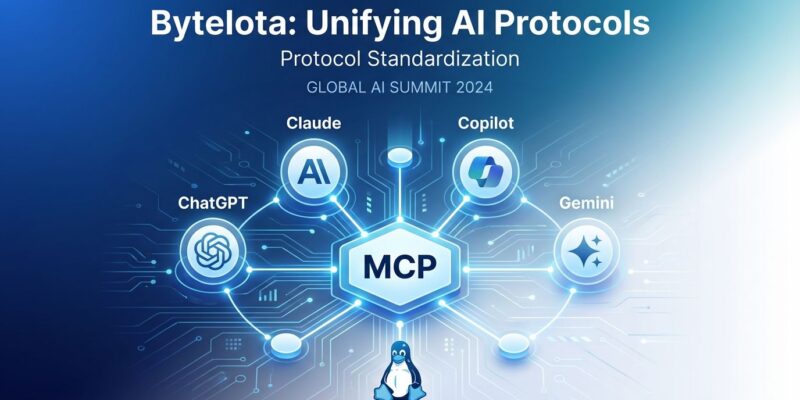
The Model Context Protocol standardizes how AI agents connect to tools and data sources. Think of it as USB-C for AI—a universal connector replacing dozens of proprietary cables. Before MCP, developers built custom integrations for every AI platform multiplied by every tool combination. With MCP, you build one server and it works across Claude, ChatGPT, Microsoft Copilot, and Gemini.
Anthropic introduced MCP in November 2024 as an open-source protocol with client-server architecture. It’s not an agent framework—it’s the integration layer that lets agents access tools without custom plumbing for each platform. The protocol defines three core primitives: tools, resources, and prompts.
Adoption happened fast. Before the Linux Foundation announcement, developers had published over 10,000 MCP servers covering GitHub and Slack integrations, Postgres databases, browser automation, and more. The SDK sees 97 million downloads monthly. Major platforms adopted quickly: OpenAI integrated MCP into ChatGPT in March 2025, Google added support to Gemini, and Microsoft’s Copilot followed. Cursor, VS Code, Replit, and Zed joined in.
Why Competitors Are Collaborating
Microsoft’s Den Delimarsky said “it just clicked,” and within weeks contributors from Anthropic, Microsoft, GitHub, OpenAI, and independent developers started expanding the protocol. That speed signals something important: fragmentation would hurt everyone more than vendor lock-in would help competitive positioning.
The AI agent market is large enough that interoperability creates more value than walled gardens capture. When OpenAI donated AGENTS.md—a standard for giving AI coding agents project-specific guidance—it had already been adopted by over 60,000 open source projects including Cursor, Devin, GitHub Copilot, and Jules.
Simon Willison, co-creator of Django, had called for a community-managed specification for OpenAI’s Chat Completions API, noting “dozens of slightly incompatible implementations” scattered across the ecosystem. The Linux Foundation provides that: a vendor-neutral home where no single company dominates.
What Developers Gain
Protocol standardization changes workflows. Instead of maintaining separate integrations for each AI platform, developers write one MCP server and deploy it everywhere. Popular use cases already work: GitHub integration, database access, browser automation with Playwright and Puppeteer, file system access, and enterprise tools like Slack and Google Drive.
Enterprise adoption is real. In a typical 10,000-person organization, about 15% of employees are running MCP servers—an average of two per user, totaling over 3,000 deployments per company. Local deployments dominate at 86%, while remote MCP servers have grown nearly 4x since May 2025.
Developer experience improved quickly. Desktop extensions now enable single-click installation instead of manual JSON configuration and dependency management. SDKs are available in Python, TypeScript, Kotlin, and Java. Early feedback calls it “a good developer experience for a first release,” though debugging challenges remain.
The Linux Foundation Signal
Moving to the Linux Foundation signals maturity and long-term commitment. The foundation manages Kubernetes, Node.js, and other critical infrastructure, bringing vendor-neutral governance, community-driven development, and funding for research.
Not everyone’s convinced the timing is right. Some Hacker News developers noted that Kubernetes was “relatively proven technology at Google” before CNCF formation, while MCP launched only 13 months before donation. Questions about revenue models persist—CNCF generates income from events and certifications, but it’s unclear how that works for a protocol this young.
The counterpoint: 10,000+ servers and major platform adoption before the announcement show organic traction. AI moves faster than infrastructure, and fast-moving markets need faster standardization cycles. The adoption curve suggests production readiness even if foundation timing feels early.
What’s Next
The MCP Dev Summit North America takes place April 2-3, 2026 in New York City, with keynotes from Anthropic, OpenAI, and Microsoft. Three tracks will cover roadmap, security, orchestration, and observability.
Watch for competing or complementary standards like A2A (Agent-to-Agent protocol) from Google, which handles agent-to-agent communication while MCP handles agent-to-tool connections. Most enterprise systems will likely need both—MCP for vertical integration with tools and data, A2A for horizontal coordination between agents.
Market analysts project the MCP ecosystem at $4.5 billion in 2025, with some estimating 90% organizational adoption by year-end. Whether those numbers hold depends on how well vendor-neutral governance actually works. The collaboration is real. Now we see if it lasts.