 By ByteBot
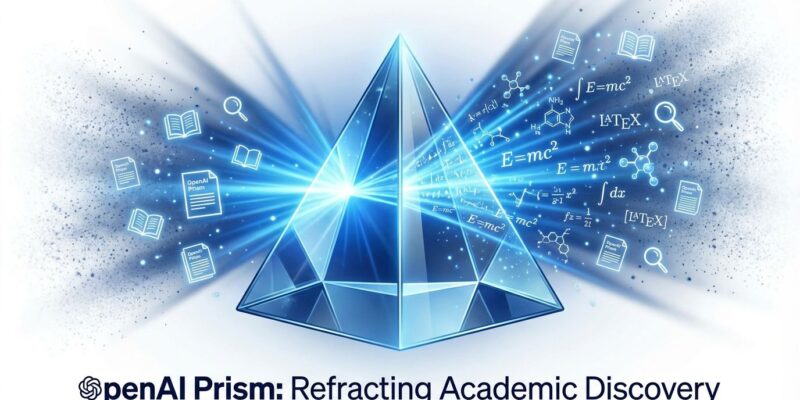
OpenAI launched Prism on January 27, 2026—a free AI workspace for scientists powered by GPT-5.2. Built on Crixet, a LaTeX platform OpenAI acquired the same day, Prism replaces fragmented research workflows with a single AI-native tool. It’s OpenAI’s second vertical push after healthcare, validating the profession-specific workspace trend that Claude Code pioneered for developers.
This matters beyond academia. For developers who write papers, Prism changes your workflow. For everyone else, it signals that AI companies are now competing on vertical tools, not just general models. The question isn’t whether this is happening—it’s which profession gets the next AI workspace.
A Single Workspace for Scientific Research
Prism consolidates what used to require 10+ tools: text editor, reference manager, PDF reader, and ChatGPT in separate windows. The platform offers LaTeX editing with GPT-5.2 fully aware of your research project context. Unlike generic chatbots that treat every query in isolation, Prism’s AI knows your entire paper—drafts, notes, citations—making suggestions actually relevant.
Key features hit the friction points researchers know too well. GPT-5.2 drafts and revises text, reasons through mathematical derivations, and searches arXiv for related papers. The handwritten formula conversion is particularly clever: snap a photo of your whiteboard, get LaTeX code back. For anyone who’s spent hours manually translating diagrams to TikZ, that’s a legitimate time-saver.
Access is free for anyone with a ChatGPT account, including unlimited projects and collaborators. Enterprise and Education versions are coming later. The Crixet acquisition announcement alongside the launch makes OpenAI’s strategy clear: acquire an established platform, integrate GPT-5.2, target enterprise. They did this with Torch Health for healthcare; now they’re doing it for science.
OpenAI’s Vertical Playbook: Healthcare, Science, What’s Next?
January 2026 has been busy for OpenAI’s vertical strategy. Earlier this month, they launched OpenAI for Healthcare—HIPAA-compliant tools targeting hospitals and health systems. Three weeks later, Prism arrives for scientists. The pattern is unmistakable: OpenAI is moving from general-purpose AI to profession-specific workspaces.
This mirrors what Anthropic did with Claude Code, which validated that developers want AI-native environments, not just better autocomplete. Prism tests whether scientists feel the same way. If successful, expect more verticals: legal research, financial analysis, design workflows. AI companies are now competing on how well they understand specific professions, not just model benchmarks.
The acquisition strategy matters too. OpenAI spent $100 million on Torch Health, amount undisclosed for Crixet. Buying platforms with existing users beats building from scratch. Crixet brings LaTeX infrastructure and user workflows; OpenAI brings GPT-5.2 and enterprise distribution. It’s a pragmatic approach to vertical expansion that sidesteps the cold-start problem.
Can Prism Beat Overleaf’s 20 Million Users?
Here’s the uncomfortable reality: Overleaf has 20 million users and 400,000 daily actives. They’re the market leader with deep institutional support—universities buy site licenses, research teams standardize on it, collaboration workflows are entrenched. Prism enters as a newcomer with AI advantages but significant adoption barriers.
Researchers are notoriously conservative about tools. Overleaf launched AI features in June 2025, responding to the competitive threat. They’re not standing still. Yes, one analysis claimed “OpenAI has outshined Overleaf overnight,” but adoption doesn’t work that way. Free plus better AI doesn’t automatically overcome institutional lock-in and switching costs.
This is the classic innovator’s dilemma. Prism is objectively better on paper—context-aware AI, modern infrastructure, superior mathematical reasoning. However, “better” doesn’t always win. Ask anyone who watched Slack compete with Microsoft Teams in enterprise markets. The question isn’t whether Prism is superior; it’s whether OpenAI can overcome academic inertia and institutional contracts.
GPT-5.2’s Mathematical Muscle (and the Privacy Trade-off)
GPT-5.2 brings credible mathematical reasoning to the table. Benchmarks show 100% on AIME 2025 competition mathematics, 40.3% on FrontierMath expert-level problems, and 92.4% on GPQA Diamond graduate-level science questions. More impressively, GPT-5.2 Pro contributed to a statistical learning theory result that human researchers actually verified and extended. That’s beyond formatting—it’s genuine research assistance.
Nevertheless, Prism is cloud-only with no offline option. Your research IP lives on OpenAI’s servers. For academics working on pre-publication discoveries or proprietary research, this creates a trust problem. OpenAI learned this lesson in healthcare, adding HIPAA compliance and data residency options. They’ll likely need similar privacy guarantees for academic research, especially in sensitive fields like defense, pharmaceuticals, or competitive patent research.
The trade-off is real: convenience and AI assistance versus control over intellectual property. Claude Code runs locally by default, prioritizing privacy. Prism prioritizes integration and collaboration, accepting cloud dependency. Neither approach is wrong—they serve different risk tolerances.
Key Takeaways
- Prism validates the vertical AI workspace trend that Claude Code started. OpenAI’s move from healthcare to science in three weeks signals aggressive vertical expansion. The pattern is clear: profession-specific tools are the next battleground.
- Free and better AI don’t guarantee adoption when competing with 20 million entrenched users. Overleaf has institutional lock-in, site licenses, and established workflows. Prism’s success depends on overcoming academic conservatism, not just technical superiority.
- OpenAI’s acquisition strategy (Crixet for science, Torch Health for healthcare) trades capital for speed. Buying platforms with existing users and infrastructure beats building from scratch. Expect more vertical M&A.
- GPT-5.2’s mathematical reasoning is credible (100% AIME, 40.3% FrontierMath), but the cloud-only model creates privacy concerns for sensitive research. Privacy guarantees will determine enterprise adoption.
- The industry question isn’t whether vertical AI workspaces work—Claude Code proved that. The question is which profession gets the next one: legal, finance, design, or something else entirely.
Prism isn’t just another AI tool launch. It’s evidence that AI companies are pivoting from “build the best general model” to “own the workflow for specific professions.” That shift matters more than any single feature.