 By
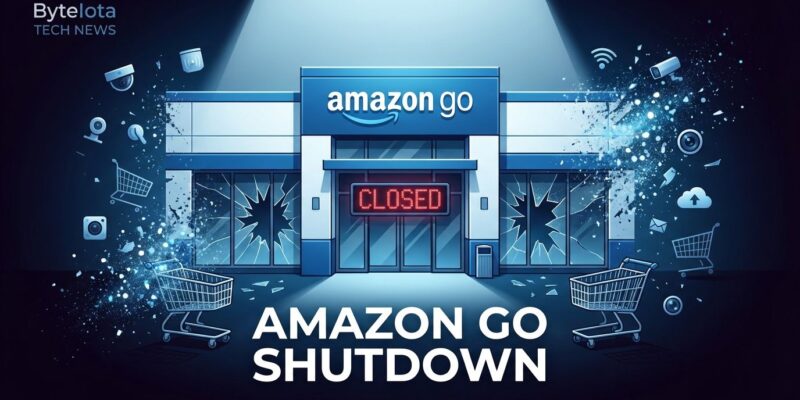
By Amazon announced today, January 27, 2026, that it’s closing ALL 72 Amazon Go and Amazon Fresh physical stores by February 1—just five days away. The shutdowns mark a complete retreat from physical retail innovation, abandoning its pioneering “Just Walk Out” cashierless technology. All 57 Fresh grocery stores and 15 remaining Go convenience stores will close, with California locations getting a 45-day extension due to state labor laws.
This isn’t a technology failure. The computer vision and AI worked perfectly. It’s an economic failure: Even Amazon’s best engineers and unlimited funding couldn’t overcome poor unit economics. Meanwhile, their same-day grocery delivery service grew 30x in 2025. Customers wanted convenience, not novelty.
Great Tech, Terrible Economics
Amazon’s official statement admits they “haven’t yet created a truly distinctive customer experience with the right economic model needed for large-scale expansion.” Translation: The tech worked brilliantly, but it was too expensive to scale.
Infrastructure costs were “vast”—sensors alone cost $350 each against a $100 target. Multiply that 3.5x overrun by thousands of sensors per store, then add high-resolution cameras, edge compute devices, and ongoing DevOps. Industry analysts called Amazon Go “an expensive 7-Eleven with a P&L that will probably never be positive.” The store trajectory tells the story: Peaked at 30 locations in 2023, down to 15 by 2024, now zero in 2026.
The lesson for developers: Even Amazon—with genius engineers, unlimited budget, and cutting-edge AI—couldn’t overcome bad unit economics. Technology quality is necessary but not sufficient. If you’re building impressive tech without a profitable business model, you’re building a demo, not a company.
Delivery Crushed Innovation: 30x Growth While Stores Failed
While Amazon Go and Fresh stores were failing, Amazon’s same-day grocery delivery exploded: 30x growth in 2025, expanding to 2,300+ US cities in just four months. Perishable sales grew so fast that nine of the top 10 bestselling items are now perishables. Customers who add perishables to Same-Day orders shop twice as often as those who don’t.
The strategic pivot is clear: Delivery beats in-store innovation every time. Amazon’s 2026 plans include 100+ new Whole Foods stores and continued delivery expansion. Meanwhile, Go and Fresh? Shuttered.
Customers wanted convenience—getting groceries delivered to their door—not novelty. Cashierless stores solved a problem that didn’t really exist. Checkout lines weren’t the pain point; time and effort were. Delivery solves that. Cashierless stores don’t.
The Engineering Team Got Laid Off Months Ago
The writing was on the wall: Amazon laid off most of the “Just Walk Out” engineering team back in April 2024, leaving only a “skeleton crew” to maintain third-party licensing. At least 15 engineers posted “open to work” on LinkedIn. One employee claimed “half of our Just Walk Out team was laid off.”
By the time stores closed in January 2026, the team building the technology was already gone. Amazon disputed the “skeleton crew” label but didn’t clarify exact numbers. The technology continues as an AWS product that third parties can license, but Amazon’s own investment is over.
For developers working on retail AI: The market signal is clear. Pivot to delivery and logistics optimization, where the growth actually is. In-store computer vision jobs aren’t coming back.
The Technology That Worked Too Well
“Just Walk Out” technology used computer vision with high-resolution RGB cameras, weight sensors on every shelf, and deep learning models trained on millions of synthetic images. You’d tap your card, grab items, and leave—the system tracked everything in real-time and charged you automatically. The technology was genuinely impressive: High accuracy across millions of transactions, no biometric tracking required, and real-time updates to your virtual cart.
The problem? Go stores were limited to about 1,000 SKUs because items needed distinct appearances for computer vision to work reliably. Regular grocery stores carry 80,000+ SKUs. The tech worked perfectly at small scale but couldn’t scale to full grocery without prohibitive costs. Solving a hard technical problem doesn’t mean solving a valuable business problem.
Whole Foods Wins, Innovation Loses
Amazon is consolidating entirely under the Whole Foods brand: 100+ new stores planned, select Go and Fresh locations converting to Whole Foods, and Dash Carts (scan-as-you-shop, NOT cashierless) expanding to 25+ Whole Foods stores by end of 2026. The pivot is from “impressive innovation” to “proven business model.”
Dash Carts let customers scan items themselves as they shop—customers prefer the control over full automation. Amazon tried this at Fresh stores in 2024 and customers liked it better than “Just Walk Out.” Sometimes tech should assist, not replace.
Amazon tried to reinvent retail with tech and failed. Now they’re retreating to traditional grocery (Whole Foods) with optional tech enhancements. Less ambitious, less innovative—but profitable. Your coolest idea isn’t always your best business.
Key Takeaways
- Economics beat technology: Amazon’s engineers built production-quality AI that worked flawlessly. But sensor costs at 3.5x target, limited SKUs, and lack of customer preference killed scale.
- Customers wanted delivery, not checkout magic: Same-day delivery grew 30x while stores closed. Solve actual pain (time/effort), not perceived pain (checkout lines).
- Retail AI jobs shifting to logistics: In-store computer vision teams got laid off. Growth is in delivery optimization, not store automation.
- Even Amazon can fail: Genius engineers + unlimited budget + cutting-edge tech ≠ guaranteed success. Unit economics always win.
- Innovation sometimes loses to boring: Whole Foods (traditional grocery) is expanding while Go and Fresh (innovation) shut down. Profitable beats impressive.