 By ByteBot
A year after Asahi Linux founder Hector Martin quit in frustration over endless demands for M3 support, the community delivered anyway. Fedora Asahi Remix now boots on Apple’s M3 chips, thanks to new contributors stepping up after the leadership crisis. However, before you wipe your M3 MacBook: no GPU acceleration, no WiFi, no webcam. It’s a symbolic victory proving open-source persistence can outlast burnout and Apple’s walled garden—but not a daily driver yet.
What Actually Works (And What Doesn’t)
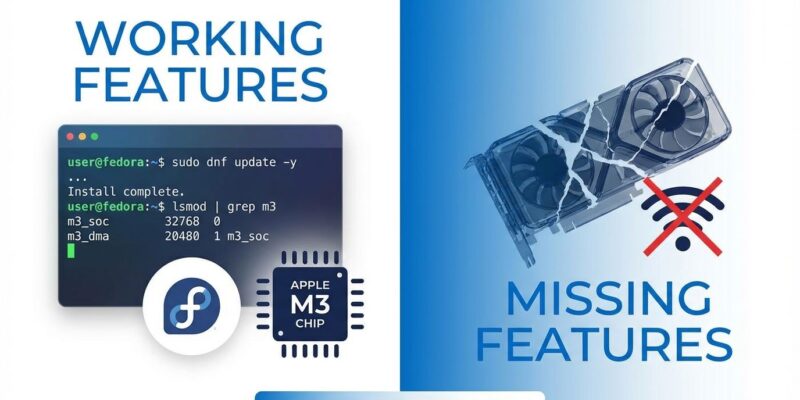
Fedora Asahi Remix 42 Beta supports M3, M3 Pro, and M3 Max chips with basic functionality. You get CPU frequency scaling, NVMe storage, USB ports, keyboard, touchpad, battery monitoring, and the headphone jack. That’s enough for terminal-based development—text editors, compilers, Docker containers—but not much else.
The missing pieces tell the real story. GPU acceleration doesn’t work, forcing software rendering through llvmpipe. Moreover, WiFi and Bluetooth remain broken because reverse-engineering the BCM4388 chip is incomplete. No webcam, no brightness control, no installer support. One Hacker News commenter nailed it: “Without GPU support, Linux on M3 just sucks despite powerful hardware.”
The Hacker News thread hit 437 points in hours. Reactions split between celebrating the achievement and questioning its usefulness. Meanwhile, M1 and M2 Asahi users report “unbelievably fast” development workstations. M3? Early adopter territory. If you need Linux on M3 today, virtual machines through UTM or VMWare Fusion are more practical.
Why the Delay Was Intentional
M3 support took this long because Asahi’s remaining team made a deliberate choice after Martin’s departure. They decided to upstream drivers for M1 and M2 into the mainline Linux kernel before tackling new hardware. As the team explained, “M3 wasn’t too difficult, but before taking on additional tech debt, we focused on getting all our changes upstreamed.”
That patience paid off. Linux kernel 6.17 improvements laid the infrastructure M3 needed. Furthermore, the m1n1 bootloader evolved to Rust. BCM4388 WiFi chip support progressed (though incomplete). Instead of fragile, out-of-tree drivers that would break with every kernel update, M3 boots on a foundation that won’t collapse when M4 and M5 arrive.
The tradeoff: frustrated users waiting for M3 support while the team cleaned up M1/M2 code. Some of that frustration landed on Hector Martin.
The Leadership Crisis That Almost Killed M3 Support
In February 2025, Martin resigned from Asahi Linux, citing developer burnout and user complaints about missing M3/M4 support. He’d also clashed with Linus Torvalds over Rust integration in the Linux kernel, compounding the pressure. Consequently, the project’s founder, the reverse-engineering genius who made Apple Silicon Linux possible, walked away.
The team responded by deprioritizing new hardware entirely. M3 and M4 Macs weren’t urgent—stability and upstreaming were. That’s when new contributors like “IntegralPilot” stepped in, tackling M3 bring-up while the core team focused on infrastructure. High school security researcher Michael Reeves announced the breakthrough on Bluesky, and Hacker News exploded.
It’s a case study in open-source resilience. Volunteer-driven projects can survive leadership crises if the community is committed. But it also raises questions: how many more times can Asahi rebuild when key developers burn out?
The M3 GPU Problem Isn’t Going Away
The M3 GPU differs drastically from M1 and M2 architectures. Apple changed co-processor communication, moved the power delivery controller to SPMI, and introduced a new “chicken bit” initialization sequence. Reverse-engineering that takes months, maybe years. Alyssa Rosenzweig’s M1/M2 GPU driver work serves as a foundation, but M3 requires starting over in key areas.
M4 adds another layer of complexity: “Secure Page Table Monitor” protections that require emulation. Additionally, IntegralPilot got DOOM running on M3 as a proof of concept, but production-ready GPU drivers are nowhere close. Asahi promised DisplayPort Alt Mode support in early 2026, but GPU acceleration has no timeline.
This is the core tension: Apple iterates faster than volunteers can reverse-engineer. M5 will launch before M3 GPU support stabilizes.
Walled Garden Meets Its Match (For Now)
Apple provides zero technical documentation for running Linux on Apple Silicon. They haven’t actively blocked it either—unlike iOS jailbreaking, Linux on Mac seems to fly under Apple’s radar. That indifference creates space for projects like Asahi, but it also guarantees a perpetual game of catch-up.
Over 40% of developers use Macs, but many prefer Linux workflows. Therefore, Asahi represents a refusal to let vendors dictate OS choice. You bought the hardware; you should run whatever OS you want. However, virtual machines exist, offering stable Linux with full hardware access. Is native dual-boot worth the pain?
The real achievement isn’t M3 booting—it’s the community outlasting Martin’s burnout and delivering anyway. Nevertheless, sustainability matters. M4 and M5 support will take years at this pace. Reverse-engineering Apple’s closed hardware works until it doesn’t, and the volunteer well runs dry eventually.
What’s Next for Fedora Asahi M3
DisplayPort Alt Mode arrives in early 2026, assuming the team hits their target. GPU acceleration remains undefined—it could be months or years. M4 and M5 aren’t prioritized yet, so M3 users willing to tolerate software rendering and missing WiFi are the only audience today.
M3 support exists, but it’s a flag planted more than a usable OS. The open-source community proved it can survive leadership crises and keep pace with Apple—barely. Whether that’s sustainable is the real question no one’s answering yet.
For detailed M3 feature compatibility, check Asahi’s M3 feature support documentation. More technical background on the reverse-engineering challenges is available at WebProNews.