 By ByteBot
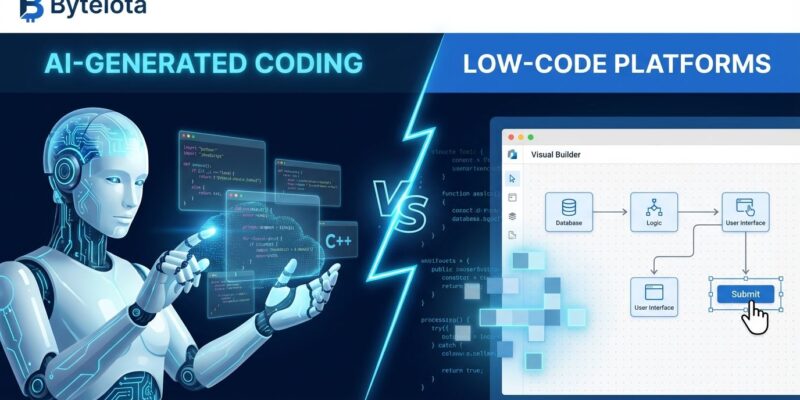
Replit CEO Amjad Masad made headlines in January 2026 with a provocative declaration: “We don’t care about professional coders anymore.” His company is betting that AI will render both low-code platforms and traditional coding obsolete, replaced by “vibe coding“—describing apps in plain English and letting AI generate everything. The narrative has taken hold. “No Code is Dead,” declared The New Stack. Developers are panicking, asking not “will I be replaced?” but “which developers will survive?”
It’s a compelling story. It’s also wrong.
AI and Low-Code Aren’t Competing—They’re Merging
The “AI vs. low-code” framing misses the real story: these tools are converging, not competing. Major platforms aren’t dying—they’re integrating AI at breakneck speed. Microsoft Power Platform added Copilot for natural language app creation. OutSystems launched AI Mentor to identify code issues before deployment. Mendix embedded agentic AI features into its workflows.
These aren’t defensive moves. They’re the future of low-code. Microsoft reports 40-50% reductions in development cycles with AI-augmented Power Platform. Meanwhile, Gartner predicts 75% of new applications will use low-code by 2026, driving the market to $44.5B. The platforms aren’t shrinking—they’re evolving from visual development tools into AI orchestration layers.
Developers framing this as “AI replacing low-code” will miss the shift. The winners aren’t choosing sides; they’re using hybrid models where AI handles boilerplate, low-code provides governance, and custom code solves complex problems. All three, working together.
Vendor Lock-In, Not AI, Threatens Low-Code
Low-code platforms aren’t struggling because AI is better. They’re struggling because vendors exploit customers. OutSystems tripled its prices in the last year. Once you’re locked into proprietary platforms, you either pay up or tear down your infrastructure and start over. That’s not a technology problem—it’s an economic trap.
The numbers tell the story. Research shows 47% of organizations worry about poor scalability and 37% fear vendor lock-in. Meanwhile, AI coding assistants like GitHub Copilot, Cursor, and Claude generate standard languages—Python, JavaScript, TypeScript—with zero vendor control. The code is yours. Fully portable.
This is the real argument developers are making. Not “AI is better than low-code,” but “why pay platform fees AND accept lock-in when AI generates standard code?” Complexity creep makes it worse: low-code becomes “low-code with code on top and all around it,” eroding the simplicity promise. Vendors who don’t address this will bleed customers to AI-assisted custom development.
AI Delivers 20-30%, Not the 10x Miracle
AI coding assistants aren’t the 10x productivity revolution promised in 2023. Real-world data shows 20-30% gains, concentrated in specific workflows. That’s significant—but it’s not magic. The Pragmatic Engineer survey found 85% of developers use at least one AI tool, and 82% use AI for writing code. Yet productivity improvements remain modest and uneven.
The benefits vary dramatically by experience level. Junior developers see massive gains as AI handles boilerplate they’d otherwise Google. Senior developers see marginal improvements because they already know the patterns. Mid-market teams (10-100 developers) capture the most value, balancing skill diversity with adoption agility.
Tool selection matters more than raw capability. GitHub Copilot speeds daily coding. Cursor manages large projects with superior context awareness. Claude excels at understanding complex problems. The real skill in 2026 isn’t using AI religiously—it’s knowing when to trust it, when to question it, and when to ignore it completely. Developers must still catch the mistakes AI inevitably makes.
Related: Vibe Coding Hits 92% Adoption—But 45% Code Fails Security
The Future Is Hybrid: 60% Low-Code, 40% Custom
The future isn’t pure low-code OR pure AI coding. It’s hybrid models combining both strategically. High-performing enterprises use low-code for standard operations—the stable skeleton—and AI-assisted custom code for complex logic—the muscle. This isn’t low-code dying. It’s low-code evolving from visual development to AI orchestration.
AI agents are being embedded directly into low-code platforms. Microsoft’s Plan Designer uses a team of agents to build enterprise solutions spanning apps, workflows, and analytics. OutSystems’ Agent Workbench lets developers orchestrate AI agents for multi-step tasks. These platforms are shifting from “speed tools” to strategic capabilities running mission-critical systems.
However, governance can’t be ignored. Gartner warns that 40% of agentic AI projects will be cancelled by end of 2027 due to cost overruns, unclear value, or inadequate risk controls. Organizations enabling citizen developers without governance are building toward a 2027-2028 technical debt reckoning. The hybrid model works only with proper oversight.
Related: Tech Debt Blocks 56% of Firms From AI Investment: KPMG 2026
What Developers Should Actually Do
Don’t abandon your workflow—augment it. The question isn’t “low-code or AI coding?”—it’s “which tool for which situation?” Learn AI prompt engineering to describe requirements precisely. Study system architecture to make decisions AI can’t. Focus on debugging and code review, not writing boilerplate from scratch.
Watch for AI-integrated low-code platforms. They’re not niche experiments; they’re where the market is heading. Microsoft, OutSystems, and Mendix are betting billions on this convergence. Developers who treat this as either/or will struggle. Those who see complementary tools will thrive.
The career advice for 2026 is clear: adapt to hybrid workflows. Use Copilot for daily speed. Use Cursor for large projects. Use Claude for complex problem-solving. Use low-code for governed enterprise deployment. The developers surviving aren’t those clinging to pure code OR pure platforms—they’re the ones mastering the hybrid model.
Key Takeaways
- AI and low-code are merging, not competing—major platforms are integrating AI capabilities, creating hybrid development models that combine the best of both approaches
- Vendor lock-in is the real threat to low-code platforms—not AI superiority but economic exploitation, with some platforms tripling prices while customers are trapped
- AI coding assistants deliver 20-30% productivity gains, not the overhyped 10x revolution—benefits vary by experience level and require code literacy to review AI mistakes
- The future is 60% low-code for standard operations, 40% AI-assisted custom code for complexity—enterprises using hybrid models outperform those picking sides
- Developers should augment their workflows, not abandon them—learn prompt engineering, system architecture, and strategic tool selection for specific contexts