 By ByteBot
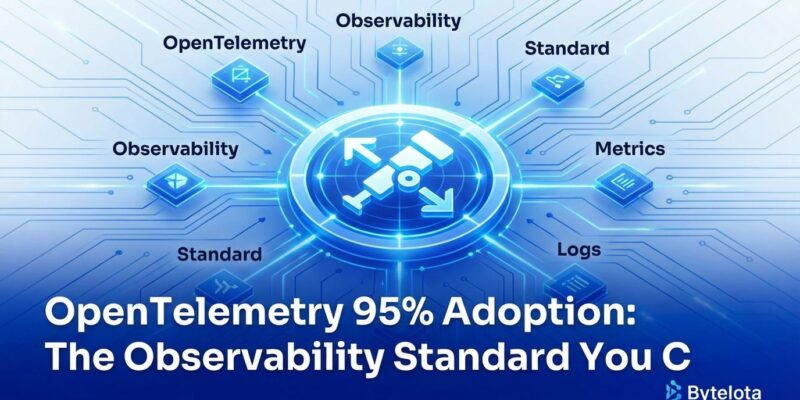
OpenTelemetry crossed 95% adoption for new cloud-native instrumentation in 2026. The debate over whether to adopt it is over. But hitting critical mass doesn’t mean hitting stability—and the gap between adoption intent and production reality is wider than the numbers suggest.
The Tipping Point Nobody Saw Coming
When 48.5% of organizations already use a technology and another 25% are planning implementation, that’s not emerging adoption—that’s standardization. Production adoption jumped from 6% in 2025 to 11% in 2026, while 81% of users now believe OpenTelemetry is production-ready. The industry has aligned around a single instrumentation standard, and the question shifted from “should we use OTel?” to “why haven’t we yet?”
This isn’t gradual adoption. When 90% of greenfield projects default to OpenTelemetry, when job postings require OTel experience, when universities add it to DevOps curricula—that’s an inflection point. Not using it has become the decision that requires justification.
Why Every Vendor Surrendered
Datadog, New Relic, Splunk, AWS, Azure, GCP—every major vendor now supports OpenTelemetry natively. The proprietary instrumentation battle is over. Vendors aligned around OTel because it removes duplicate agents, vendor-specific SDKs, and migration barriers. One instrumentation approach works across all backends, all clouds, all monitoring tools.
But vendor convergence isn’t altruism. It’s acknowledgment that the lock-in game is lost. Competition shifted to what happens after data collection: Collector-based optimization, sampling strategies, cost control. Vendors now compete on “Data Optimization as a Service”—advanced filtering, enrichment, and routing before telemetry hits expensive backends. The new vendor wars happen at the Collector layer.
The Complexity Tax Nobody Mentions
Here’s the part the adoption numbers don’t tell you: complexity and lack of stability create real impediments to production deployments. Configuration breaks between minor versions. Performance regressions appear at scale. Coordinating rollouts across hundreds of services becomes a nightmare. The tracing component is mature, but metrics and logging are still evolving.
Organizations treating OpenTelemetry as “just another library” hit walls. The Collector becomes a single choke point as traffic grows—CPU, memory, and queue depth all scaling together. Configuration management requires dedicated expertise. Troubleshooting paralysis sets in as deployments expand.
This isn’t FUD. It’s the reality of adopting a rapidly evolving standard. 95% adoption doesn’t mean 95% success rate. But these are growing pains, not fatal flaws. The project is addressing stability. Expertise is building. Platform teams dedicated to observability are forming. The standard is maturing faster than alternatives ever did.
Cost Control Is the Killer App
The ROI case for OpenTelemetry isn’t just vendor portability—it’s active cost reduction. The Collector is where you decide what data is expensive enough to keep versus cheap enough to sample. Filter unnecessary attributes, sample routine traffic, retain errors and high-latency paths. Route full-fidelity data to internal backends, send samples to paid SaaS.
A gaming company cut observability costs 50% using tail sampling—keeping only failed requests and critical traces while sampling routine traffic. Engineers retained the insights they needed while storage and vendor bills dropped dramatically. SAP operates one of the world’s largest OpenSearch deployments with 11,000+ Kubernetes instances, achieving zero-downtime migration and unified multi-cloud observability through OpenTelemetry.
Vendors know this, which is why they’re pivoting to Collector optimization services. The money isn’t in proprietary instrumentation anymore—it’s in helping you not pay for telemetry you don’t need.
Why AI Observability Makes 2026 Different
OpenTelemetry isn’t just standardizing traditional observability. GenAI semantic conventions are being finalized in 2026, establishing standard telemetry for AI agent systems. The draft covers tasks, actions, agents, teams, artifacts, and memory—everything needed to debug reasoning chains, track token costs, optimize performance, and meet compliance requirements.
As AI agents move from demos to production, observability becomes critical. Frameworks like CrewAI, AutoGen, LangGraph, and IBM Bee Stack are converging on OTel semantic conventions. The same vendor-neutral approach that won for traditional systems is positioning to win for AI systems too.
Adopt, But With Eyes Open
You will adopt OpenTelemetry. The 95% adoption rate makes that inevitable. The question is when and how—whether you invest in Collector expertise and platform teams now, or struggle with “science project” implementations that break at scale later.
The standard is here. The hard work is just beginning. But between vendor lock-in escape, cost optimization through sampling, and emerging AI observability standards, the case for OpenTelemetry is stronger than ever. Just don’t mistake critical mass for operational maturity. The expertise gap is real, and closing it is what separates successful OTel deployments from failed ones.