 By ByteBot
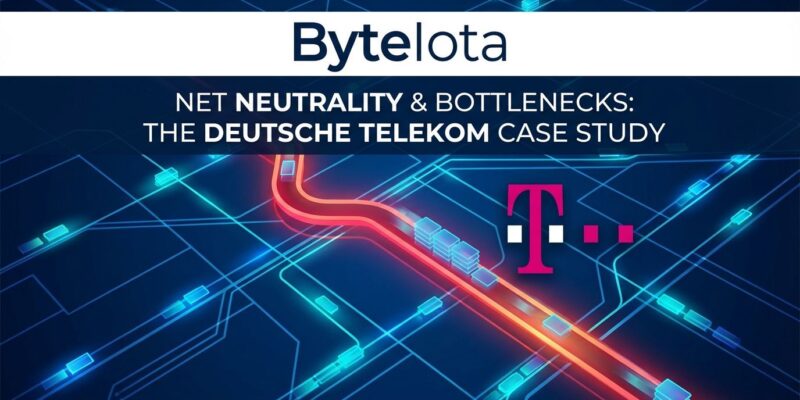
Deutsche Telekom, controlling 40% of Germany’s ISP market, stands accused of deliberately creating artificial bottlenecks at network peering points and demanding payment from online services for “unrestricted access”—practices banned under EU net neutrality law. A coalition led by Stanford Law Professor Barbara van Schewick filed a formal complaint with Germany’s telecom regulator in April 2025, presenting evidence that Telekom under-provisions peering capacity to force services like Netflix, YouTube, and GitHub into paid agreements at rates “several times higher than market price.” The timing couldn’t be worse: on January 21, 2026, the EU Commission published its Digital Networks Act (DNA) proposal, which critics warn would legalize such practices across all of Europe.
This isn’t just European telecom politics—it’s a threat to how the internet works. If Telekom succeeds, startups will face gatekeeping fees just to reach users, while big tech gets faster access because they can afford to pay. The open internet that let GitHub, Stripe, and Vercel compete with IBM is at risk of becoming a two-tier system where your network speed depends on your Series A funding.
The Artificial Bottleneck: How Telekom’s Network Brake Works
Telekom deliberately under-provisions peering capacity at interconnection points—allocating 10Gbps when 50Gbps is needed—creating artificial congestion that forces content providers to pay for “direct peering” to bypass the bottleneck. The evidence is damning: users report speeds of 650 KB/s without a VPN but normal speeds with a VPN, proving the issue is routing-based throttling, not genuine capacity limits.
The degradation targets peak hours (18:00-24:00 CET) and specific services. GitHub loads at dial-up speeds. YouTube buffers endlessly. Cloudflare-hosted sites crawl. German university networks become nearly inaccessible. Meanwhile, Telekom’s own services work flawlessly. A $5/month VPN instantly fixes everything—because VPN routing bypasses Telekom’s deliberately congested peering points.
# Test without VPN (Telekom throttling)
$ curl -w "Speed: %{speed_download} bytes/sec\n" -o /dev/null -s https://github.com
Speed: 650000 bytes/sec  # ~650 KB/s (dial-up speeds)

# Test with VPN (bypasses Telekom routing)
$ curl -w "Speed: %{speed_download} bytes/sec\n" -o /dev/null -s https://github.com
Speed: 15000000 bytes/sec  # ~15 MB/s (normal fiber speeds)
VPN circumvention proves this is intentional traffic discrimination. If capacity was genuinely limited, VPN wouldn’t help—it doesn’t add bandwidth. It just changes the routing path, exposing the artificial constraint.
The Startup Death Tax: Who Can Afford Telekom’s Toll?
Normal settlement-free peering costs $0 between peers of equal size. That’s how the internet has worked since the 1990s—networks exchange traffic because both sides benefit. Legitimate paid peering runs about $5-11 per Mbps per month when traffic is genuinely asymmetric. Telekom demands “several times higher than market price” according to the complaint—potentially $5,000-10,000/month for a small SaaS streaming 100Mbps constantly.
Meta, Google, and Netflix can afford this as a cost of doing business. Startups, indie developers, and non-profits cannot. This creates a two-tier internet where deep-pocketed services flow smoothly while bootstrapped competitors face degraded access to 40% of the German market. If you’re Cloudflare paying billions for CDN infrastructure, your sites still get throttled unless you separately pay Telekom. If you’re an indie SaaS founder, your product appears broken to German users, and you can’t afford the toll to fix it.
This creates a permanent competitive moat for incumbents. Big tech can pay; startups get throttled. It’s rent-seeking that punishes innovation and rewards market power.
EU’s Digital Networks Act: Legalizing Paid Fast Lanes?
On January 21, 2026, the EU Commission published its Digital Networks Act (DNA) proposal, merging four existing laws including the Open Internet Regulation that currently bans paid fast lanes. Critics from epicenter.works and digital rights groups warn the DNA replaces net neutrality protections with vague “traffic management” language that would legalize what Telekom is doing. If DNA passes, Telekom’s business model could become the EU-wide standard.
The EU Commission frames this as “infrastructure funding,” but the technical reality is different. Telekom built its network knowing the internet was neutral. ISPs artificially congest networks they control, then charge services to bypass their own bottlenecks. It’s creating artificial scarcity where none should exist.
The timing of Telekom’s case and DNA’s publication—four days apart—isn’t coincidental. Telekom is testing the limits while EU policy shifts toward allowing it. If DNA passes, this isn’t just a German problem. It’s every EU startup facing gatekeeping fees across 27 member states.
What Developers Can Do: Detecting and Documenting Throttling
If you’re experiencing unexplained latency or throttling for German users on Telekom (40% market share), here’s how to confirm peering issues. First, test with and without VPN—if VPN fixes it, it’s routing-based throttling. Second, check peak hours (18:00-24:00 CET)—if degradation concentrates there, it’s intentional. Third, monitor specific services—if GitHub loads slowly but Telekom services work fine, it’s traffic discrimination.
Telekom customers should file complaints with Bundesnetzagentur, Germany’s telecom regulator. Document evidence with speed tests from netzbremse.de, the campaign site collecting user reports. The investigation is ongoing, but regulatory complaints need evidence. If your service is being throttled, document the pattern: speeds without VPN, speeds with VPN, time of day, affected routes.
This is Rent-Seeking, Not Infrastructure Funding
Telcos claim they need revenue to fund network upgrades, but this argument falls apart under scrutiny. Telekom’s customers already pay €40-60/month for internet access. Content providers already pay for their own connections and CDN infrastructure. Settlement-free peering has worked for decades because both sides benefit—users get content, content reaches users.
Other German ISPs (1&1, Vodafone, O2) don’t engage in this practice according to the complaint. They provision peering adequately and exchange traffic settlement-free as the internet has always worked. Telekom is an outlier exploiting its 40% market share to extract tolls. The VPN circumvention evidence proves capacity exists. Telekom is artificially constraining it, then charging to bypass their own artificial constraint.
Call it what it is: gatekeeping. Telekom isn’t “funding infrastructure”—they’re toll-booth operators on roads customers already paid to build. If this model spreads, every ISP becomes a gatekeeper, and the open internet that enabled the last 30 years of innovation dies. Startups need to understand this threat isn’t theoretical; it’s here, now, with EU policy moving to legalize it.
Key Takeaways
- Telekom’s artificial bottlenecks are proven by VPN circumvention—if capacity was the issue, VPN wouldn’t fix it. Peak-hour targeting (18:00-24:00) and service-specific throttling expose intentional traffic discrimination.
- Startups can’t afford $5,000-10,000/month peering tolls that Meta and Google pay as routine costs. This creates a two-tier internet where technical merit matters less than Series A funding.
- The EU Digital Networks Act (published January 21, 2026) threatens to legalize paid fast lanes across all 27 member states, replacing net neutrality with “traffic management” provisions that favor deep-pocketed incumbents.
- Developers: Test with VPN, monitor peak hours, document throttling patterns. If German users report slowness but VPN fixes it, you’re facing ISP discrimination—not a code problem. File complaints with Bundesnetzagentur and netzbremse.de.
- Stanford Law Professor Barbara van Schewick’s coalition filed a 100+ page complaint in April 2025. The investigation is ongoing, but DNA’s passage could render it moot by legalizing the practice outright.
The open internet succeeded because anyone with good code could compete. Paid fast lanes kill that model. If Telekom’s approach becomes the European standard, the startup disadvantage becomes structural and permanent—not something better engineering can overcome.