 By ByteBot
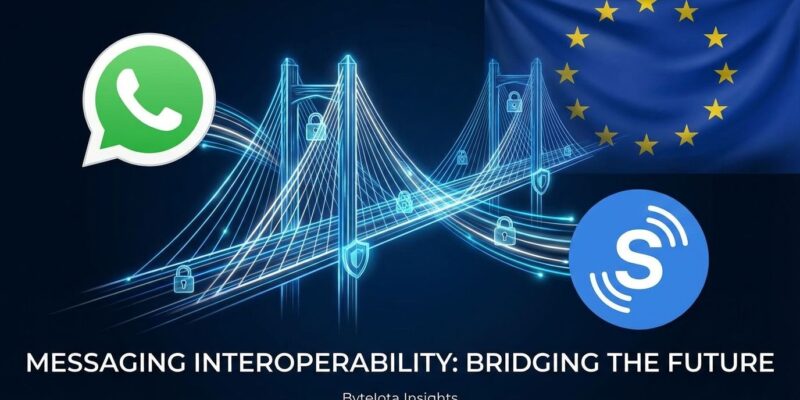
WhatsApp enabled third-party messaging interoperability in the EU last November, with BirdyChat and Haiket as the first compatible messengers. This marks the first real-world implementation of the EU Digital Markets Act’s interoperability requirements, allowing WhatsApp’s 2 billion users to optionally chat with users on competing platforms via Signal Protocol encryption. The feature is trending on Hacker News today with 660 points and 404 comments—the developer community is divided on whether this breaks Meta’s monopoly or just creates new security risks.
The EU forced Meta’s hand here, and the implications go far beyond two obscure messenger apps.
Signal Protocol Becomes the Interoperability Standard
The EU Digital Markets Act mandates Signal Protocol as the required encryption standard for all third-party messengers integrating with WhatsApp. Consequently, this turns Signal Protocol—already used by WhatsApp, Facebook Messenger, and Google Messages—into the de facto industry standard for end-to-end encrypted interoperability. For developers, this means one thing: if you want to build a messenger that talks to WhatsApp’s 2 billion users, you’re implementing Signal Protocol correctly or you’re not playing at all.
The rollout is phased over three years. However, Year 1 (2025-2026) covers 1:1 messaging with images, voice messages, videos, and files. By March 6, 2026—just two months away—group chats become mandatory. Moreover, voice and video calls follow by March 6, 2028. Third-party apps must pass Meta’s security audit process and maintain “the same level of end-to-end encryption as WhatsApp,” according to Meta’s engineering team.
This creates a genuine market entry opportunity for the first time ever. Building an interoperable messenger no longer requires overcoming network effects—the DMA creates a legal right to access WhatsApp’s user base from day one. Therefore, the challenge shifts from user acquisition to passing Meta’s security audit and implementing Signal Protocol without bugs that break E2EE. That’s a technical hurdle, not a monopolistic moat.
BirdyChat and Haiket Are Tiny—This Is Compliance Theater
Let’s be clear about what just happened. Furthermore, the first two “compatible” messengers are essentially unknown apps with almost zero users. BirdyChat has fewer than 500 Android downloads and a single iOS review. Haiket isn’t even live in app stores yet—just a waitlist for a “voice-first communications app” that may or may not ship. Meta chose the smallest possible partners to meet the DMA deadline without facing real competition.
This is minimum viable compliance, not a competitive threat. The Hacker News thread erupted with skepticism: “This is compliance theater, not real competition” and “Wait until Telegram or Signal joins, then it gets interesting.” They’re right. Real competition arrives when Telegram (900 million users) or Signal itself decides to federate with WhatsApp. Until then, this is Meta demonstrating technical capability while avoiding the strategic risk of letting an actual competitor access their user graph.
Developers should watch for major players joining. When Telegram, Signal, or enterprise platforms like Slack apply for interoperability, Meta’s network effects advantage starts eroding. That’s the inflection point, not November’s launch with two apps nobody uses.
The Privacy Versus Competition Debate Is Split
The developer community is genuinely divided on whether forced interoperability helps or hurts users. Privacy advocates worry about trusting third-party apps with E2EE implementation. In contrast, competition advocates celebrate breaking Meta’s walled garden. Both sides have valid points, and the tension isn’t resolved.
The privacy concern is straightforward: Signal Protocol is solid, but implementation bugs can catastrophically break encryption. WhatsApp users who opt into third-party chats now depend on BirdyChat’s (or eventually Telegram’s) security practices, not just Meta’s. As TechPolicy.Press notes, “interoperability between E2EE messaging applications introduces severe security and architectural complexity” because these systems were never designed to federate. Additionally, metadata leakage across platform boundaries remains a risk—phone numbers, online status, typing indicators, read receipts all cross the trust boundary.
The competition argument counters that walled gardens are anti-competitive by design. The Electronic Frontier Foundation frames it bluntly: “When all data, social relations and ties are trapped inside a company’s silo, the garden walls become prison walls.” Users can’t switch messengers without abandoning their entire contact network. The DMA breaks that lock-in, making it theoretically possible to choose a privacy-focused alternative without losing access to WhatsApp contacts.
The EU’s solution is opt-in interoperability with a separate inbox option. Users control whether to enable third-party chats and can keep them isolated if desired. It’s a middle ground that neither side loves but both can tolerate. The real test comes when adoption data arrives—if most users never enable the feature, Meta wins without the EU being able to claim non-compliance.
iMessage Escaped, But Reappraisal Looms in May 2026
Apple’s iMessage successfully avoided DMA regulation in February 2024—the EU ruled it’s not dominant enough in Europe. However, the DMA requires a reappraisal by May 3, 2026. That’s just over three months away. If iMessage gets designated a gatekeeper, Apple faces the same interoperability requirements as WhatsApp.
What would that mean? Cross-platform messaging between iPhone and Android without SMS fallback. The end of the “green bubble” stigma. 1.2 billion iMessage users suddenly accessible to third-party apps via Signal Protocol or RCS. Apple’s ultimate walled garden cracks open, and the entire mobile messaging landscape shifts.
Apple is resisting aggressively—appealing broader DMA interoperability requirements and citing privacy concerns. Critics call it an anti-competitive excuse wrapped in security theater. The May reappraisal will determine whether EU regulators buy it. Watch that date closely.
What’s Next: Build Interoperable Messengers or Wait for Telegram
For developers, the opportunity is clear but underexploited. The DMA creates legal access to WhatsApp’s 2 billion users—something that was impossible before November 2025. Niche-focused apps (privacy-first, business messaging, regional compliance) can now compete without needing network effects. The technical path is straightforward: implement Signal Protocol, pass Meta’s security audit, submit an interoperability request, and launch. First movers get market advantage before saturation.
Nevertheless, the challenges are real. Meta controls the security audit gatekeeping, and rigor levels are unknown. UX fragmentation is inevitable—WhatsApp features won’t map perfectly to your app’s capabilities. Spam and abuse prevention across platform boundaries remains unsolved. Metadata handling (phone numbers, status indicators, read receipts) crosses trust boundaries in ways users may not understand.
Alternatively, wait for Telegram or Signal to join and watch what happens. When 900 million Telegram users gain opt-in access to WhatsApp contacts, that’s the real competitive shift. The current implementation with BirdyChat and Haiket is proof of concept, not market disruption. The disruption comes later, assuming Meta doesn’t find creative ways to dark-pattern users away from enabling third-party chats.
The EU forced Meta to open the door. Whether anyone walks through it depends on developers building compelling alternatives and users choosing to trust them. November 2025 was the technical milestone. The market test is just beginning.