 By ByteBot
On January 19, 2026, Matthew Forsyth, Google’s Director of Product Management for Play, publicly confirmed what Android developers feared: a high-friction sideloading process rolling out September 2026. Starting then, all Android apps—even those installed outside the Play Store—must come from Google-verified developers. Apps from unverified sources will trigger multiple warning screens, intentional delays, and require users to dig through settings for a buried “install without verifying” option. The initial rollout targets Brazil, Indonesia, Singapore, and Thailand in September 2026, expanding globally throughout 2027.
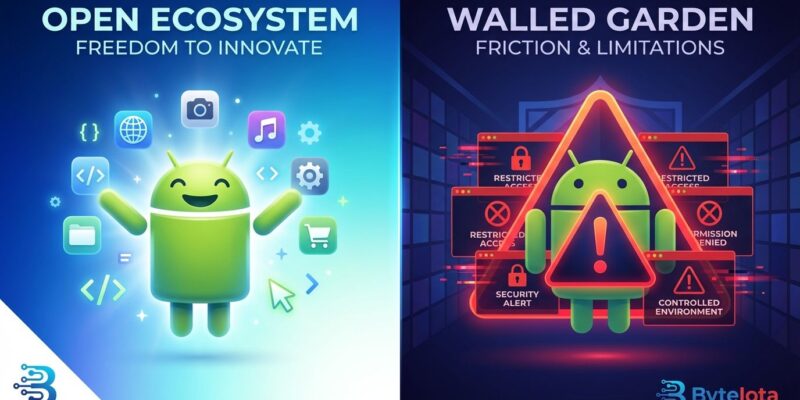
This isn’t just a security update. It’s a fundamental shift in Android’s identity—from open platform to controlled ecosystem—coming months after Google lost the Epic Games antitrust case that ruled the company maintains an illegal app store monopoly.
What’s Changing: The “Accountability Layer”
Google calls it an “Accountability Layer,” not a restriction. But the implementation tells a different story. When users attempt to install sideloaded apps starting September 2026, they’ll face a gauntlet designed to discourage installation:
- Developer verification check requiring internet connectivity
- Multiple warning screens about malware, data theft, and financial fraud
- Intentional confirmation delays
- “Install without verifying” option available but hidden in advanced settings
- High friction maintained even with the bypass—warnings and extra steps persist
The phased rollout begins in four countries chosen for their high sideloading-related malware rates. Google blocked 900,000 high-risk installations in Singapore alone, making it a logical test market. By 2027, all 3+ billion Android users worldwide will encounter this system.
Forsyth emphasized that “advanced users will still be able to choose ‘Install without verifying,'” but didn’t explain how users would discover this option or navigate the friction-laden process. Code strings in Google Play Store version 49.7.20-29 confirm the implementation is already underway.
F-Droid Faces Existential Threat
The real casualties are open-source app repositories like F-Droid, which hosts nearly 4,000 free/libre applications maintained by community volunteers. F-Droid published a blunt response: “We do not believe that developer registration is motivated by security. We believe it is about consolidating power and tightening control over a formerly open ecosystem.”
F-Droid operates on a community maintainer model incompatible with Google’s verification system. The project refuses to require independent maintainers to undergo Google verification or pre-register package names—both actions that would essentially grant Google control over free software distribution. This means every F-Droid app will be flagged as “unverified,” triggering the full high-friction warning process.
For average users who don’t know about the “install without verifying” bypass, F-Droid apps will look dangerous and suspicious. User decline is inevitable unless the bypass option becomes widely publicized. Meanwhile, commercial apps already distributed through the Play Store remain unaffected—developer verification is trivial for corporations but represents an existential barrier for volunteer-maintained FOSS projects.
Hacker News discussions generated over 1,000 comments with overwhelmingly negative sentiment from developers. The F-Droid forum discussion spans 33 pages, with developers debating whether to comply, abandon Android, or migrate to custom ROMs like GrapheneOS that don’t include Google Mobile Services.
Security Measure or Revenue Protection?
The timing raises uncomfortable questions. Google announced developer verification in August 2025—months after losing the Epic Games antitrust case. In late 2023, a jury found Google violated antitrust laws and maintained an illegal monopoly. The October 2024 court injunction ordered Google to allow alternative app stores and prohibited the company from paying developers for Play Store exclusivity for three years. Those changes cost Google an estimated $250 million to $1.3 billion annually.
Google’s official justification centers on legitimate security concerns. Android malware increased 151% in the first half of 2025, according to Kaspersky. Researchers detected 143,000 malicious APK files in Q2 2025 alone, with spyware up 147% and SMS malware surging 692%. Banking Trojans accounted for 42,220 of those malicious files. Google claims sideloaded apps contain 50 times more malware than Play Store apps.
But critics point out that Google Play itself isn’t malware-free, and developer verification won’t stop sophisticated attackers—it will, however, severely impact legitimate independent developers and open-source projects. F-Droid’s assessment is harsh: this policy helps Google far more than it helps users.
The pattern is familiar. Apple faced similar scrutiny when the EU’s Digital Markets Act forced iOS to allow sideloading in March 2024. Apple complied technically but added a €0.50 Core Technology Fee per download, required a €1 million letter of credit from alternative store operators, and implemented multi-step installation warnings. The EU Commission preliminarily found Apple in breach of the DMA’s spirit despite technical compliance. Google appears to be following the same playbook: comply with the antitrust ruling by letter, undermine it in execution.
Android’s Identity Crisis
Android’s differentiation from iOS always centered on freedom. Sideloading, custom ROMs, user control—these weren’t bugs, they were features. They defined what Android meant. If Google removes that advantage through high friction and buried bypass options, what remains to justify Android over iOS?
The trade-offs are clear. Average users arguably gain protection from malware, assuming the verification system works as intended. Power users lose convenience, freedom, and control. Indie developers face new barriers to entry. Google consolidates power and protects Play Store revenue. F-Droid and the open-source ecosystem that helped build Android’s early success get penalized.
This looks like a slow boil strategy. Start with friction and maintain a bypass option in 2026. Make the bypass harder to find in 2027-2028, adding more warnings and burying it deeper in settings. Eventually remove it entirely? That last step seems unlikely today, but the direction is unmistakable—toward an iOS-style controlled ecosystem, just moving more gradually.
Power users face a choice: accept the friction, migrate to custom ROMs without Google Mobile Services, or switch to iOS entirely. If Android loses its openness advantage, it becomes “iOS with worse hardware integration” for many technical users. That’s not a compelling value proposition.
What This Means Going Forward
Developer verification isn’t inherently wrong. The malware threat is real, and some level of accountability might reduce anonymous malware campaigns. But the execution matters, and Google’s approach sacrifices the open-source community that made Android successful in order to protect Play Store market share.
If you distribute Android apps outside the Play Store, decide now whether you’ll submit to Google verification or resist. If you’re a power user, learn about the “install without verifying” option before the rollout hits your region—once you need it, finding the setting might be deliberately difficult. And if you value Android’s openness, understand this is a philosophical fork in the road. The platform you know is changing.
The question isn’t whether Google will implement this policy. That’s confirmed. The question is whether the Android community will accept it, work around it, or abandon the ecosystem entirely. By September 2026, we’ll start finding out.