 By ByteBot
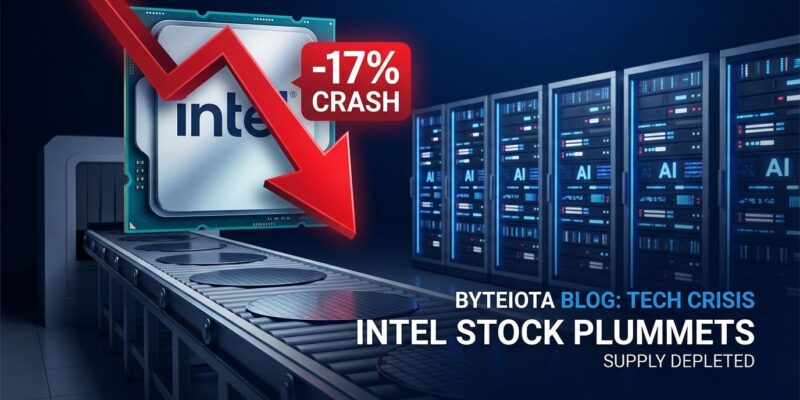
When beating Wall Street expectations sends your stock into freefall, something’s fundamentally broken. Intel reported Q4 2025 results that beat guidance on January 22, 2026—then watched its stock crater 17% the next day, marking one of its worst trading sessions since 2024. The culprit: a Q1 2026 forecast revealing the company’s chip supply will be “depleted” just as AI data center demand hits peak levels. The AI boom that should be lifting Intel is instead exposing how badly its foundry bet is backfiring.
Full Capacity, Empty Shelves
Intel’s factories are running at maximum capacity, yet the company cannot meet demand. CFO David Zinsner warned that “Q1 2026 will be most challenging” for chip supply, with inventories set to be depleted. The company’s Diamond Rapids Xeon 7 processors—critical for AI server workloads—are yielding below internal targets, leaving Intel unable to fulfill orders from cloud service providers.
CEO Lip-Bu Tan acknowledged the transition has been “fraught with execution friction,” admitting yields are “in line with internal plans” but “still below what I want them to be.” Translation: Intel’s 18A process node is struggling. Industry-standard yields won’t arrive until 2027, a delay that puts the company two years behind its own roadmap and miles behind AMD’s TSMC-manufactured alternatives.
Caught With Pants Down
Zinsner confessed Intel was “caught with its pants down”—the company badly misjudged how fast hyperscalers would ramp AI infrastructure spending. The top five hyperscalers (Amazon, Microsoft, Google, Meta, Oracle) are deploying $602 billion in capex during 2026, up 36% year-over-year, with roughly $450 billion earmarked for AI infrastructure alone. That’s data centers, servers, and the CPUs to power them.
Each hyperscaler is spending north of $100 billion annually. AI model training and inference devour CPU clusters at unprecedented scale, and Intel’s manufacturing constraints mean it can’t capitalize. Lead times for chip orders now exceed 30 weeks, with hyperscalers locking up entire production runs through long-term contracts. Smaller cloud providers and enterprise customers are left scrambling for allocation.
Price Hikes, Cloud Pain
Intel’s response to scarcity: raise prices. The company is planning 10-15% server CPU price hikes in 2026, with Zinsner noting Intel is “adjusting pricing and mix” to maximize output. For developers relying on cloud infrastructure, this translates directly to higher bills. Cloud providers don’t absorb cost increases—they pass them downstream.
The timing couldn’t be worse. AI workloads are driving compute demand through the roof, and now the underlying infrastructure costs are spiking too. Intel’s 2026 server CPU capacity is already “largely sold out,” with hyperscalers securing supply while smaller providers face shortages. Developers building on constrained, expensive cloud platforms are feeling the squeeze from both ends.
AMD’s TSMC Advantage
While Intel struggles with yields and capacity, AMD’s EPYC processors are shipping in steady supply. The key difference: AMD manufactures on TSMC’s 2nm process, which has none of Intel’s yield problems. AMD’s Venice EPYC chips are gaining traction with hyperscalers who value reliability over loyalty.
The market is responding. AMD’s server revenue share hit 41% in Q2 2025, with unit share climbing to 27.8% by Q3. Analysts project AMD will reach a record 35% market share by the end of Q1 2026, with some predicting 50/50 parity with Intel by year’s end. AMD’s TSMC partnership model—outsource manufacturing, focus on design—is proving superior to Intel’s vertically integrated foundry bet.
The strategic contrast is stark. AMD executes consistently while Intel admits “execution friction.” AMD supplies chips reliably while Intel depletes inventory. AMD prices competitively while Intel hikes 10-15%. During an AI boom where supply reliability determines long-term customer relationships, AMD is winning the positioning battle.
Recovery or Structural Failure?
Intel promises capacity relief in Q2 2026, with yield improvements and new technologies coming online. The company expects 18A yields to reach “desired cost levels” by year-end, with full industry-standard performance in 2027. But investors are skeptical. The Q4 earnings beat was supposed to validate Intel’s turnaround—instead, the Q1 guidance revealed deeper problems.
The fundamental question: Is Intel’s foundry strategy salvageable, or did the company make a multi-billion-dollar bet on the wrong approach? AMD’s TSMC partnership delivers chips when promised. Intel’s in-house foundries deliver “execution friction” and yield problems. The AI boom should be Intel’s moment. Instead, it’s AMD’s opportunity to break Intel’s server dominance permanently.