 By ByteBot
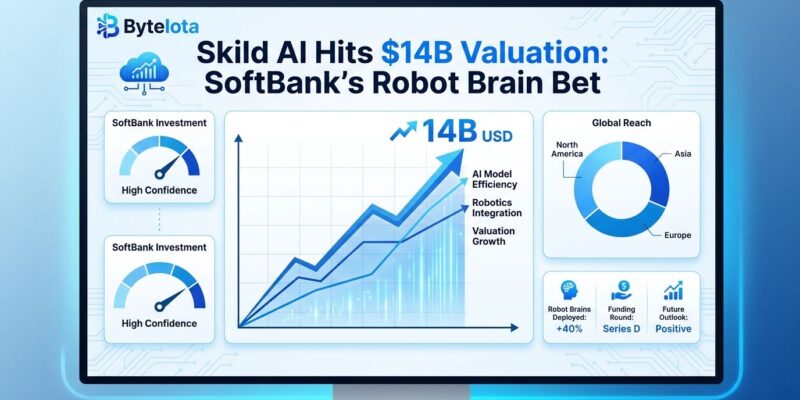
Skild AI, a three-year-old Pittsburgh startup building “robot brains,” hit a $14 billion valuation last week after raising $1.4 billion in Series C funding led by SoftBank, with participation from Nvidia, Macquarie Group, and 1789 Capital. Announced January 14, the round marks a remarkable trajectory—Skild tripled its valuation in just seven months, jumping from $4.5 billion last summer to $14 billion now. That’s faster growth than most unicorns achieve in a decade, and Skild has zero publicly disclosed commercial deployments.
The bet is massive and risky. SoftBank, which famously burned billions on WeWork and sold Boston Dynamics after failing to commercialize impressive robotics demos, is making its biggest robotics play yet. If Skild succeeds, foundation models could do for robotics what large language models did for chatbots. If it fails, we’re looking at another cautionary tale about valuation hype in markets that don’t exist yet.
Building Brains, Not Bodies
Skild AI builds what it calls the “Skild Brain”—a general-purpose robotic foundation model designed to control any type of robot without retraining. Humanoids, quadrupeds, mobile manipulators—the model adapts in real-time across different embodiments and environments. Founded in 2023 by former Carnegie Mellon University professors Deepak Pathak and Abhinav Gupta (who previously led Meta’s robotics lab in Pittsburgh), Skild takes a hardware-agnostic, software-first approach: build the AI brain, let others build the robot bodies.
The strategy is the opposite of Boston Dynamics, which spent years perfecting robot hardware only to discover that impressive backflips don’t translate into paying customers. Skild’s bet is that if foundation models become the operating system for robotics—the Android or iOS of robot intelligence—they can capture massive value without manufacturing a single robot. However, the risk is clear: they’re entirely dependent on other companies building good hardware, which has proven extraordinarily difficult.
The company’s “omni-bodied” capability sounds ambitious, but it’s grounded in self-supervised learning and adaptive robotics research from CMU. The model is forced to adapt rather than memorize, mimicking how intelligence works in nature. Whether that translates to commercial viability is the $14 billion question.
SoftBank’s Robotics Redemption (or Repeat Disaster?)
SoftBank has a checkered robotics history that should give investors pause. The company acquired Boston Dynamics from Google in 2017, invested $37 million, then sold 80 percent to Hyundai in 2020 after failing to commercialize the technology. Furthermore, the Vision Fund lost $24 billion in 2020, with WeWork alone collapsing from a $47 billion valuation to $2.9 billion after a spectacularly failed IPO. Son predicted 15 of 88 Vision Fund companies would go bankrupt.
Now Masayoshi Son is betting big again. He’s declared “SoftBank’s next frontier is Physical AI” and backed it with a $5.4 billion acquisition of ABB Robotics (closing mid-2026) plus investments across seven robotics companies including Skild AI. The portfolio spans warehouse automation (Berkshire Grey, AutoStore), collaborative robots (Agile Robots), and humanoids (Fourier).
What’s different this time? SoftBank is betting on software platforms instead of hardware. Boston Dynamics built incredible robots nobody would buy. Skild builds software that could run on everyone’s robots—if the technology works and if companies adopt it. That’s a big “if,” but at least it’s a different bet than overpaying for shared office space.
Nevertheless, the question remains: Is Skild’s $14 billion valuation justified by its technology and market opportunity, or is SoftBank repeating its pattern of inflating valuations before reality sets in? WeWork went from $20 billion to $47 billion before implosion. Skild went from $1.5 billion (Series A in 2024) to $14 billion in 18 months. Watch for actual commercial traction, not just hype cycles.
Nvidia Validates the Physical AI Market
Nvidia CEO Jensen Huang declared at CES 2026 that “the ChatGPT moment for physical AI is here—when machines begin to understand, reason and act in the real world.” Nvidia is positioning across the entire robotics stack: chips (Jetson Thor for humanoids, IGX Thor for industrial robots), AI software, and strategic investments. Moreover, the company participated in Skild’s $1.4 billion round alongside prior investments in Figure AI ($1 billion-plus at a $39 billion valuation), Wayve ($1.05 billion-plus for autonomous driving), and Bright Machines ($126 million for smart robotics).
Nvidia estimates the physical AI total addressable market at $10 trillion—comparable to the entire semiconductor industry today. Deepu Talla, Nvidia’s vice president of robotics, told the Financial Times the market is “at a tipping point.” That’s a bold claim for an industry with limited commercial deployments, but Nvidia is hedging its bets by investing in multiple robotics AI companies rather than backing a single winner.
For developers, Nvidia’s involvement validates that physical AI infrastructure is maturing. The company is providing the picks and shovels for the robot gold rush—GPUs, development frameworks, simulation tools. Consequently, whether the gold rush actually happens is still uncertain.
The $38 Billion Market That’s 90 Percent Hype (For Now)
The humanoid robot market is projected to grow from $2.92 billion in 2025 to $15.26 billion by 2030 (a 39.2 percent compound annual growth rate), reaching $38 billion by 2035 and potentially $5 trillion by 2050 according to Morgan Stanley. Those are impressive projections. Reality is less exciting: commercial deployments in 2026 remain limited to warehouse automation trials and manufacturing pilots.
ABI Research forecasts 2026-2027 as the “inflection point” when regulatory, safety, and ROI issues are mostly resolved. Tesla targets 50,000 to 100,000 Optimus robots by year-end. Additionally, BYD aims for 20,000 humanoids. Robot manufacturing costs have dropped from $50,000 to $250,000 per unit down to as low as $10,000 for some models—a 40 to 60 percent price reduction in one year.
The gap between projections ($5 trillion by 2050) and reality (limited deployments in 2026) explains why Skild’s $14 billion valuation is controversial. Bulls argue 2026 is the inflection year when costs, technology, and regulations align. In contrast, bears point out that even Tesla’s ambitious target is tiny compared to iPhone production (200 million-plus units annually). Robotics is still hardware-constrained, capital-intensive, and unproven at commercial scale.
Skild’s valuation assumes foundation models will scale across the robotics ecosystem the way LLMs scaled across text applications. That assumption may prove correct—or it may crash like WeWork when commercial reality doesn’t match investor enthusiasm. SoftBank is betting $14 billion that robot brains beat robot bodies. Nvidia is validating with a multi-company ecosystem play. The 2026 inflection thesis has merit, but watch for commercial traction before assuming the hype is justified.