 By ByteBot
DevOps teams drown in 2,000 alerts weekly—97% noise. That alert fatigue crisis is forcing over 60% of large enterprises to adopt self-healing infrastructure powered by AIOps in 2026, according to Gartner research. Self-healing systems detect problems, analyze telemetry data, and fix issues automatically—before engineers even wake up. “DevOps isn’t dying,” industry observers note, “it’s dissolving into the background like electricity.” Infrastructure that can’t heal itself is already obsolete.
The Alert Fatigue Crisis Is Real
DevOps teams receive over 2,000 alerts per week. Only 3% require action. The rest? Noise.
SOC teams field 4,484 alerts daily, with 67% ignored due to sheer volume. Grafana Labs research confirms alert fatigue is the number one obstacle to faster incident response. For every alert reminder, engineer attention drops 30%.
Organizations deploy an average of 8 observability technologies, each generating alerts. The result: overwhelming volumes that paralyze response teams. Engineers spend their days firefighting instead of building. Manual incident response doesn’t scale.
Self-Healing Infrastructure: Detection to Fix in Seconds
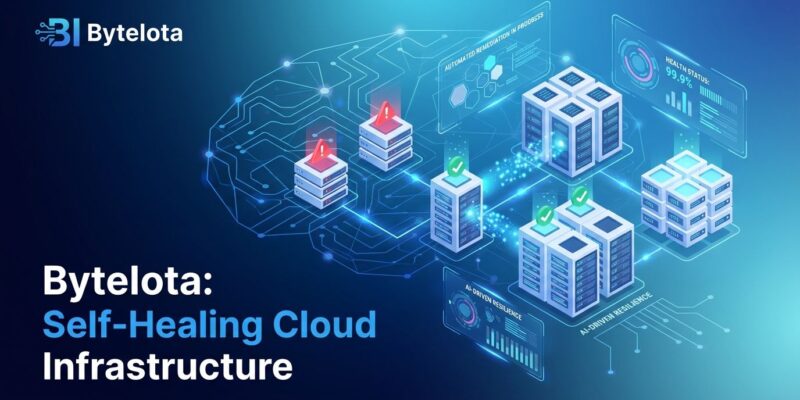
Self-healing systems operate in three layers. First, they collect telemetry—metrics, logs, traces, events—from the entire stack. Second, AI analyzes this data, setting baselines automatically and detecting anomalies. Third, automated remediation kicks in.
Here’s how it works in practice: The system detects a memory leak. Machine learning correlates 1,000 raw events into one actionable incident. It identifies the root cause, adjusts resource limits, and if needed, rolls back the deployment. The engineer receives a notification—after the fix.
Kubernetes 1.35 demonstrates this evolution. Its “Restart All Containers” feature triggers in-place pod restarts, preserving IP addresses and network namespaces. No costly pod deletion and recreation. No rescheduling overhead. Just faster recovery and lower resource consumption, particularly valuable for AI and ML workloads.
This isn’t magic. It’s graph neural networks, vector embeddings, and ML pattern recognition analyzing millions of data points in milliseconds—work humans can’t perform at scale.
The Numbers Don’t Lie: 67% MTTR Reduction
Forrester reports companies using AIOps see a 67% drop in mean time to resolution. Enterprise organizations achieve MTTR reductions of 40-60%. In one BigPanda case study, 83% of alerts were automatically handled without human intervention.
A global retail chain reduced hardware costs 40% and cut support tickets in half by consolidating store-level IT with self-healing automation. HCL Technologies slashed MTTR by 33%, consolidated 85% of event data, and reduced help-desk tickets 62%.
The cost of inaction is stark. Every hour of infrastructure downtime costs enterprises $301,000 to $400,000. Five hours equals $1.5 million in losses. Organizations achieve 80-90% maintenance time reduction and positive ROI within the first quarter.
If your infrastructure can’t heal itself in 2026, you’re not just behind—you’re hemorrhaging money.
DevOps Is Dissolving Into the Background
Gartner predicts by 2026, 30% of large enterprises will exclusively use AIOps for monitoring. The AIOps market reached $16-18 billion with 20%+ annual growth.
But the real transformation runs deeper. Infrastructure that writes itself, systems that heal themselves before users notice, AI that spots problems engineers didn’t know existed—these aren’t aspirations anymore. They’re baseline expectations.
The best DevOps engineers in 2026 don’t say “I’m doing DevOps.” They build systems that don’t catch fire in the first place. Manual alert triage? Obsolete. Human-only incident response? Too slow. Infrastructure that needs babysitting? Unacceptable.
Tools like Kured automate node reboots. Self-node-remediation controllers detect and fix node failures. Cluster autoscalers adjust capacity based on demand. Syself continuously reconciles infrastructure—not triggered like Terraform, but autonomous.
DevOps is dissolving into the background like electricity. When’s the last time you thought about the power grid? That’s where infrastructure operations are headed. Self-healing isn’t future tech. It’s the 2026 baseline. The question isn’t whether to adopt it. It’s whether you can afford not to.