 By ByteBot
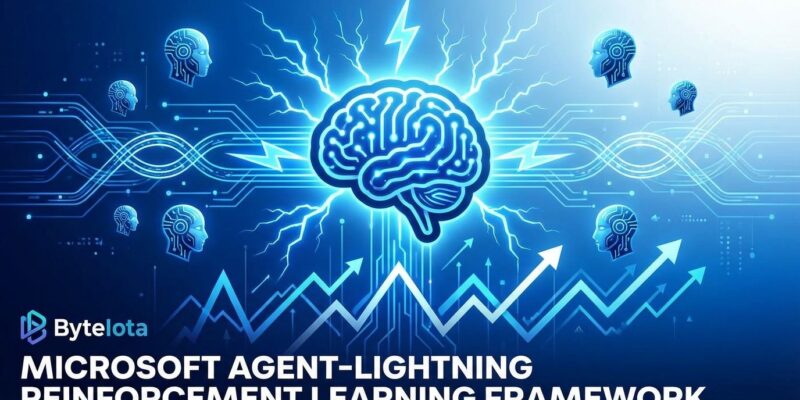
Microsoft Research launched Agent-Lightning on January 20, making AI agents trainable through reinforcement learning with minimal code modifications. Most AI agents today are expensive scripts—they execute tasks but never improve. Agent-Lightning changes that by enabling agents to learn from experience through trial and error, addressing a critical gap as Gartner predicts 40% of enterprise applications will embed AI agents by year’s end.
How Credit Assignment Makes Agents Learn
The technical breakthrough centers on credit assignment—determining which actions contributed to successful outcomes. Traditional reinforcement learning requires complete agent rewrites because tightly coupling training logic with execution code creates framework lock-in and makes iteration painful.
Moreover, Agent-Lightning decouples execution from training through a three-component architecture. The Agent Runner manages task execution independently, collecting data without interfering with LLM calls. The LightningRL algorithm uses hierarchical credit assignment to evaluate each step’s contribution, pairing individual LLM requests with reward scores. LightningStore acts as the central repository, standardizing data exchange across diverse workflows.
This approach works with any framework—LangChain, OpenAI Agents SDK, AutoGen, CrewAI, even pure Python without frameworks. Microsoft tested the system on text-to-SQL generation, retrieval-augmented generation on the MuSiQue dataset, and mathematical problem-solving with tools, reporting stable continuous improvements across all three domains.
The Zero Code Marketing Meets Developer Reality
Microsoft markets Agent-Lightning as requiring ZERO CODE CHANGE but that asterisk matters. You add agl.emit and agl.PromptTemplate API calls while keeping existing agent logic intact—significantly easier than rewrites, but not actually zero changes.
However, developer response on Hacker News shows cautious skepticism. One commenter flagged the fine print. Another called it a worse DSPy after reading the documentation, criticizing complex flow charts without clear value explanation and excessive emojis suggesting LLM-generated marketing copy.
The practical reality? Installation is simple but continuous RL training requires GPU infrastructure, reward signal design, and training loop management. The real question is not whether integration is easy, but whether most development teams have the resources to actually train agents continuously. That is where the zero code hype meets operational complexity.
Framework-Agnostic Positioning in the Agent Ecosystem
Agent-Lightning occupies unique territory as the only framework-agnostic RL training solution. DSPy optimizes prompts at scale but focuses on research workflows, not production training. LangGraph handles multi-agent orchestration but lacks learning capabilities. AutoGen enables multi-agent collaboration with static roles. CrewAI coordinates role-based teams that do not improve over time.
Furthermore, the framework works as a complement, not a replacement. You can orchestrate agents with LangGraph and train them with Agent-Lightning. The multi-agent selective optimization feature lets you improve one agent in a system or all of them, giving teams control over where to invest training resources.
Use Agent-Lightning when you have existing agents you want to improve, need framework flexibility, and have GPU resources for training. Skip it if you are building from scratch, lack compute infrastructure, or face sparse reward signals where train any agent claims typically break down—a valid concern raised by the Hacker News community.
Timing the Learning Agents Trend
Agent-Lightning launches exactly when enterprises need learning agents. The AI agent market is growing from 7.8 billion dollars in 2025 to a projected 52 billion by 2030, with organizations reporting 5x-10x ROI from deployments. Consequently, deploying static agents is table stakes—competitive advantage comes from agents that improve over time.
Learning from experience is the 2026 trend analysts are watching. Organizations generate massive digital exhaust from agent execution but cannot extract learning value from it. Agent-Lightning addresses this directly, enabling agents to improve through reinforcement on their own task history.
What is missing? Public production case studies and specific performance metrics. Microsoft shows academic partnerships—Stanford AgentFlow integration, Tencent 128-GPU scaling verification—but has not published accuracy improvements or real-world ROI data. The framework with 11.5k GitHub stars and v0.3.0 released December 24 is actively developed but unproven in production. Therefore, developers should experiment, but set realistic expectations about deployment complexity beyond the zero code marketing.