 By ByteBot
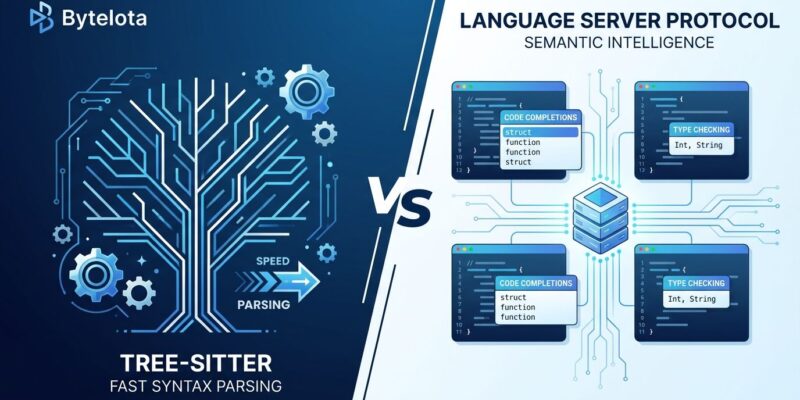
Developers are choosing sides in the Tree-sitter vs Language Server debate, but the answer isn’t either/or—it’s both. Tree-sitter, the incremental parsing library powering GitHub’s code analysis, excels at fast syntax-level features like highlighting and code folding. Language Server Protocol (LSP) provides semantic intelligence like completions and refactoring. Modern editors like Zed are proving the future belongs to hybrid architectures that use Tree-sitter for performance-critical paths and LSP for intelligence-critical features.
Tree-sitter and LSP Aren’t Competing—They’re Complementary
Tree-sitter is a syntax parser designed for real-time editing—it parses code on every keystroke and updates in under 1ms. LSP is a semantic analyzer running in a separate process—it understands types, scopes, and cross-file references. They’re complementary, not competing.
Tree-sitter creator Max Brunsfeld clarified this in a Hacker News discussion: “Tree-sitter isn’t really an alternative to LSP. We think of it as solving a different, more targeted problem. LSP is the best way to provide a fixed set of classic IDE features. Tree-sitter is more about enabling various features that require an editor to understand a document’s structure.”
Zed editor demonstrates this separation perfectly. Tree-sitter handles syntax highlighting and code folding—delivering immediate UI feedback. LSP handles completions and diagnostics, which can tolerate 50-100ms latency. Misunderstanding this distinction leads to architectural mistakes that plague developers daily.
Why VS Code Feels Slow on Large Codebases
VS Code users frequently report slow performance on large projects—IntelliSense consuming 100% CPU for hours, 2-5 minute delays for syntax highlighting, and lag on every keystroke. The root cause: over-reliance on LSP for features Tree-sitter handles better.
GitHub issues document the pain. Chromium developers report IntelliSense using 100% CPU for hours during initial parse, with code completion taking seconds per request even after parsing completes. Large files in remote SSH workspaces cause “very slow and laggy” behavior. These aren’t isolated complaints—dozens of issues span C++, TypeScript, Python, and other languages.
Contrast this with Zed’s hybrid approach. Tree-sitter provides instant syntax highlighting with sub-millisecond updates, freeing LSP to focus on semantic features. Zed benchmarks show 40% faster Python LSP response times than VS Code. The architecture matters—a lot.
Related: Developer Productivity 2026: AI and Platform Engineering Shift
Zed’s Hybrid Architecture Proves It Works
Zed editor pioneered a hybrid model: Tree-sitter for performance-critical paths like syntax highlighting, folding, and selections; LSP for intelligence-critical features like completions, diagnostics, and refactoring. The results are measurable. Tree-sitter’s O(n) incremental parsing delivers 10x faster syntax highlighting than regex-based editors. Python LSP adapters in Zed cut response times by 60% via batched requests, outperforming VS Code by 40% in benchmarks.
Helix editor follows similar principles—both Tree-sitter and LSP as first-class features, not one or the other. Neovim integrated Tree-sitter natively in version 0.5+, combining it with LSP plugins for full IDE capabilities. The pattern is clear across modern editors.
This is the future. Editors sticking to LSP-only sacrifice performance on large codebases. Editors going Tree-sitter-only sacrifice semantic intelligence. The debate is resolving toward hybrid architectures as the clear winner.
What Each Tool Does Best
Tree-sitter excels at syntax-level features: highlighting, folding, indentation, structural selections. It understands syntax but not semantics—it knows foo is an identifier but not whether it’s a variable or function. LSP provides semantic intelligence: completions, diagnostics, go-to-definition, refactoring. It understands types, scopes, and cross-file references.
The distinction is fundamental. Tree-sitter produces concrete syntax trees (CST) preserving all source text. LSP builds abstract syntax trees (AST) with semantic annotations. Tree-sitter is fast—O(n) incremental parsing—but syntax-only. LSP is slower, requiring type inference, but semantically aware.
Feature responsibility breaks down clearly:
- Syntax Highlighting: Tree-sitter (instant), LSP (slow, asynchronous)
- Code Folding: Tree-sitter (structural), LSP (expensive)
- Completions: Tree-sitter (not suitable), LSP (context-aware)
- Diagnostics: Tree-sitter (no semantic analysis), LSP (type-aware)
- Go-to-Definition: Tree-sitter (syntax-based only), LSP (cross-file semantic)
- Refactoring: Tree-sitter (no cross-file understanding), LSP (safe, project-wide)
Here’s how Tree-sitter defines highlighting rules with S-expression queries:
; Highlight function definitions vs calls
(function_declaration
  name: (identifier) @function.definition)

(call_expression
  function: (identifier) @function.call)
This runs locally, instantly, without server communication. LSP requests, by contrast, require JSON-RPC messages to a separate process for semantic analysis.
Choosing the Right Architecture for Your Workflow
Understanding these trade-offs helps developers make informed choices. VS Code prioritizes intelligence but sacrifices speed on large projects. Helix and Zed prioritize speed with hybrid architectures. Neovim offers full customization but requires configuration.
The decision tree is straightforward:
- Large monorepo (10k+ files): Choose Zed or Helix for hybrid benefits, or optimize VS Code with exclusion settings and disabled extensions
- Small-to-medium projects: VS Code works fine—LSP overhead is manageable
- Performance-critical workflows: Zed or Helix keep UI responsive even on massive files
- Deep IDE features (refactoring, debugging): VS Code or IntelliJ offer mature LSP ecosystems
GitHub uses Tree-sitter, not LSP, for code search and navigation across millions of repositories—LSP doesn’t scale to that level. But individual developers working on single projects benefit from LSP’s deep semantic understanding. Context matters.
The future isn’t about declaring a winner. It’s about using the right tool for the right job. Tree-sitter for instant feedback. LSP for intelligent features. Hybrid architectures for both.
Key Takeaways
- Tree-sitter and LSP solve different problems—syntax parsing vs semantic analysis—and work best together, not as alternatives
- VS Code’s performance issues on large codebases stem from over-relying on LSP for tasks Tree-sitter handles better
- Zed, Helix, and Neovim prove hybrid architectures deliver 10x faster syntax highlighting while maintaining full LSP intelligence
- Choose editors based on workflow: large projects need hybrid speed, small projects tolerate LSP-only, and both approaches have clear use cases
- The debate is resolving—modern tooling converges on Tree-sitter for performance-critical paths and LSP for semantic features