 By ByteBot
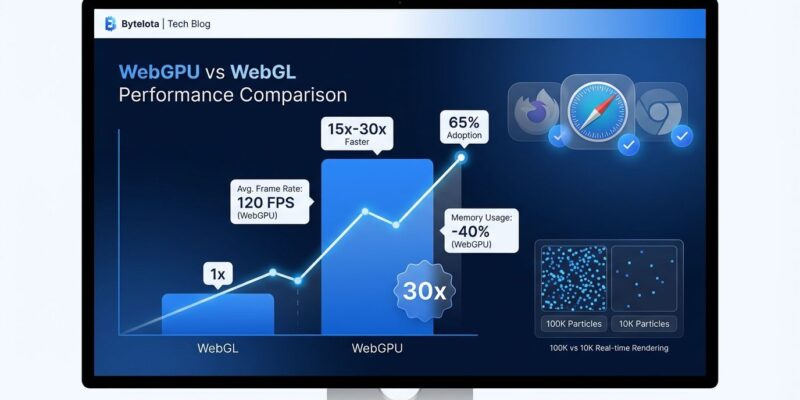
WebGPU achieved full cross-browser support in January 2026, marking the end of the 15-year WebGL era. Firefox 147 shipped WebGPU on January 13, Safari enabled it by default in iOS 26 and macOS Tahoe 26, and the 2025 Web Almanac reports 65% of new web applications already leveraging the technology. This isn’t experimental—companies like Nexara Labs deploy AR experiences serving 3 million users, and ChartGPU is trending on Hacker News for rendering 1 million data points at 60fps.
Moreover, WebGPU’s shift from WebGL’s high-level state-machine API to low-level GPU control delivers 15-30x performance improvements for compute workloads and browser-based AI inference reaching 80% of native performance. The convergence of browser support, production deployments, and framework maturity signals WebGPU adoption crossed from “emerging” to “production-ready.”
15-30x Performance Gains Unlock New Applications
WebGPU’s performance advantages reshape what’s viable in web applications. The architectural shift from WebGL’s sequential, CPU-bound command translation to WebGPU’s async, multi-threaded command buffers enables GPU parallelization previously impossible in browsers.
ChartGPU demonstrates this capability by rendering 1 million data points at 60fps—a workload that would bring Canvas2D or WebGL to a crawl. Furthermore, Nexara Labs built real-time facial AI for AR try-ons hitting 58FPS on iPhone 15 versus 12FPS with JavaScript/WebGL. Their production deployment serves 3 million users with a 40% conversion boost, proving WebGPU delivers business value beyond raw speed.
The performance gains extend across use cases. Babylon.js reports approximately 10x faster scene rendering using WebGPU’s render bundles, which pre-record commands for reuse. Browser AI inference via WebLLM reaches 80% of native performance, making client-side machine learning practical. Even power consumption improves dramatically: the same workload draining phone batteries in 2 hours on WebGL runs for 3 hours on WebGPU.
Full WebGPU Browser Support Reached January 2026
WebGPU adoption crossed a critical threshold this month with all major browsers shipping support. Firefox 147 released January 13 with WebGPU enabled on Windows and ARM64 macOS, while Safari shipped it by default in iOS 26, iPadOS 26, and macOS Tahoe 26. Chrome and Edge have supported WebGPU since version 113 on Windows, macOS, and ChromeOS.
Global browser coverage hit approximately 70% as of October 2024 and continues growing. Consequently, Mozilla plans Firefox Linux support throughout 2026 with Android work ongoing. This browser convergence matters because production deployment requires confidence in user reach.
Framework support reinforces production readiness. Three.js—the dominant web 3D library with 2.7 million weekly npm downloads—has supported WebGPU since release r171, complete with automatic WebGL 2 fallback. Babylon.js maintained WebGPU support since version 5.0 (May 2022) and rewrote all core engine shaders in native WGSL in 2024. Even Unreal Engine 5 added WebGPU backend support in April 2024.
Production WebGPU Deployments Prove Viability
WebGPU moved beyond prototypes into production applications serving real users. Nexara Labs’ AR e-commerce deployment stands out: their real-time facial AI for try-ons processes 4K frames at 58FPS on iPhone 15, serves 3 million users, and boosted conversion rates by 40%. These aren’t lab benchmarks—they’re production metrics.
Additionally, ChartGPU’s viral traction on Hacker News (616 points, 173 comments) signals developer demand for WebGPU-powered data visualization. Rendering 1 million data points at 60fps demonstrates practical utility beyond what Canvas2D or WebGL charting libraries achieve. Browser AI represents another success story—WebLLM enables in-browser LLM inference reaching 80% of native performance without servers.
WebGPU Migration: Two-Line Code Change
Framework support makes WebGPU adoption trivial for existing Three.js or Babylon.js projects. Three.js migration requires changing two lines: import from 'three/webgpu', then instantiate THREE.WebGPURenderer. That’s it—automatic WebGL 2 fallback handles older browsers without manual feature detection.
// Old WebGL approach
import * as THREE from 'three';
const renderer = new THREE.WebGLRenderer();

// New WebGPU approach (r171+)
import * as THREE from 'three/webgpu';
const renderer = new THREE.WebGPURenderer();
// Automatic fallback to WebGL 2 on older browsers
Similarly, Babylon.js follows an async pattern. Developers instantiate BABYLON.WebGPUEngine instead of BABYLON.Engine, then call await engine.initAsync(). Both frameworks maintain side-by-side WebGL and WebGPU support indefinitely.
// WebGL
const engine = new BABYLON.Engine(canvas);

// WebGPU (async initialization)
const engine = new BABYLON.WebGPUEngine(canvas);
await engine.initAsync();
This low migration friction explains why 65% of new web apps already use WebGPU. Developers experiment by changing two lines, test on modern browsers, and deploy confidently knowing older browsers fall back automatically.
WebGPU Challenges: Compatibility and Bugs
However, WebGPU adoption faces real challenges. Approximately 45% of older devices don’t support storage buffers in vertex shaders, forcing compatibility mode with reduced features. GPU vendor-specific bugs create friction: NVIDIA’s 572.xx drivers crash RTX 30/40 series cards, AMD Radeon HD 7700 produces artifacts, and Intel integrated graphics experience driver hangs.
The performance gap compared to native APIs is honest 20%. WebLLM achieves 80% of native performance for browser AI inference—impressive but not equivalent to native implementations. While 70% global coverage sounds strong, that leaves 30% relying on WebGL fallbacks. Production applications must implement progressive enhancement rather than WebGPU-only deployment.
When to Adopt WebGPU: Decision Framework
WebGPU adoption makes strategic sense in specific scenarios. For new projects starting today, WebGPU should be the default choice—framework support provides automatic fallback with no downside. Existing projects hitting WebGL performance walls are prime candidates. If you’re struggling with 100+ draw calls or 60 FPS ceilings, WebGPU’s 2-10x gains justify migration effort.
Use cases benefiting most include large-scale particle systems (100,000+ particles), real-time physics simulations, GPU-accelerated AI/ML, and data visualization exceeding 100,000 points. The progressive enhancement approach—WebGPU primary, WebGL fallback—captures performance gains for 70% of users without abandoning the remaining 30%.
Key Takeaways
- Production-ready now: 70% browser support (Firefox 147, Safari iOS 26, Chrome/Edge) with 65% of new apps already adopting
- 15-30x performance gains: Compute acceleration, 150x particle improvements, 80% native AI inference enable new application categories
- Real deployments prove value: Nexara Labs 3M users with 40% conversion boost, ChartGPU 1M data points at 60fps
- Easy migration: Two-line change in Three.js/Babylon.js with automatic WebGL fallback eliminates risk
- Honest challenges: 45% devices need compatibility mode, GPU vendor bugs, 20% native performance gap
- Adopt for new projects: Default to WebGPU with auto-fallback; migrate existing projects hitting performance walls