 By ByteBot
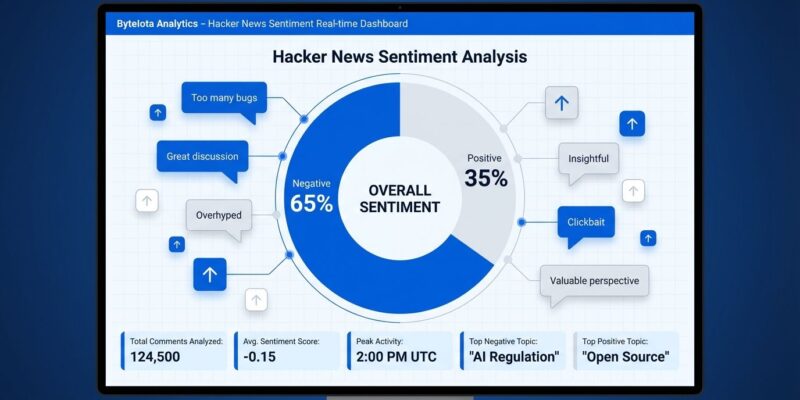
If you’ve ever wondered why tech discourse feels like a perpetual code review where everything is wrong—there’s data to prove it. A 2026 study by Philipp Dubach analyzed 32,000 Hacker News posts and 340,000 comments, finding that 65% register as negative sentiment. More striking: negative posts averaged 35.6 points versus 28 points overall—a 27% performance premium for criticism. The pattern held across six different AI sentiment models, proving this bias is real and measurable.
This isn’t just a Hacker News quirk. It reflects a broader pattern where skepticism equals sophistication and optimism equals naivety.
Why Negativity Wins: Biology Meets Algorithms
Humans have an evolutionary negativity bias—our ancestors who paid more attention to threats survived and passed on their genes. However, social media platforms amplify this tendency with engagement-based algorithms. Research analyzing 95,282 articles and 579 million social media posts found users are 1.91 times more likely to share negative news. Moreover, Twitter’s algorithm amplifies angry political content by 0.75 standard deviations.
The feedback loop is predictable: negative content drives engagement, algorithms boost it for visibility, more creators produce negative content to compete for attention. Platform algorithms optimize for engagement, not satisfaction. Consequently, you click on criticism because your brain is wired to prioritize threats, and the algorithm learns to show you more.
On Hacker News specifically, titles like “The Downfall of [Tech Trend]” or “Why [Popular Tool] Fails” outperform neutral submissions by doubling interaction rates. This creates a culture where negativity signals sophistication—even when it crosses into performative cynicism.
The Paradox: Feature AND Bug
Here’s the uncomfortable truth: negativity in tech discourse is both necessary and toxic. This isn’t a contradiction—it’s the central tension.
The FEATURE: We need critical voices. Tech moves fast, hype cycles abound, and skeptics call out bad architecture, security risks, and vaporware before they scale. Critical discourse prevented Theranos from destroying more lives, exposed crypto scams before they metastasized, and challenges AI washing claims. Without criticism, we’d drown in marketing disguised as innovation.
The BUG: When negativity becomes performative—when criticizing tech signals intelligence—it kills innovation. Stack Overflow epitomizes this dysfunction. Beginners asking questions get marked as duplicate without links, told to “Google it,” and often never ask again. April Wensel, founder of Compassionate Coding, noted the platform’s “condescending and blatantly rude responses dissuaded me from ever creating an account.”
Reddit’s r/programming earns its reputation as “one of the most toxic communities” with gatekeeping statements like “You don’t know JavaScript if you don’t understand closures.” Code reviews devolve into “WTFs per minute” scorekeeping, blocking pull requests over semicolon placement while ignoring architectural issues.
The Real-World Cost of Tech Discourse Negativity
The negativity bias shapes how developers evaluate tools destructively. Consider AI coding assistants: 96% of developers believe AI-generated code isn’t functionally correct, yet controlled studies show experts are 19% slower on complex tasks when refusing to use AI tools.
“X is Dead” articles proliferate—DevOps, .NET, software development itself—because negativity performs. LinkedIn’s 2026 Jobs on the Rise report lists DevOps engineer as the 4th fastest-growing role with 35% year-over-year growth, yet discourse insists the field is dying. Furthermore, the gap between reality and narrative reveals performative cynicism at work.
Constructive Criticism vs Performative Cynicism
The line between constructive criticism and toxic negativity isn’t always clear, but it matters. The test is simple: “Will this make them a better developer, or will this make them want to quit?”
Constructive criticism is clear, specific, and actionable. It focuses on behaviors, not personalities. Example: “I appreciate how quickly you deliver features. Your code lacks comments, which slows debugging. Adding documentation will help the team long-term.”
Toxic negativity attacks the person, offers no actionable feedback, and uses a condescending tone. Example: “This code is garbage. Did you even try?”
What This Reveals About Developer Culture
The 65% negativity rate on Hacker News is a mirror showing us who we’ve become as a tech community. We reward criticism because it feels like critical thinking. Nevertheless, there’s a difference between skepticism and cynicism. Skepticism asks questions and demands evidence. Cynicism assumes everything is terrible and dismisses new ideas preemptively.
Tech culture needs both critical thinking AND optimism. The solution isn’t eliminating negativity—it’s recognizing when you’re being constructively critical versus performatively cynical. Ask yourself: Am I criticizing to help or to signal sophistication?
Communities can shift culture by rewarding constructive feedback. Celebrate good work as loudly as you critique bad work. Additionally, when someone says “X is dead,” ask for specifics. Challenge cynicism with the same rigor you’d apply to optimism.
The Choice We Face
Tech moved too fast for too long. Skepticism is understandable—we’ve been burned by hype cycles and watched companies fail spectacularly. However, performative cynicism isn’t the answer. It’s thoughtlessness disguised as wisdom.
Hacker News’s negativity bias isn’t a bug to fix. It’s a feature revealing our priorities. Subsequently, we can choose to be critical without being cruel, skeptical without being cynical, and demanding without being destructive. Balance is possible if we examine our own patterns.
The discourse we build is the culture we deserve. Choose carefully.