 By ByteBot
IBM has staked its reputation on a bold claim: 2026 is the year quantum computers finally outperform classical systems at solving real-world problems. At CES 2026, the company doubled down on this timeline, positioning the Nighthawk processor as the hardware that will deliver verified quantum advantage by year-end. For developers, this isn’t just another roadmap promise—IBM is shipping tools like Qiskit Code Assistant that let you write quantum code today, using AI trained on quantum algorithms. The question isn’t whether quantum advantage is coming. It’s whether your organization is ready when it arrives.
Nighthawk: The Hardware That Delivers
IBM’s Quantum Nighthawk processor represents the company’s most ambitious hardware to date. Designed specifically to enable quantum advantage, Nighthawk handles problems requiring up to 5,000 two-qubit gates, with plans to reach 7,500 gates by year-end. These aren’t incremental improvements—IBM’s previous-generation Heron R2 processor reduced workload execution time from 122 hours to 2.4 hours. That’s a 50x performance jump on production workloads.
The company expects the first verified cases of quantum advantage will emerge by Q4 2026. To address credibility concerns that have plagued quantum computing claims, IBM is establishing an open, community-led validation tracker alongside partners including Algorithmiq, the Flatiron Institute, and BlueQubit. No more “trust us”—verification will be public and rigorous.
AI That Writes Quantum Code
While IBM builds the hardware, it’s also lowering the barrier for developers who lack quantum physics PhDs. Qiskit Code Assistant is an AI-powered tool that generates quantum code from natural language prompts. Built on the mistral-small-3.2-24b-qiskit model—now open-source on HuggingFace—the assistant integrates directly into VS Code and JupyterLab.
The tool has been benchmarked as the best available model for writing usable Qiskit code, validated against approximately 150 tests across three difficulty levels. For developers, this is the meta moment: AI is helping you write quantum code that will eventually outperform classical systems. The future is enabling itself.
IBM Quantum Premium Plan users can access Qiskit Code Assistant today, and the open-source model means developers can experiment without enterprise budgets. The GitHub extension is already available for those ready to start learning.
Industry Bets Real Money on 2026
Pharma companies aren’t waiting. AstraZeneca has partnered with AWS, IonQ, and NVIDIA to demonstrate quantum-accelerated chemistry workflows for small-molecule drug synthesis. Merck KGaA and Amgen are working with QuEra to predict biological activity of drug candidates using quantum systems. These aren’t academic experiments—they’re production partnerships with real budgets.
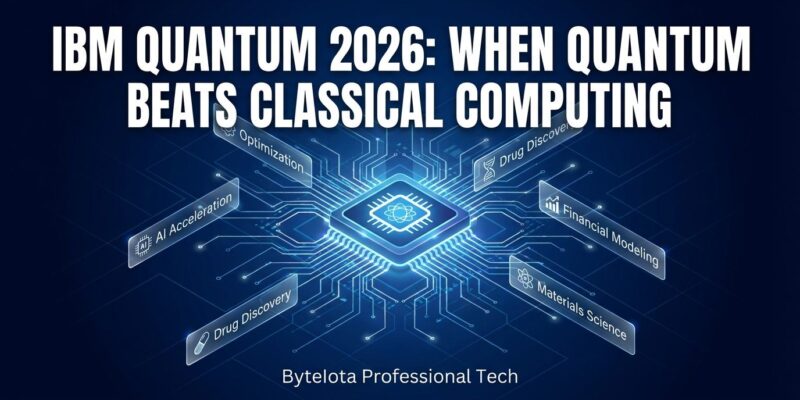
The applications extend beyond drug development. Materials scientists are using quantum systems to design superconductors and nanomaterials at the atomic level. Financial firms are exploring portfolio optimization and risk analysis at scales classical computers can’t handle. McKinsey estimates quantum computing could create between $200 billion and $500 billion in value for the life sciences industry alone by 2035.
Quantum Advantage Means Efficiency, Not Speed
A recent breakthrough reframes what quantum advantage actually means. Researchers demonstrated that a 12-qubit quantum system solved a memory-intensive task that would require at least 62 classical bits. This is “unconditional quantum advantage”—quantum systems are fundamentally more efficient, not just faster.
This distinction matters. Quantum computing won’t replace your laptop or cloud infrastructure. It’s a specialized tool for specific problem classes: molecular simulations, combinatorial optimization, and certain cryptographic challenges. The advantage comes from unlocking memory and computational resources that classical architectures simply can’t match, regardless of how much hardware you throw at the problem.
IBM targets fault-tolerant quantum systems for 2029. Until then, quantum advantage in 2026 will be limited to specific domains where the efficiency gains outweigh current error rates and hardware limitations.
The 2026 Inflection Point
IBM’s Borja Peropadre called 2026 “the decisive moment” for quantum computing at CES. The hardware is reaching practical gate counts. The developer tools are mature enough for broader adoption. Industry partnerships are moving from experiments to production. Community validation mechanisms are in place to separate real breakthroughs from hype.
For developers, the message is clear: quantum advantage is no longer a distant promise. IBM has put specific timelines, hardware capabilities, and validation mechanisms on the table. Whether you’re in pharma, materials science, finance, or optimization, 2026 is the year to start learning. The tools are available. The community is forming. The question is whether you’ll be ready when quantum systems start solving problems your classical infrastructure can’t touch.