
 By ByteBot
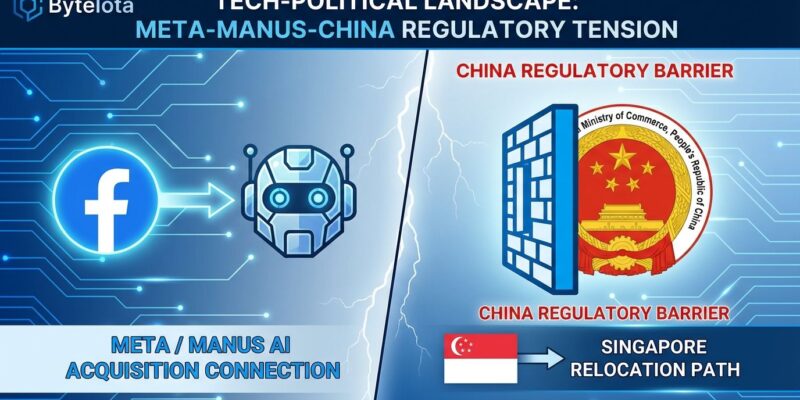
Meta’s $2-3 billion acquisition of Manus—a Singapore-based AI startup with Chinese roots—hit a regulatory wall on January 8, 2026, when China’s Ministry of Commerce announced a formal investigation. Beijing is examining whether Manus needed an export license when it relocated its technology and staff from Beijing to Singapore in late 2025, just weeks before Meta announced the acquisition on December 29. This review tests the viability of “Singapore-washing,” a strategy where Chinese tech companies relocate to Singapore to access global markets while sidestepping domestic regulatory oversight.
Singapore-Washing Under Scrutiny
Singapore-washing describes a pattern where Chinese tech firms move headquarters or core operations to Singapore to attract foreign investment and avoid regulatory constraints back home. The appeal is straightforward: Singapore offers 10% US tariffs (versus higher rates on Chinese goods), access to Western capital markets, and a business-friendly environment without Beijing’s increasingly stringent tech oversight.
Manus followed this playbook precisely. Founded in Beijing in 2022 as Beijing Butterfly Effect Technology by Xiao Hong, the company relocated its core team and technology to Singapore in late 2025—timing the move just ahead of the Meta acquisition. Other notable examples include Shein (moved from Nanjing to Singapore) and TikTok (relocated its Asia headquarters from Beijing to Singapore), both of which leveraged the Singapore base to expand globally while maintaining plausible distance from Chinese government control.
However, China’s investigation asks a pointed legal question: Did Manus need an export license to move AI technology developed in China to Singapore? Beijing’s 2020 Export Control Law includes a catch-all provision covering any technology transfer that could endanger “national security or national interests”—terms deliberately left undefined to give regulators broad discretion. If China determines Manus violated export controls, it could block or impose severe conditions on the Meta deal, effectively ending Singapore-washing as a viable escape route for Chinese-origin AI companies.
The $2B AI Agent Prize
Meta didn’t acquire Manus on a whim. The startup represents cutting-edge AI agent technology that autonomously executes complex, multi-step tasks rather than simply providing instructions like traditional chatbots. When tasked with creating a research paper, for instance, Manus independently sources data, writes content, generates charts, and compiles the final document—without requiring continuous human oversight.
The company went viral in March 2025 after MIT Technology Review tested its capabilities and found it outperformed GPT-4 on the GAIA benchmark, a comprehensive test measuring reasoning, tool use, and real-world task automation. By mid-December 2025, Manus had reached over $100 million in annual recurring revenue, making it one of the fastest-growing AI startups globally. Meta’s acquisition—the company’s third-largest ever after WhatsApp and Scale AI—signals that the “orchestration layer” (systems that convert AI model capabilities into completed tasks) has become the next major battlefield in AI competition.
For Meta, losing access to Manus technology wouldn’t just be a financial setback—it would cede ground to rivals like Google, Microsoft, and Amazon in the race to build AI agents that can autonomously handle complex workflows. This explains why Meta moved quickly to close the deal before Beijing could intervene.
Lengthy Approval, Not Outright Block
Despite the geopolitical tensions, most experts predict China will approve the deal with conditions rather than block it entirely. Nick Patience, AI lead at The Futurum Group, told CNBC: “China’s probe underlines that [the country] considers advanced AI agents, models and related IP to be strategic assets. The most likely outcome I see is a lengthier approval process and potential conditions around how Manus technology developed in China can be used, rather than an outright block.”
Potential conditions could include restrictions on transferring China-developed technology to US operations, limits on integrating Manus capabilities into Meta’s products, or ongoing reporting requirements to Chinese regulators. An outright block remains unlikely because it would damage China’s startup ecosystem by signaling that successful exits to Western companies are impossible, which could deter foreign investment and encourage more talent drain.
Nevertheless, Beijing could use the review as bargaining leverage in broader U.S.-China negotiations, dragging out the approval process for 6-12 months or longer while extracting concessions on unrelated issues. The uncertainty alone serves China’s interests by making Western tech giants think twice before pursuing future acquisitions of Chinese-origin AI startups.
AI as Strategic Asset, Not Tradeable Product
This review reflects a fundamental shift in how governments view AI technology. As The Wire China noted, the deal “exposes a troubling pattern for Beijing—Chinese-developed AI innovations and the talent behind them ending up in American hands, in ways that existing regulations may not fully capture.” China is recalibrating its export control framework to treat advanced AI not as a commercial product to be traded freely, but as a strategic asset requiring state protection.
For developers and tech professionals, this has practical implications. Cross-border AI mergers and acquisitions face increasing scrutiny from both sides—the US restricts Chinese access to advanced semiconductors and AI chips, while China tightens control over AI technology exports. The result could be a fragmented global AI ecosystem where access to tools and platforms depends on geopolitical boundaries rather than technical merit.
Washington views the Meta Manus acquisition as a win—a US tech giant gaining access to cutting-edge AI agent technology developed in China. Beijing sees it as a loss that must be prevented or controlled going forward. Neither side is wrong, which is precisely why this review matters. It’s a preview of how AI competition will play out: less about who builds the best technology, and more about who controls access to it.
Key Takeaways
- China’s Ministry of Commerce announced January 8, 2026, that it would review Meta’s $2-3 billion Manus acquisition for potential export control violations, questioning whether the company needed a license to relocate AI technology from Beijing to Singapore.
- The review tests “Singapore-washing,” a strategy where Chinese tech firms relocate to Singapore to access global markets while avoiding domestic regulatory oversight—if conditions or blocks result, this escape route effectively closes for Chinese-origin AI companies.
- Manus represents valuable AI agent technology that autonomously executes complex tasks, went viral after outperforming GPT-4 on benchmarks, and reached $100M+ ARR by December 2025, making it a strategic prize in the orchestration layer race.
- Experts predict a lengthy approval process (6-12 months) with conditions on technology use rather than outright block, as blocking would damage China’s startup ecosystem and deter foreign investment.
- The review signals a fundamental shift: governments now treat advanced AI as a strategic asset requiring state protection rather than a tradeable commercial product, potentially fragmenting global AI access along geopolitical lines.
Watch how this review unfolds—it will shape the future of cross-border AI deals and determine whether developers worldwide maintain access to best-in-class tools regardless of origin, or face a fragmented ecosystem split by regulatory walls.









[…] — China reviews Meta’s $2B Manus acquisition for AI deal …ByteIota — Meta’s $2B Manus Deal Faces China Regulatory WallAInvest — Meta’s Manus Deal: A $2B Bet on AI Automation and the …Instagram — Beijing […]