 By ByteBot
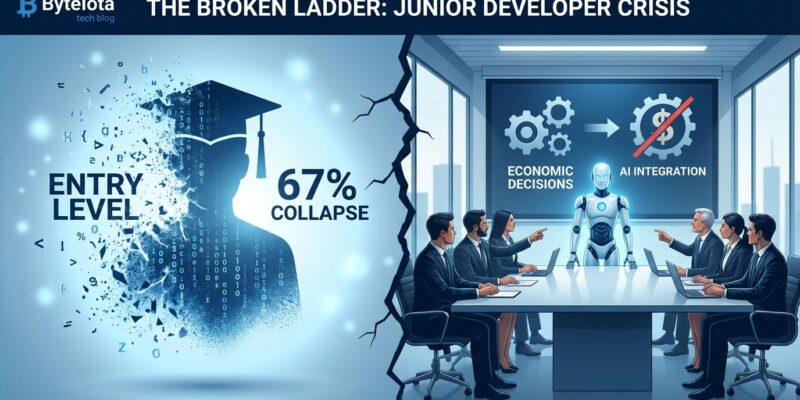
Entry-level developer jobs vanished by 67% between 2023 and 2024, and “entry-level” positions now demand 3+ years of experience. Companies blame AI for making junior developers obsolete, but Stanford data reveals the truth: AI productivity gains measure 2.1%, not the 24.69% executives believe. This isn’t AI-driven evolution—it’s industry self-sabotage disguised as innovation. High interest rates killed training budgets, and AI became a convenient scapegoat for short-term economic decisions that will create a catastrophic leadership vacuum by 2031.
This affects every developer: juniors locked out despite skills, seniors burned out with no succession plan, and companies optimizing for quarterly earnings while destroying their 2031 leadership pipeline. The tech industry is eating its seed corn.
The Data: Junior Hiring Collapsed 67%
U.S. entry-level tech job postings dropped 67% between 2023 and 2024, according to Stanford Digital Economy Lab analysis of ADP payroll data. The UK saw a 46% decline in 2024, projected to hit 53% by year’s end. Employment for the youngest software developers sits 20% below its late fall 2022 peak. This isn’t a minor correction—it’s a structural collapse.
The numbers tell a brutal story. The 15 biggest tech firms cut entry-level hiring by 25% from 2023 to 2024. Programmer employment fell 27.5% between 2023 and 2025, while software developer roles (more design-oriented) declined only 0.3%. Computer science graduates face 6.1% unemployment versus 3.6% overall—nearly double the general rate. Europe mirrors this trend with a 35% decline in junior tech positions across major EU economies.
Developers describe the paradox plainly: “We’re the first generation who have to be Seniors before we’re allowed to be Juniors.” The average tech job search now takes 5-6 months with 200+ applications. Entry-level roles demand 3-5 years of experience. The math doesn’t work, and it’s destroying careers before they start.
The AI Myth Falls Apart
Companies claim “Senior + AI = Junior work automated,” but measured reality exposes the lie. Businesses self-report a 24.69% productivity increase from GenAI adoption. However, actual measured results from 39,000 developers show only a 2.1% overall productivity increase and 3.4% code quality improvement. Moreover, software delivery performance actually declined 7.2% in some studies. Consequently, the gap between expectation (24.69%) and reality (2.1%) is a 12x overestimation.
AI completes boilerplate 55% faster, but boilerplate isn’t the bottleneck. AI handles routine tasks—not system design, architectural trade-offs, or business judgment. AI executes without reasoning; it can’t make architectural decisions, interpret vague client needs, or decide when NOT to build something at all. Those capabilities still require human judgment.
When organizations expect 24.69% gains but see 2.1%, they blame developers. “You have AI, why aren’t you faster?” The unrealistic expectations based on marketing hype drive the “must be senior on Day 1” paradox. Therefore, AI didn’t kill junior roles—flawed assumptions and executive wishful thinking did.
The Real Cause: Economics, Not AI
In 2021, cheap capital from zero interest rate policy allowed companies to pay juniors to learn for 6 months. Growth-at-all-costs mentality dominated. Companies hired speculatively, and training budgets were affordable luxuries. Nevertheless, by 2026, high interest rates demand Day 1 ROI and profitability. Training budgets requiring 12-18 month payback got slashed first. Corporate salary increases hover around 3.5% for 2026—tight constraints everywhere.
AI became a convenient narrative. “AI made juniors obsolete” sounds better in board meetings than “We can’t afford to train anyone in this economic climate.” The timing proves it. If AI truly made juniors obsolete, the collapse would’ve started in late 2022 when ChatGPT launched. Instead, it accelerated in 2023-2024 when interest rates spiked. Furthermore, sixty-six percent of global enterprises plan to cut entry-level hiring due to AI, according to IDC/Deel surveys—but AI is the excuse, economics is the driver.
The industry is eating its seed corn. Short-sighted executives optimize quarterly earnings over long-term talent development, then point at AI to justify it.
The 2031 Leadership Vacuum
Today’s juniors are tomorrow’s senior engineers and tech leads. A 67% hiring cliff in 2024-2026 means 67% fewer potential leaders in 2031-2036. Industry veterans call this “slow decay”—an ecosystem that stops training its replacements. The U.S. faces a shortage of 1.2 million software engineers by 2026 (already here). By 2032, expect a 60-70% reduction in qualified tech leads and architects.
The math is simple. Cut 67% of 2026 hires, lose 67% of 2031 senior candidates, face catastrophic shortage of 2036 tech leads. Addy Osmani warns: “Cutting off the talent pipeline entirely creates a leadership vacuum in 5-10 years.” LeadDev analysis confirms: “Short-term leadership gaps are threatening to undermine long-term leadership pipelines.” A Bay Area VP of Technology puts it bluntly: “There’s no question that the leadership vacuum has arrived in tech.”
As Boomers exit the workforce, they take decades of leadership and long-term thinking that shaped entire sectors. Organizations risk drifting in a sea of short-term decisions without strategic capacity. You can’t automate institutional knowledge, mentorship, or strategic leadership. Indeed, five years from now, these same companies will panic over talent shortages they created today.
Senior Developer Burnout: The Hidden Cost
Senior developers now spend 19% more time on code review than before AI tools arrived—reviewing AI-generated code at scale, not mentoring juniors. The traditional pressure valve (handing off UI tweaks and unit tests to juniors) is gone. Seniors can’t delegate anymore because AI took junior work, but no juniors exist anyway. They’re left with only high-risk, high-complexity architectural decisions and no breathing room.
Code review fatigue ranks as a top contributor to burnout. Seniors describe themselves as “holding the production system together with zip ties and Terraform.” Job satisfaction among senior engineers is lower than juniors—a reversal from historical patterns. Additionally, good mentorship feels rare, not because people are unwilling, but because everyone is stretched thin. A burned-out senior developer can damage more than code—they accelerate junior burnout too, when juniors even exist to mentor.
This isn’t sustainable. Expecting seniors to do all junior work, plus senior work, plus review AI output creates a burnout epidemic. And who will mentor the few juniors who do get hired? Everyone’s drowning.
This Is Industry Self-Sabotage
This is industry self-sabotage, not AI evolution. Companies are sacrificing 2031 leadership for 2026 quarterly gains. The “senior on Day 1” expectation is a fantasy built on AI marketing hype that promises 24.69% productivity but delivers 2.1%. AI doesn’t replace juniors—it shifts what juniors need to learn. Instead of writing boilerplate, they should audit AI-generated code for bugs. Instead of implementing designs, they should evaluate multiple AI-generated implementations. Likewise, instead of following patterns, they should understand system design before prompting AI.
The career ladder isn’t broken—executives broke it to save training budgets during high interest rates. The scenario is predictable: 70% likelihood of a crisis point in 2029-2031 when mass senior retirements meet talent shortage. Consequently, then comes panic, bidding wars for anyone with 3+ years of experience, and forced reinvention of training programs. Historical pattern confirms: industries ignore talent pipelines until crisis forces intervention.
For juniors: The path exists but is brutal. Focus on portfolio quality over quantity, demonstrate AI-assisted skills, consider side-door entry via support roles. For seniors: Advocate for training programs now or drown in 2031 when there’s no one to replace you. For companies: Invest in talent development today or pay ten times more in 2031 bidding wars.
Five years from now, these same companies will panic over talent shortages. They’re creating the crisis right now, one canceled training budget at a time.