 By ByteBot
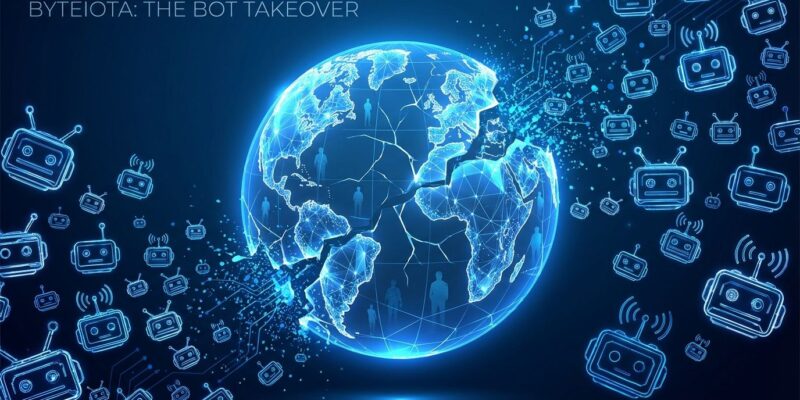
The Dead Internet Theory is no longer a conspiracy. Bots now generate 51% of web traffic, up from 42% just three years ago. Nearly three-quarters of newly published web pages contain AI-generated content. What started in 2021 as fringe speculation is now documented reality—but here’s the uncomfortable part: we did this to ourselves.
The Numbers Don’t Lie
Every metric points in the same direction. Imperva’s 2024 Bad Bot Report shows bot traffic crossed the 50% threshold for the first time, making humans the minority online. Ahrefs analyzed 900,000 newly published web pages in April 2025 and found 74.2% contained AI-generated content. Only a quarter of new content is purely human-written.
Moreover, the trend is accelerating. On X (formerly Twitter), approximately 64% of accounts are likely bots. LinkedIn’s long-form posts are 54% AI-generated. Even Zillow’s real estate reviews jumped from 3.6% AI-generated in 2019 to 23.7% in 2025. Timothy Shoup at the Copenhagen Institute for Futures Studies predicts 99% of online content will be AI-generated by 2030. We’re well on track.
Search is Broken, Publishers Are Dying
The economic consequences are brutal. Google traffic to publishers dropped 33% globally between November 2024 and November 2025, according to Press Gazette. In the U.S., the decline hit 38%. These aren’t abstract numbers—they’re existential threats.
Stereogum lost 70% of its ad revenue in 2025. Business Insider’s organic search traffic fell 55% between April 2022 and April 2025, forcing the company to cut 21% of its staff. Chegg reported a 49% decline in non-subscriber traffic year-over-year. Consequently, some smaller publishers have already shut down. More will follow in 2026.
Zero-click searches jumped from 56% to 69% in a single year. When Google’s AI Overviews appear in results, click-through rates drop 46.7%—from 15% to 8%. Users get their answers without visiting publisher sites. As a result, the economic model that funded quality content creation is collapsing, and Gartner predicts search engine volume will decline another 25% by late 2026 as users abandon keyword search for AI chatbots.
AI is Eating Itself
The irony runs deeper. Large language models are increasingly trained on AI-generated content because 30-40% of the active web is now synthetic. This creates a phenomenon researchers call “model collapse”—when AI systems trained on AI-generated data progressively degrade.
The mechanism is simple but devastating. Each generation of models introduces small statistical distortions. When the next generation trains on that contaminated data, those errors compound. Furthermore, outputs become more homogeneous, less diverse, increasingly prone to hallucinations. The 2024-2025 “Slop Era” poisoned the training data for every model being developed today.
There’s no way back. The pre-2023 “clean data” is gone. Every new model trains on a web increasingly polluted by the output of previous models. The entropy spiral has no exit.
Humans Are Retreating
Meanwhile, human activity is moving behind digital walls. Substack reached a $1.1 billion valuation with over 5 million paid subscriptions and 100 million monthly website visits. Private Discord servers, paid newsletters, company intranets—quality human conversation is increasingly paywalled or invitation-only.
The open web isn’t dying. It’s being abandoned. When search returns AI slop and publishers shut down, people pay for curated, human-verified content. In fact, what used to be free and open is now expensive and closed. The commons we built has been poisoned, so we’re retreating to walled gardens.
We Did This
This wasn’t inevitable technological progress. We made specific choices. AI vendors trained their models on the open web without compensating creators, then deployed those models to flood the same web with synthetic content. Google’s PageRank optimized for engagement over quality, setting the stage for content farms and SEO spam. When AI generation arrived, the infrastructure to game the system was already built.
Developers—us—built these tools. We deployed them for “productivity gains.” Publishers discovered they could generate content for pennies instead of paying human writers. Everyone optimized for scale and speed. Nobody asked whether this would make the internet better.
Taylor Lorenz put it bluntly: “The internet was terminally ill before ChatGPT was announced and released. Algorithmic ranking systems set the stage for endless, worthless pieces of content.” We were already killing the open web. AI just accelerated the timeline.
The Dead Internet Theory stopped being a theory the moment we chose convenience over quality, profit over the commons, and automation over craft. The internet isn’t dead yet, but we killed it. Now we’re just watching the corpse decay while bots pick over what’s left.