 By ByteBot
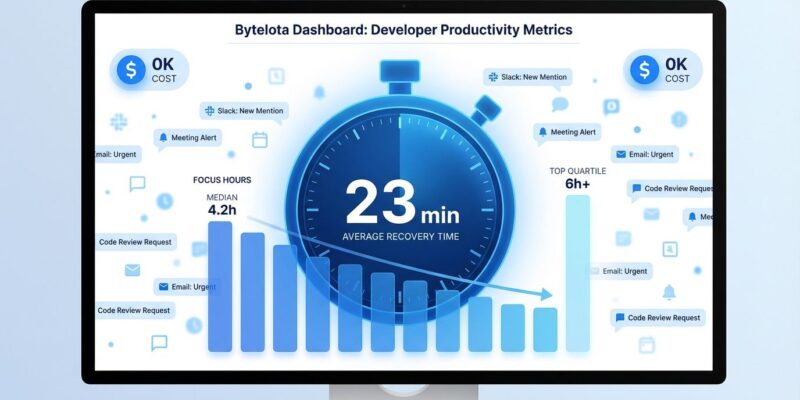
Your engineering team is bleeding $50,000 per developer every year—23 minutes at a time. Every “quick question” from Slack, every unscheduled standup, every notification ping destroys nearly half an hour of productive work. According to Dr. Gloria Mark’s research at UC Irvine, it takes 23 minutes and 15 seconds to regain deep focus after a single interruption. With developers averaging 31.6 interruptions per day, the math is brutal: you’re losing entire workdays to context switching. It’s not just an annoyance—it’s a $178 billion industry-wide productivity drain that’s accelerating in 2026.
The Data Is Undeniable
LinearB’s 2026 benchmarks tell the story in numbers that should alarm every engineering leader. Analyzing 8.1 million pull requests across 4,800 teams in 42 countries, they found median engineering teams achieve just 4.2 focus hours per day—barely half of an 8-hour workday. Top-quartile teams? They protect 6+ hours. That 40% gap between average and elite isn’t talent or tooling—it’s systematic focus time protection.
Here’s what makes the data impossible to dismiss: 90% of developers who get 2+ hour uninterrupted blocks report both higher productivity AND better code quality. The correlation isn’t subtle. Interrupted tasks take twice as long and contain twice as many errors. Yet 68% of knowledge workers say they struggle to get enough uninterrupted time, and 60% of work hours vanish into low-value reactive tasks. Most organizations don’t even track focus time as a metric, despite its measurable impact on delivery velocity and system stability.
Why Developers Get Hit Harder
The 23-minute recovery time is just the baseline for general knowledge work. For developers juggling complex code abstractions, the cost of context switching extends to 30-60 minutes of what researchers call “attention residue”—leftover thoughts from the previous task competing for mental bandwidth. Sophie Leroy, who coined the term, found that cognitive function declines when the mind remains fixated on previous tasks, making it harder to achieve new work even after switching away.
Think about what happens when you’re deep in a complex refactoring: you’re holding multiple abstractions, edge cases, and dependencies in working memory. One interruption collapses that entire mental structure. You don’t resume where you left off—you rebuild from scratch. A University of California study tracking actual developer workdays found 47 interruptions per day yielding just 2.3 productive hours out of 8. Developers in that study reported higher stress, frustration, and time pressure, all accelerating burnout.
The science backs this up: entering flow state requires 15-20 minutes of warm-up, and reaching full flow takes 52-90 minutes for complex problem-solving. Standard advice like the Pomodoro Technique’s 25-minute intervals barely allows developers to get into flow before interrupting them again. Meanwhile, our collective attention span on screens has collapsed from 2.5 minutes in 2004 to 47 seconds today—a cognitive environment hostile to deep work.
The $50,000 Hidden Tax
StackOverflow pegs average developer time at $83 per hour. Context switching burns 1-2 hours daily—that’s roughly $250 per developer per day, or over $50,000 annually per developer. For a team of 10, you’re hemorrhaging $650,000 per year before accounting for cascade effects.
Those cascade effects multiply the damage. Fragmented work introduces 25% more bugs, adds 40% rework time fixing context-switching-induced errors, requires 30% more clarification due to scattered communication, and cuts creative problem-solving by 60% during interrupted sessions. Gallup’s research puts the U.S. economy-wide cost of lost productivity from task juggling at $450 billion annually. For the software industry specifically? We’re looking at a $178 billion drain.
Most budgets don’t have a line item for “productivity lost to Slack pings,” which is precisely why the problem persists. It’s death by a thousand cuts—invisible in any single moment, catastrophic in aggregate.
Why 2026 Is Making It Worse
Three trends are accelerating the focus time crisis. First, distributed teams: 78% of development organizations now operate across multiple time zones according to GitLab’s 2025 report. Instead of enabling async work, this creates more meetings to coordinate globally, spreading calendar fragmentation across all hours.
Second, AI tools have introduced new categories of interruptions. LinearB’s 2026 data shows AI-generated PRs wait 4.6 times longer for review, creating bottlenecks that generate more check-ins, more follow-ups, more context switches. Developers spend focus time reviewing AI outputs and fixing hallucinations rather than building.
Third, always-on culture has gone global. The “someone’s always online” mentality that used to plague Silicon Valley has spread worldwide. Traditional individual tactics like closing your door or wearing headphones don’t translate to remote work. The problem now requires systematic organizational solutions, not personal willpower.
What Actually Works
Top-quartile teams don’t talk about focus time—they protect it systematically. The most effective individual strategy isn’t the standard 25-minute Pomodoro (too short for complex work) but 90-minute deep work sessions aligned with natural cognitive rhythms. Cal Newport’s research suggests three 90-minute sessions per day is the maximum most developers can sustain. Quality over quantity.
At the team level, no-meeting blocks work better than asking individuals to guard their own calendars. Some organizations designate “Throughput Thursday” where engineers block calendars entirely and decline all meeting requests. Others adopt “no meetings before noon” policies, protecting mornings when focus peaks. The key insight: meetings aren’t just the hour they occupy—they fragment days into pieces too small for meaningful work.
Async-first communication tools show measurable results. Teams using Twist’s thread-based async messaging report 71% “calmer collaboration” compared to real-time chat. The difference isn’t the tool—it’s removing typing indicators, read receipts, and notification pressure that makes immediate response feel mandatory. Async creates space for deep work.
Organizations seeing ROI measure focus time as a KPI: tracking uninterrupted 2+ hour blocks, monitoring deep work ratio (meeting time versus focused work time), and correlating focus time with delivery velocity. They reward deep work outcomes, not responsiveness. The median team gets 4.2 hours of focus daily. The top quartile protects 6+. That gap is a measurable competitive advantage.
The Bottom Line
Context switching isn’t a minor irritation—it’s a $178 billion industry problem with a measurable $50,000 annual cost per developer. The 2026 data from LinearB’s 8.1 million PR analysis proves focus time directly correlates with both productivity and code quality. Top-performing teams systematically protect it through no-meeting blocks, async-first communication, and treating deep work sessions as non-negotiable commitments.
The gap between median (4.2 hours) and top-quartile (6+ hours) focus time represents the difference between struggling teams and elite performers. The fix isn’t individual willpower—it’s organizational design. Measure focus time. Protect it systematically. Reward outcomes, not responsiveness. The ROI is undeniable.