 By ByteBot
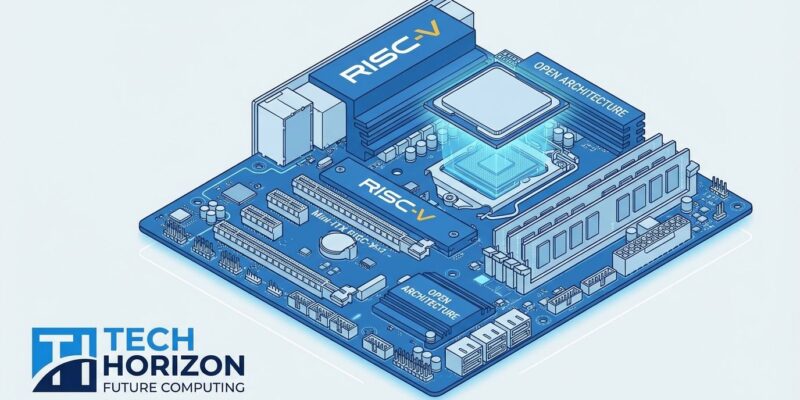
Milk-V’s Titan mini-ITX motherboard launched for pre-order this week at $329, marking the first consumer-ready RISC-V desktop board with full GPU support. The board, powered by an 8-core UltraRISC UR-DP1000 processor running at 2.0 GHz, supports up to 64GB DDR4 RAM and includes a PCIe 4.0 x16 slot for graphics cards—a first for RISC-V desktops. Pre-orders opened January 12 and ship within 45 days, with Ubuntu pre-installed. Use coupon code ARACE-TITAN to drop the price to $279.
RISC-V Hits 25% Market Share as Ecosystem Matures
The Titan’s arrival coincides with RISC-V capturing 25% of the global processor market in January 2026, signaling the architecture’s leap from experimental curiosity to mainstream contender. Previous RISC-V boards like the Milk-V Jupiter required DIY assembly and offered limited peripheral support. Titan ships with Ubuntu pre-installed and uses standard interfaces—M.2 NVMe storage, DDR4 memory, PCIe expansion—meaning developers can use existing GPUs, SSDs, and RAM without waiting for RISC-V-specific hardware.
The market agrees. RISC-V tech was valued at $1.35 billion in 2025 and is projected to hit $10.7 billion by 2031, a 41% annual growth rate. That’s not hype—companies like Qualcomm and Meta are betting real money on open-source silicon as an alternative to x86 and ARM licensing fees.
First RISC-V Board With Serious GPU Support
The Titan’s PCIe 4.0 x16 slot is the real story here. Every previous RISC-V desktop board either had weak integrated graphics or no GPU support at all. The Titan requires a dedicated graphics card for display output—there’s no integrated video. That’s not a bug, it’s the point.
The PCIe 4.0 x16 slot delivers 31.5 GB/s theoretical bandwidth, enough for high-end GPUs, AI accelerators, or network cards. Combined with 64GB DDR4 ECC RAM, M.2 NVMe storage (PCIe Gen4 x4), and a baseboard management controller for remote admin, this is the first RISC-V board spec’d like a real workstation, not a hobbyist toy.
Power efficiency is solid: 14W idle, 30W under full load. That’s competitive with ARM-based alternatives while delivering better performance.
Performance: Fastest RISC-V Desktop, But Context Matters
Titan’s UR-DP1000 chip benchmarks 30% faster in single-threaded workloads and 400% faster in multi-threaded tasks compared to SiFive’s P550 processor, according to Hacker News discussions analyzing MT clang compilation tests. At $329 ($279 with pre-order discount), it undercuts SiFive’s HiFive Premier P550 board by $71 while delivering better performance in a compatible Mini-ITX form factor.
But context matters. RISC-V still lags Intel, AMD, and Apple in instructions-per-cycle efficiency, cache optimization, and branch prediction. Performance parity with high-end ARM is expected by the end of 2026, but we’re not there yet. This isn’t a drop-in replacement for an x86 workstation.
Software Reality: Developer-Ready, Not Consumer-Ready
Let’s be clear: you won’t run Zoom, Netflix, or Windows on this board. Microsoft has no official RISC-V Windows build (predicted timeline: 2027-2029). Closed-source software like Adobe Creative Suite, AutoCAD, and AAA games aren’t ported to RISC-V. The GPU driver situation is rough—NVIDIA and AMD optimize for x86 and ARM, not RISC-V.
What does work? Most developer tools run fine. Linux distros (Ubuntu, Debian, Fedora) are fully supported. Open-source apps like Firefox and LibreOffice work. Compilers, editors, Git, Docker, and terminal tools mostly \”just work\” according to developer reports. The software gap is closing faster than expected, but it’s still a gap.
This is a development platform for exploring RISC-V, not a daily driver for mainstream computing.
Who Should Buy the Titan
The Titan targets developers exploring open-source hardware alternatives, systems programmers benchmarking alternative architectures, and academic researchers working on embedded systems. If you’re testing RISC-V cross-platform compatibility, porting software, or need a platform for open-source hardware experimentation, the $329 price point makes this accessible.
Skip it if you need Windows, mainstream apps, or production-ready stability. The ecosystem isn’t there yet. But if you’re comfortable with Linux, willing to deal with software gaps, and curious about RISC-V’s trajectory, Titan offers the best performance-to-price ratio in RISC-V desktops today.
Pre-orders ship within 45 days. By the time units arrive in March, we’ll have a clearer picture of whether RISC-V’s projected 2026 performance parity timeline holds up. Learn more at the official announcement.