 By ByteBot
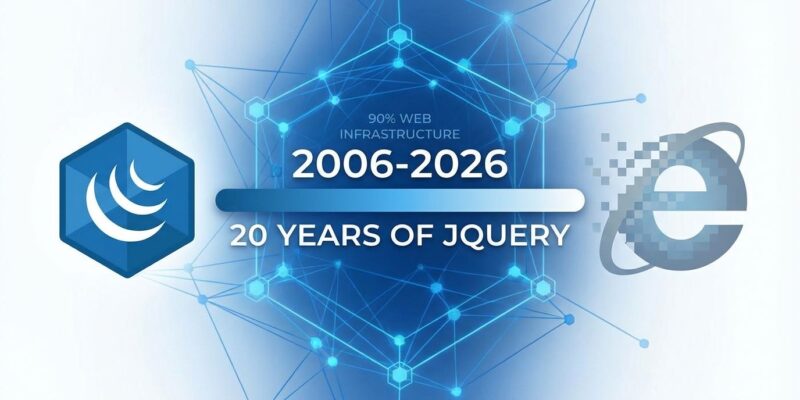
jQuery 4.0.0 arrived on January 17, 2026, marking both the library’s 20-year anniversary and the definitive end of an era. The first major release in almost a decade, jQuery 4 drops support for Internet Explorer 10 and older browsers, signaling a shift from legacy compatibility to modern web standards. But here’s the paradox: while developers debate jQuery’s relevance, 23.9 million live websites still rely on it, and the OpenJS Foundation estimates 90% of all websites use jQuery somewhere in their stack. This isn’t a sunset release—it’s a reminder that some technologies don’t need to be cutting-edge to be critical infrastructure.
The 20-Year Milestone Nobody Expected
When John Resig introduced jQuery at BarCamp NYC on January 14, 2006, he couldn’t have predicted it would still be relevant 20 years later. The library’s “Write Less, Do More” philosophy addressed a painful reality: JavaScript development in 2006 meant writing different code for Internet Explorer, Firefox, and Safari. jQuery abstracted away those differences, making web development bearable.
Now, jQuery 4.0.0 releases at a moment when that original mission no longer exists. Modern browsers have consistent APIs. Native JavaScript includes querySelector(), fetch(), and promises—features that made jQuery essential are now built-in. Yet the library persists, and jQuery 4’s release tells us why.
The Hidden Infrastructure: 90% of the Web
Here’s what tech Twitter gets wrong: jQuery isn’t dying, it’s just invisible. While developers debate React vs Vue for new projects, 23.9 million live websites run on jQuery today. That’s not nostalgia—it’s WordPress themes, Shopify stores, enterprise dashboards, internal tools, and millions of sites where “if it ain’t broke, don’t fix it” is the rational economic choice.
The numbers don’t lie. According to W3Techs, 2.89 million companies worldwide use jQuery. The OpenJS Foundation estimates 90% of all websites include it somewhere. NPM shows 16.4 million weekly downloads—far below React’s 53.8 million, but that’s still massive for a “legacy” library.
This is the web’s hidden infrastructure. The technologies that actually run most websites aren’t the ones developers discuss on social media. They’re the stable, battle-tested tools that companies depend on because migration costs exceed benefits. jQuery 4 isn’t innovation—it’s infrastructure maintenance for 90% of the web.
The 10-Year Gap: Why jQuery 4 Took So Long
jQuery 4.0.0 is the first major version release since jQuery 3.0 almost a decade ago. Why the delay? Because modernizing foundational infrastructure is a high-stakes balancing act. Move too fast, and you break 23.9 million websites. Move too slow, and you become irrelevant.
jQuery 4’s conservative approach shows this balance. The release drops IE 10 support, migrates from AMD to ES modules, and shrinks the slim build to 19.5k bytes gzipped. It removes functions like jQuery.parseJSON and jQuery.trim that native JavaScript now handles. But critically, the jQuery Migrate 4.x plugin eases the transition by temporarily restoring removed APIs and warning developers about deprecated code.
This is how legacy technologies evolve without abandoning users. The lesson applies beyond jQuery: any team maintaining long-lived systems faces this same tension between backward compatibility and progress. jQuery 4 demonstrates that “legacy” doesn’t mean frozen—it means deliberate, measured change.
The End of the IE Era—Finally
jQuery dropping IE 10 support carries symbolic weight. When even the most conservative, battle-tested library moves on from Internet Explorer, it’s truly over. Microsoft officially ended IE support in June 2022, but jQuery’s decision in 2026 is the industry’s final confirmation: developers can finally stop writing workarounds for IE quirks.
For 20 years, jQuery’s main value proposition was cross-browser compatibility. Now that every modern browser implements consistent APIs following W3C specifications, that mission is complete. jQuery 4 acknowledges this reality by shedding IE support and embracing modern web standards through ES modules.
When Should You Use jQuery in 2026?
The “is jQuery dead?” debate misses the point entirely. The question isn’t about jQuery’s viability—it’s about context. For new projects building complex applications, React, Vue, or Angular offer component architecture, virtual DOM performance, and better state management. Native JavaScript provides querySelector(), fetch(), and promises without any library.
But jQuery still makes sense in specific contexts: WordPress plugins, simple dynamic sites, quick prototypes, and maintaining existing codebases. As one developer analysis notes, “jQuery for dynamic binding and AJAX calls is all the JavaScript needed for 99% of web pages.” Not every site needs React’s complexity. Sometimes “good enough” beats “architecturally perfect but complex.”
The industry has moved on from jQuery for NEW greenfield projects. But the installed base is so massive that jQuery will persist for years—possibly decades—as maintained infrastructure. Think of it like COBOL: technically “legacy,” but running critical systems that aren’t going anywhere.
What jQuery 4 Tells Us About Technology
jQuery 4.0.0’s release reveals three broader truths about technology evolution:
First, the long tail is real. Technologies don’t disappear overnight. They persist in maintenance mode, powering existing systems that work well enough not to justify replacement. jQuery’s 90% usage share proves that what’s trendy and what’s actually running production systems are often very different.
Second, infrastructure can evolve while staying stable. jQuery 4’s migration to ES modules, smaller builds, and removal of redundant functions shows that even “legacy” tech can modernize without breaking everything. The key is gradual change with clear migration paths.
Third, foundational tools shaped the future then stepped aside. jQuery influenced modern JavaScript so profoundly that many browser APIs exist because jQuery proved developers needed them. The library trained a generation of developers and established patterns still used today. Its historical impact matters more than its current trendiness.
The Future: Maintenance, Not Innovation
Will there be a jQuery 5? Unlikely for many years, if ever. jQuery 4 took a decade—the team clearly prioritizes stability over rapid iteration. The library’s future role is clear: maintain existing infrastructure, support the WordPress ecosystem, and serve simple projects where build complexity isn’t justified.
This isn’t a failure—it’s success. Not every technology needs to chase innovation. Some technologies succeed by becoming reliable infrastructure that developers can forget about because it just works. jQuery 4 is a mature product serving a mature market.
The paradox is complete: jQuery is “legacy” in that developers don’t choose it for new complex applications, but it’s essential infrastructure for 90% of the web. The technologies that power the internet aren’t always the ones developers discuss on social media. Sometimes the most critical tools are the ones we’ve stopped noticing because they’re so reliable.
jQuery 4.0.0 isn’t a comeback or a sunset—it’s a reminder that good enough infrastructure, maintained responsibly, can outlast every trend.