
 By ByteBot
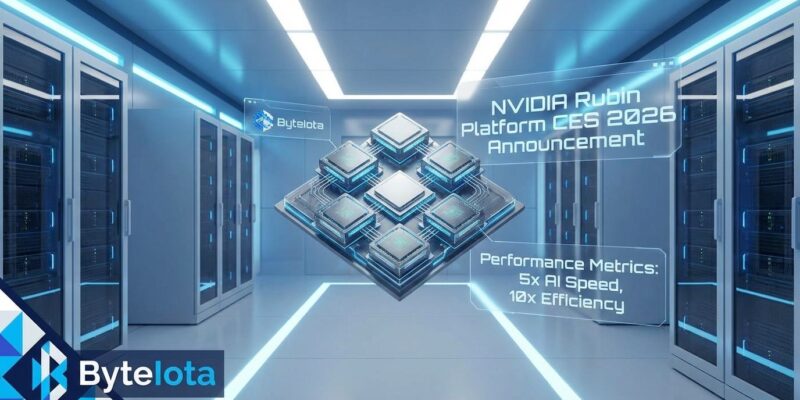
NVIDIA CEO Jensen Huang announced the Rubin platform at CES 2026 on January 5, declaring it’s already “in full production” just as Blackwell is finally ramping. The new platform delivers 5x inference performance and slashes AI token costs by 10x compared to Blackwell—which itself barely shipped before being eclipsed. All major AI labs including OpenAI, Anthropic, Meta, and xAI have committed to adopting Rubin when volume production begins in the second half of 2026.
This isn’t just faster silicon. It’s a fundamental shift in AI economics that makes previously uneconomical applications viable overnight. But it also exposes the unsustainable pace of AI hardware obsolescence: Blackwell had roughly a six-month lifespan before its successor was announced.
The Economics of 10x Cheaper AI Inference
Rubin’s cost reduction isn’t marketing spin—it’s a combination of 5x better inference performance (50 PFLOPS versus Blackwell’s 10 PFLOPS), architectural optimization, and third-generation Transformer Engine improvements. For companies currently spending $100,000 monthly on inference, Rubin cuts that to $10,000. More importantly, it changes what’s economically viable: long-context agents with million-token contexts, multimodal systems processing video in real-time, and production inference for billions of users all shift from “too expensive” to “feasible.”
Dario Amodei, Anthropic’s CEO, called Rubin “the kind of infrastructure progress that enables longer memory, better reasoning and more reliable outputs.” Mark Zuckerberg described it as “the step-change required to deploy the most advanced models to billions of people.” These aren’t empty endorsements—Anthropic and Meta are betting their next-generation models on this hardware.
The platform also reduces the GPU count needed for training mixture-of-experts models by 4x. That’s not just cost savings—it’s faster training cycles and reduced infrastructure complexity for AI labs racing to deploy smarter models.
Blackwell’s Six-Month Lifespan
Here’s the timeline that infrastructure teams need to absorb: Blackwell was announced in 2024, suffered overheating issues and connection glitches through 2025, started volume production in early 2026—and Rubin was unveiled January 5, 2026, before Blackwell hit full deployment. JP Morgan projects 5.2 million Blackwell units shipping in 2025, dropping sharply to 1.8 million in 2026 as Rubin replaces it. That’s a product lifecycle measured in months, not years.
Microsoft CEO Satya Nadella addressed this directly: “The biggest competitor for any new Nvidia AI chip is its predecessor.” Microsoft is now “spacing out purchases” to avoid being stuck with rapidly obsolete hardware. When your largest customer publicly admits hesitation about buying your current-generation product because the next-generation is coming too soon, you’ve crossed into unsustainable territory.
AI chips have a useful life of one to three years due to technological obsolescence and physical wear, yet companies depreciate them over five to six years for accounting purposes. This financial mismatch is creating valuation issues across the industry. Three-year-old H100 systems now resell at roughly 45% of new H100 prices—and that depreciation is accelerating.
Related: Cloud Repatriation 2026: 80% of Enterprises Leaving AWS
NVIDIA Rubin: Six Chips, One System
Rubin represents NVIDIA’s first “extreme co-designed” platform—six chips architected together as a unified system rather than optimized independently. The platform integrates the Vera CPU (88 ARM cores), Rubin GPU (336 billion transistors with 288GB HBM4 memory), NVLink 6 interconnect, ConnectX-9 networking, BlueField-4 DPU, and Spectrum-6 Ethernet switch. Traditional data centers optimize components separately; Rubin treats the entire rack as a single compute unit.
This matters particularly for agentic AI workloads that constantly shuffle data between model inference, tool calls, and context retrieval. Rubin’s coherent memory architecture allows CPUs and GPUs to share a unified address space, eliminating bottlenecks that plague previous generations. Each GPU delivers 22 TB/s HBM4 memory bandwidth—2.8x Blackwell’s 8 TB/s—and the NVL72 rack configuration provides 260 TB/s scale-up bandwidth across 72 GPUs.
Assembly time dropped by 18x compared to Blackwell thanks to cable-free, modular design. That might sound like a manufacturing detail, but faster assembly means faster time-to-deployment for customers desperate to get capacity online.
No Alternatives to NVIDIA
Every major AI lab announced Rubin adoption without exception: OpenAI, Anthropic, Meta, xAI, Cohere, Mistral AI, Perplexity, and Cursor. All major cloud providers—AWS, Google Cloud, Azure, and Oracle—are committing to H2 2026 availability. AMD’s MI300/MI400 chips exist on paper but lack the ecosystem. Google’s TPUs remain proprietary and cloud-only. Intel’s Gaudi 3 is a distant third.
NVIDIA’s moat isn’t the silicon—it’s the 20 years of CUDA investment: 4+ million developers, 3,000+ GPU-accelerated applications, and deep integration into every AI framework. Elon Musk called Rubin “a rocket engine for AI” and the “gold standard” for frontier models. When even NVIDIA’s critics can’t find viable alternatives, you’re looking at effective monopoly pricing power.
Expect the first 12 months of Rubin allocation to be fully committed to major AI labs and cloud providers. Enterprises won’t be placing on-premise orders until late 2026 or early 2027. That supply constraint creates another problem: teams can’t just “wait for Rubin” if they need capacity now.
What Developers Should Do About Rubin
If you’re planning AI infrastructure for 2026, the decision is brutal: deploy Blackwell now and accept obsolescence in six months, wait for Rubin and sacrifice H1 2026 opportunities, or stick with current hardware and miss both performance gains and cost reductions. Microsoft’s approach—spacing out purchases and avoiding overinvestment in single generations—is the only rational strategy when your vendor ships annual upgrades.
For most teams, the practical path is cloud access through AWS, Azure, or Google Cloud in H2 2026 rather than on-premise deployments. Reserve capacity now with providers. Plan infrastructure around 2-3 year useful lifespans instead of 5-year depreciation schedules. And mix old and new hardware generations based on workload types—inference benefits more from Rubin than training does.
Key Takeaways
- Rubin delivers 5x inference performance and 10x cost reduction versus Blackwell, fundamentally changing what’s economically viable for AI applications—long-context agents, multimodal systems, and production inference at scale all become feasible
- Blackwell had a six-month product lifespan before being replaced, exposing the unsustainability of annual hardware cycles—AI chips depreciate over 1-3 years but are accounted for over 5-6 years, creating financial mismatches
- All major AI labs (OpenAI, Anthropic, Meta, xAI) are adopting Rubin with zero viable alternatives—NVIDIA’s CUDA ecosystem (20 years, 4+ million developers) creates an inescapable moat competitors can’t match
- Volume production begins H2 2026, but first-year allocations are likely committed to major customers—enterprises should plan cloud access rather than on-premise deployments
- Microsoft’s strategy of “spacing out purchases” to avoid obsolescence is the only rational response to annual hardware cycles—infrastructure teams should plan for 2-3 year useful lifespans and mix hardware generations based on workload types













[…] Read the source […]