 By ByteBot
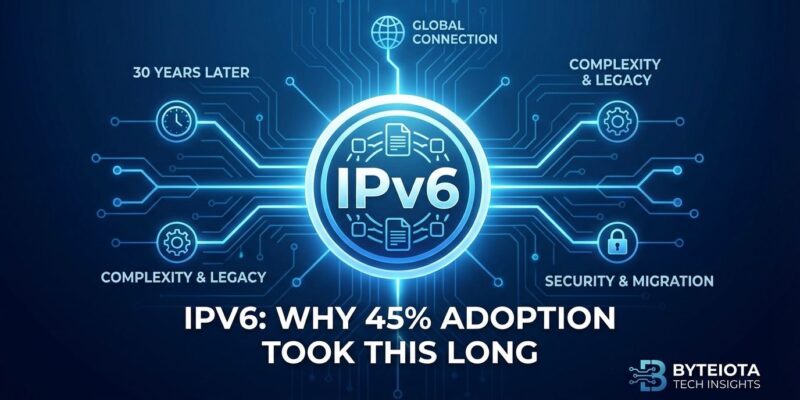
IPv6 celebrated its 30th birthday in December 2025—three decades after RFC 1883 defined the protocol meant to replace IPv4’s exhausted 4.3 billion address space. Yet global adoption remains stuck at 45-49%, and APNIC Labs projects universal deployment won’t happen until 2045. That’s 50 years from creation to completion, for a protocol designed to solve an urgent crisis.
This isn’t just a networking failure. It’s a masterclass in how “technically superior” doesn’t guarantee adoption when economics intervene. Network Address Translation (NAT) extended IPv4’s lifespan by letting thousands of devices share one address, eliminating the urgency IPv6 was supposed to solve. Developers, infrastructure teams, and cloud architects live with this reality daily: dual-stack complexity, regional disparities, and cloud providers now using pricing to force migration.
The “Temporary” Solution That Became Permanent
NAT became IPv6’s unexpected killer. By allowing thousands of devices to share a single public IPv4 address, it solved the address exhaustion problem IPv6 was designed to fix. The economic pressure that was supposed to drive adoption simply evaporated.
Geoff Huston, APNIC’s chief scientist, puts it bluntly: “Given the small amount of new functionality in v6, it’s not so surprising that deployment has been a 30-year struggle.” When the “crisis” gets solved by a cheaper workaround, the expensive infrastructure overhaul becomes optional. A secondary IPv4 market even emerged—Microsoft bought Nortel addresses for $7.5 million—proving organizations would rather buy legacy addresses than migrate to the future.
ISPs had no incentive to upgrade. Consumers didn’t care as long as their Netflix worked. NAT was “good enough,” and good enough is the enemy of better. The urgent became optional, and optional drags on for decades.
The Divided Internet: Mobile Won, Desktop Lost
IPv6 adoption reveals a stark divide. Mobile carriers deployed it successfully—T-Mobile reached 93% by 2018 and operates IPv6-only internally today. Verizon and AT&T route over 80% of traffic via IPv6. They could move fast because mobile networks were greenfield deployments with no legacy infrastructure debt.
Meanwhile, desktop enterprise networks remain stuck on IPv4. AWS, the cloud infrastructure giant, still has 59% of its endpoints IPv4-only in 2025. That includes critical services like Lambda execution environments, API Gateway, and ElastiCache. You can’t run an IPv6-only VPC for most workloads—dual-stack is mandatory.
Geographic splits are equally dramatic. France leads at 78% adoption, Germany at 75%, India at 74%. The United States? 50-53%. Regional leaders combined government mandates with ISP cooperation. Laggards have fragmented infrastructure and no policy pressure.
This split explains why every developer must support both protocols indefinitely. Mobile proved IPv6 works when you start from scratch. Desktop enterprise proved legacy infrastructure anchors you to the past.
Cloud Providers Finally Found What Works: Economics
After 30 years of failed technical arguments, cloud providers discovered what actually drives adoption: pricing. AWS, Google Cloud, and Azure now charge $0.005 per hour ($43.80 per year) for each public IPv4 address. IPv6 addresses? Free.
The math is brutal. An organization with 100 public IPs pays $4,380 annually for IPv4 versus nothing for IPv6. Suddenly, migration has ROI. AWS has responded with a serious uptick in IPv6 support announcements from 2020 to 2025—ECS got IPv6-only support in September 2025, Directory Service in October, EC2 Public DNS in May.
This is the economic pressure that technical superiority never provided. Cloud-native applications now have real incentive to migrate. After 30 years, money talks louder than architecture diagrams.
Design Flaws Made Transition Nearly Impossible
IPv6’s lack of backward compatibility with IPv4 was the “single critical failure,” according to Leslie Daigle, former Chief Internet Technology Officer at the Internet Society. No standardized IPv4 ↔ IPv6 communication meant every organization needed expensive dual-stack deployments running both protocols simultaneously.
Developers face the consequences daily. Every application must support both protocols. IPv6 code often gets poorly tested because developers assume it “just works.” The complexity compounds—more code, more testing, more failure points. Hacker News threads on IPv6 overflow with frustrated comments: “IPv4 will never go away.” They’re probably right.
The chicken-and-egg problem persists. ISPs won’t deploy IPv6 until IPv6-only servers are common. Servers won’t go IPv6-only until users have it. Infrastructure costs pile up—router and switch upgrades, training gaps (current sysadmins never learned IPv6 in school), dual network management. The “clean slate” design that was supposed to improve the internet made transition nearly impossible.
2045: 50 Years From Vision to Reality
APNIC Labs projects universal IPv6 adoption won’t happen until 2045. That’s 50 years after RFC 1883 was approved in December 1995. Current growth hovers at 2-3% annually—steady but glacial. Another 20 years of dual-stack internet await us.
John Curran, president of ARIN, reframes the narrative: “IPv6 wasn’t about turning IPv4 off, but about ensuring the internet could continue to grow without breaking. IPv4’s continued viability is largely because IPv6 absorbed that growth pressure elsewhere—particularly in mobile, broadband, and cloud environments.”
That’s the twist. IPv6 didn’t fail—it succeeded differently than intended. Mobile networks got their addresses. IoT devices got unique IPs. Cloud infrastructure scales without IPv4 constraints. Meanwhile, desktop enterprise chugs along on NAT and legacy infrastructure.
The “transition” might actually be permanent coexistence. Not replacement, but parallel protocols serving different needs. IPv6 is the future where it needs to be, and IPv4 persists everywhere else.