 By ByteBot
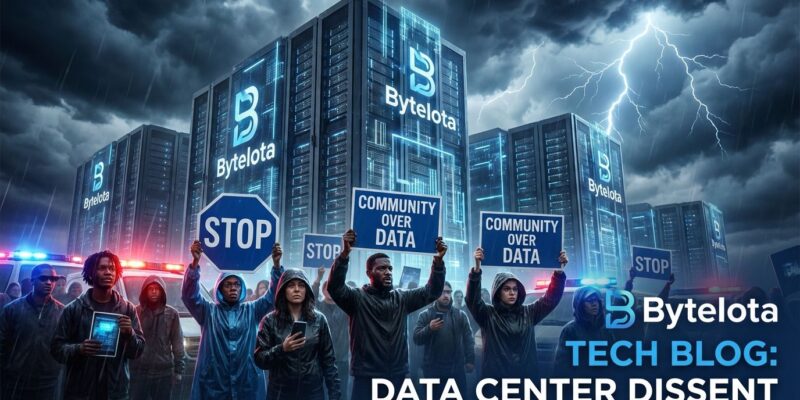
$64 billion in AI data center projects blocked or delayed. 142 activist groups organizing across 24 states. Three people arrested at a Wisconsin town hall. Microsoft abandoning a 244-acre site after community pushback. This isn’t just NIMBYism—it’s a grassroots rebellion against an AI infrastructure boom that’s consuming resources faster than it creates value. And the protestors might be the only rational actors in the room.
The Scale of Resistance
The numbers tell a story Big Tech didn’t see coming. According to Data Center Watch, $18 billion worth of data center projects have been outright blocked, with another $46 billion delayed over the past two years. That’s not a rounding error—it’s a systematic pattern of resistance that’s grown to include 142 different activist groups spanning half the country’s states.
TechCrunch calls 2025 “the year data centers went from backend to center stage”, and the shift has been dramatic. Construction spending on these facilities has skyrocketed 331% since 2021, but so has opposition. More than 230 environmental organizations—including Greenpeace, Friends of the Earth, and Food & Water Watch—have called for a national moratorium on new data center construction.
This isn’t partisan posturing. Republicans worry about grid strain and tax incentives. Democrats focus on environmental impact. Communities across the spectrum are asking the same question: Why should we bear the costs for infrastructure serving companies that can’t turn a profit?
Protests Turn Physical
In Detroit on December 3, protesters marched outside DTE Energy headquarters as the utility sought fast-track approval for a $7 billion, 1.4-gigawatt data center for Oracle and OpenAI. Over 800 people joined an online public hearing. Their concerns were blunt: rising electricity bills, threats to Michigan’s water resources, and what one resident called “a giant data center plopped in the middle of our farmland.”
Wisconsin saw escalation. Three people were arrested during a Port Washington council meeting about a 902-megawatt facility planned for OpenAI and Oracle’s Stargate project. Christine Le Jeune of Great Lakes Neighbors United was cited for disorderly conduct after exceeding the three-minute public comment limit. The arrests were part of coordinated protests across seven Wisconsin communities.
Danny Cendejas of MediaJustice captured the mood: “I don’t think this is going to stop anytime soon.”
The Economics Are Broken
Here’s why the protestors are right. Tech giants are spending nearly $400 billion in 2025 alone on AI infrastructure. Microsoft, Amazon, Meta, and Alphabet are collectively investing $405 billion this year—58% more than 2024. Morgan Stanley projects $2.9 trillion in spending from 2025 to 2028.
But profitability remains theoretical. HSBC estimates OpenAI won’t be profitable by 2030, facing a $207 billion funding shortfall even as its user base reaches 44% of the world’s adult population. The company lost $12 billion in Q3 2025 alone and expects $74 billion in operating losses in 2028.
Every single generative AI company is unprofitable. Worse, as these companies grow their customer base and usage, they lose more money. The economics don’t improve at scale—they deteriorate.
To justify current investments, AI companies need to generate $2 trillion in annual revenue by 2030. Current AI revenue sits at $20 billion. That’s a 100-fold gap. Meanwhile, communities are being asked to accept rising utility bills, water consumption equivalent to 18 million households, and traffic congestion for an industry that’s openly hemorrhaging cash.
When your business model requires forcing communities to subsidize infrastructure for companies losing billions per quarter, maybe the problem isn’t community resistance. Maybe it’s the business model.
Energy Demands Reality Check
BloombergNEF projects U.S. data center energy demand will hit 106 gigawatts by 2035—nearly triple today’s 40 gigawatts. That’s electricity for 30 million households. BloombergNEF revised this forecast upward by 36% just seven months after its previous projection, suggesting even the optimists are underestimating.
AI training and inference will account for 40% of total compute load. Nearly a quarter of new projects exceed 500 megawatts. The environmental coalition’s letter to Congress wasn’t hyperbolic: “Massive and unsustainable consumption by data centers of energy and water resources, and skyrocketing utility costs for families and small businesses.”
Grid operators are sounding alarms. Michigan has 16 different data center locations under consideration. Wisconsin ratepayers already owe $1 billion on shuttered power plants while new energy-hungry facilities loom. This isn’t theoretical future impact—it’s present-tense infrastructure crisis.
Microsoft’s Retreat Signals Shift
The most telling moment came in Caledonia, Wisconsin. Microsoft sought to rezone 244 acres of agricultural land for a data center. A 2,000-name petition circulated. At the village planning commission meeting, 40 of 49 speakers opposed the project, citing secrecy, environmental concerns, and grid instability.
Microsoft withdrew. The company’s statement acknowledged it dropped the site “based on the community feedback we heard.” Not that it couldn’t fight the opposition—that it chose not to.
This is the inflection point. For years, tech companies built where they wanted, offering tax incentives and job promises. Caledonia proves that era is ending. Communities now have leverage, precedent, and proof that resistance works. Microsoft is still looking for an alternative site, but the dynamic has shifted. Social license to operate is no longer optional.
What This Means for Developers
Cloud costs are going up. When $64 billion in projects get blocked or delayed, infrastructure constraints become price increases. Amazon, Microsoft, and Google can’t scale infinitely if communities won’t let them build.
Efficiency stops being a nice-to-have. When energy consumption triples and regulatory clampdown looms, proving ROI on compute spending becomes mandatory. “Move fast and scale” gives way to “build sustainable and justify costs.”
Developers will face sustainability scrutiny. If your application requires massive compute for marginal value, expect questions. The days of treating infrastructure as unlimited are ending, replaced by a world where physical constraints—grid capacity, water availability, community opposition—matter more than VC enthusiasm.
Edge computing and decentralized alternatives gain appeal. If centralized mega-data-centers face this level of resistance, architectures that distribute load look increasingly attractive.
The Protestors Are Right
The standard narrative frames this as NIMBYs blocking progress. But what progress? Google DeepMind CEO Demis Hassabis admits “some parts of AI are probably in a bubble.” Hugging Face CEO predicts “the LLM bubble might be bursting next year.” Gary Marcus is blunt: “LLMs are becoming a commodity… The costs are very high. Nobody except Nvidia is making all that much money.”
OpenAI’s $12 billion quarterly losses. The $207 billion shortfall. The 100-fold revenue gap. AI workplace adoption falling to 11%, declining sharply at large enterprises. CoreWeave shares down 45% since October. These aren’t success metrics—they’re bubble indicators.
The protestors aren’t blocking the future. They’re refusing to subsidize a speculative bet that looks increasingly like a bad one. They’re the canary in the coal mine, asking the question Wall Street is starting to whisper: What if we’re building cathedrals in the desert for technologies that won’t generate the returns to justify the resource consumption?
When Microsoft walks away from a site rather than fight, when 142 groups organize across 24 states, when $64 billion in projects face delays or cancellation—that’s not irrational resistance. That’s the physical world imposing reality checks that financial models ignored.
The AI infrastructure boom isn’t hitting regulatory hurdles. It’s hitting communities that did the math and realized they’re being asked to pay higher electricity bills and sacrifice water resources so companies can lose money faster. That’s not progress worth fighting for.