
 By ByteBot
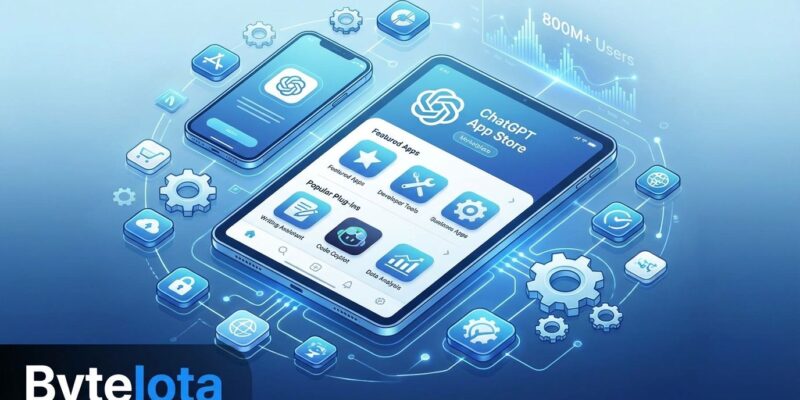
ChatGPT just became a platform. On December 17, OpenAI opened app submissions to third-party developers, launching an app directory that gives builders direct access to 800 million weekly users. If you’ve been waiting for the AI platform play, this is it.
The Platform Shift Everyone Saw Coming
This isn’t incremental. OpenAI is following the iOS App Store playbook: build a massive user base, then open the floodgates to developers. ChatGPT’s new app store lets developers submit apps for review and publication at chatgpt.com/apps. Sam Altman wasn’t subtle about the pitch: “Apps built with the Apps SDK can reach hundreds of millions of chat users.”
The timing matters. Neither Anthropic nor Google have launched app marketplaces. Claude remains API-first with enterprise integrations. Gemini lives inside Google Workspace. OpenAI is first to market with a consumer-facing AI app ecosystem, and first-mover advantage in platform plays is everything.
Apps SDK: Built on MCP, Not Vendor Lock-In
OpenAI released the Apps SDK in beta, built on the Model Context Protocol (MCP). For developers, this means you’re not building on a proprietary standard. MCP is backed by Anthropic, OpenAI, Google, Microsoft, and AWS. In December 2025, Anthropic donated MCP to the Agentic AI Foundation under the Linux Foundation.
The SDK lets developers design both logic and interface. You get an open-source UI library, example apps, documentation, and a quickstart guide. OpenAI is hosting a public “Build Hour” webinar on January 21, 2026, to walk developers through app building and submission.
Apps vs GPTs: The Critical Difference
Here’s where confusion happens. OpenAI already has a GPT Store (launched January 2024) for custom GPTs. So what’s different?
GPTs package behavior. They’re instruction-driven chatbot personas built with configurations and preset prompts. Good for structured workflows and narrow tasks.
Apps package capabilities. They connect to actual services and execute real-world transactions. DoorDash transforms recipes into shopping carts. Booking.com searches hotels and books reservations. Spotify manages playlists. Apps aren’t chatbots pretending to be integrations; they’re actual integrations.
The distinction matters. GPTs are constrained by ChatGPT’s capabilities. Apps extend them.
Launch Partners Show the Vision
OpenAI launched with Spotify, Apple Music, DoorDash, Booking.com, Dropbox, Google Drive, Canva, and Figma. These aren’t tech demos. They’re real services millions of people already use.
The app directory organizes apps into Featured, Lifestyle, and Productivity categories. Early movers like Spotify and DoorDash are securing prime real estate in a marketplace that will inevitably get crowded. If you’re a developer, that’s your signal.
The Developer Opportunity (And the Catch)
Let’s be direct: 800 million weekly users is massive distribution. Building user acquisition is expensive and slow. OpenAI is offering instant access to a user base larger than most countries. The platform stickiness effect is real. Users who build a personal toolkit of 5-10 apps inside ChatGPT aren’t switching to Claude or Gemini.
But here’s the catch: OpenAI hasn’t announced a monetization model. Revenue sharing? Transaction fees? Subscription splits? None of it is public. Right now, developers can only monetize by linking out from ChatGPT to their native apps or websites. OpenAI says it’s “exploring internal monetization options,” which is startup-speak for “we’ll figure it out later.”
For context, the GPT Store discussed revenue sharing for builders, but nothing materialized. Developers building on ChatGPT apps are betting on future monetization. That’s not necessarily a bad bet, but it’s a bet.
What Happens Next
App submissions are open now through the OpenAI Developer Platform. The first wave of approved apps will roll out gradually in 2026. OpenAI is tracking approval status, but the review process remains opaque. Quality control at scale is unproven.
The January 21 Build Hour will likely clarify some of these unknowns. Until then, developers are building in the dark on monetization, but in the light on distribution. For many, that tradeoff makes sense.
The Bigger Picture
OpenAI is pushing ChatGPT from product to platform. This is the same trajectory Apple took with iOS, Google took with Chrome, and Slack took with its app directory. Platform economics are different from product economics. Ecosystems create lock-in. Lock-in creates pricing power. Pricing power creates the revenue OpenAI needs to justify its $157 billion valuation.
The app store is strategic, not tactical. It’s OpenAI’s moat. If ChatGPT becomes the interface layer for hundreds of third-party services, switching costs skyrocket. That’s the endgame.
For developers, the window is open. First-movers get directory prominence, early user feedback, and brand association with ChatGPT’s ecosystem. The monetization risk is real, but the distribution opportunity is rarer.







[…] The Wall Street Journal CNBC Salesforce byteiota […]