 By ByteBot
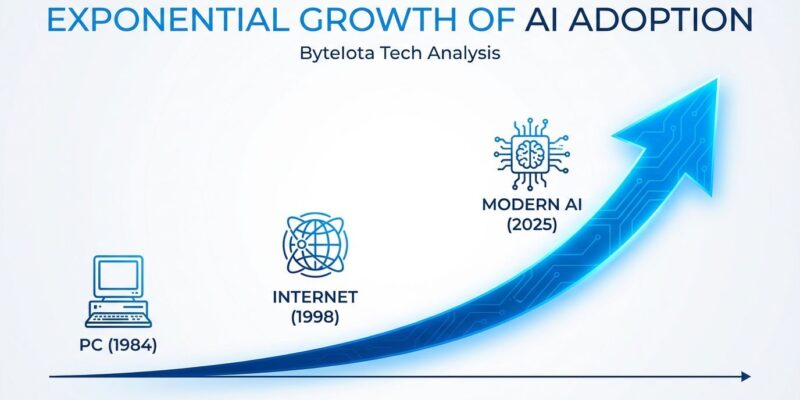
Generative AI reached 54.6% adoption in 2025—roughly three years after ChatGPT’s launch—achieving what took the PC (19.7% in 1984) and internet (30.1% in 1998) far longer at comparable stages. That’s 2.77x faster than the PC era and 1.81x faster than the internet boom. With 378 million global users expected by year-end and 64.4 million added in 2025 alone, AI isn’t just another tech wave. It’s the fastest technology adoption ever recorded.
The data comes from the St. Louis Fed’s 2025 generative AI adoption report, which compared current AI uptake to historical benchmarks. The comparison isn’t close. AI adoption is accelerating faster than every previous transformative technology, including smartphones (20 years to saturation), tablets (5 years to 50%), and social media (6 years from 5% to 72%).
How the Numbers Stack Up
Three years after the IBM PC launched in 1981, household adoption sat at 19.7% in 1984. The internet fared better but still lagged—32.7% of Americans were online in December 1998, years after early consumer internet access became available. Compare that to AI’s 54.6% penetration in roughly the same timeframe, and the acceleration becomes clear.
This isn’t a plateau. The 64.4 million users added in 2025 mark the largest single-year increase ever recorded, according to Statista Market Insights via AltIndex. Moreover, AI adoption jumped 10 percentage points in just 12 months. The growth trajectory tells the story: 116 million users five years ago, 154 million by end of 2021, and 378 million projected for 2025. By 2030, that number could hit 730 million.
The USA leads regional growth, accounting for nearly one-third of new users—21 million of the 64 million added globally in 2025. At this pace, 133 million Americans will be using AI tools by year-end.
Industry Transformation in Real-Time
Adoption rates vary dramatically by sector, but the trend is universal: AI isn’t optional anymore. Healthcare leads the charge, deploying AI at 2.2x the rate of the broader economy. According to Menlo Ventures’ 2025 healthcare AI report, 86% of healthcare organizations are leveraging AI, with 63% of professionals actively using it in their daily work. The sector’s 36.8% compound annual growth rate makes it the fastest-growing AI adopter.
Manufacturing isn’t far behind. Furthermore, 77% of manufacturers now use AI solutions, up from 70% in 2024—a 7% year-over-year increase. That’s a 32.06% projected CAGR, indicating sustained momentum beyond early experimentation.
Developers tell a similar story, with different dynamics. The Stack Overflow 2025 Developer Survey found 84% of developers are using or planning to use AI tools, with 51% using them daily. Meanwhile, JetBrains’ 2025 ecosystem survey confirms the trend: 85% of developers regularly use AI for coding, and 62% rely on at least one AI assistant or code editor.
Why GenAI Adoption Differs From Past Technologies
The speed differential isn’t accidental. AI adoption faced none of the friction that slowed PCs and the internet.
In the 1980s, adopting a PC meant spending thousands on hardware, learning DOS commands, and figuring out what to do with it. Similarly, the internet required owning a PC, buying a modem, signing up for an ISP, and understanding browsers, URLs, and email. Both demanded infrastructure buildouts—cable lines, electricity grids, phone networks—that took decades to complete.
AI requires a web browser. That’s it. Free access to tools like ChatGPT, Claude, and Gemini eliminated hardware costs and technical barriers. As Harvard’s analysis notes, AI is “built on top of those previous technologies,” leveraging existing PC and internet infrastructure. No new buildout needed.
The adoption pattern flipped too. However, PCs and the internet diffused top-down, from government and corporate labs to consumers. AI went bottom-up. Consumers led adoption, experimenting freely without corporate approval. The low friction and immediate utility—natural language interfaces delivering instant results—made onboarding trivial compared to previous tech waves.
High Adoption, Low Trust
Here’s the complexity: widespread adoption doesn’t equal satisfaction. The same Stack Overflow survey showing 84% developer adoption also revealed declining sentiment. Positive feelings toward AI tools dropped from 70%+ in 2023-2024 to just 60% in 2025. The biggest frustration, cited by 66% of developers, is dealing with “AI solutions that are almost right, but not quite.”
That gap—between usage and trust—matters. Specifically, 52% of developers don’t use AI agents or stick to simpler tools. Professionals show higher favorable sentiment (61%) than those learning to code (53%), but even the optimistic group is skeptical. The “almost right” problem is real, and it’s not going away fast.
This isn’t a contradiction. It’s pragmatism. Developers use AI because it’s faster, even when it’s flawed. The productivity gains outweigh the frustrations—for now. But declining sentiment suggests the honeymoon phase is ending. If AI tools don’t close the accuracy gap, adoption rates could stabilize or reverse.
What This Means for Tech Professionals
The fastest technology adoption in history changes career planning. AI isn’t a niche skill anymore—it’s baseline infrastructure. Healthcare professionals, manufacturers, and developers are already treating AI tools as essential, not experimental. The 2030 projection of 730 million users means more than half of all tech workers globally will rely on AI daily.
Nevertheless, the declining sentiment data is a warning. AI adoption is high because the barrier to entry is low and the immediate utility is undeniable. That doesn’t mean the technology is mature or reliable. The “almost right” gap creates real risks: buggy code, inaccurate analysis, overconfidence in flawed outputs.
The smart approach is pragmatic adoption—use AI where it excels (research, boilerplate, iteration speed) while maintaining healthy skepticism. Verify outputs. Understand limitations. Don’t outsource critical thinking to tools that are statistically probable, not logically sound.
AI reached 54.6% adoption faster than any technology before it. The data is clear. What’s less clear is whether that speed reflects genuine productivity gains or just low friction to experiment. The next few years will tell us which one it is.