 By ByteBot
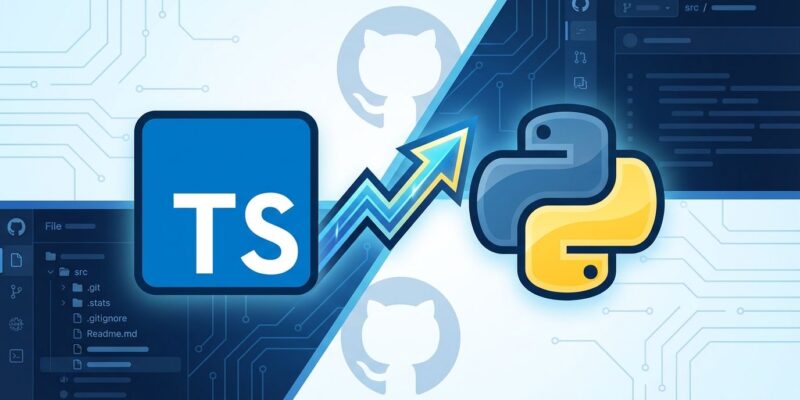
In August 2025, TypeScript achieved what no language had done in over a decade: it overtook Python to become the most-used language on GitHub. With 2.6 million monthly contributors and 66% year-over-year growth, TypeScript’s rise marks the most significant language shift in recent history. Before we declare Python dead, though, the numbers tell a more complicated story.
The Numbers Behind TypeScript’s Surge
TypeScript now commands 2,636,006 monthly contributors on GitHub, adding over 1 million developers in a single year—a staggering 66.6% growth rate. Python, meanwhile, gained 850,000 contributors at a 48.78% clip, landing at approximately 2.59 million. TypeScript leads by roughly 42,000 contributors.
Here’s where it gets interesting: while TypeScript dominates GitHub, Python sits at 23.64% in the December 2025 TIOBE Index—miles ahead of all competitors. TypeScript doesn’t even crack the top 10. GitHub measures open-source contributions; TIOBE captures broader industry adoption through search queries and educational content. These metrics tell fundamentally different stories about the same languages.
Why TypeScript is Winning on GitHub
Three forces converged to push TypeScript past Python. First, AI coding assistants changed the game. A 2025 study found that 94% of errors generated by large language models are type-related. TypeScript’s static type system catches these bugs at compile time, making tools like GitHub Copilot and Tabnine far more reliable when generating TypeScript than dynamic languages. Type inference also enables superior autocomplete and code generation.
Second, framework consolidation matters more than language preference. Next.js 15, Astro 3, SvelteKit 2, Angular 18, and Remix all generate TypeScript codebases by default. Developers aren’t choosing TypeScript—they’re choosing frameworks that made the choice for them. Once a project starts in TypeScript, inertia keeps it there.
Third, enterprises no longer view type safety as optional. Large codebases demand typed languages for reliable refactoring, code reviews, and team collaboration. Companies like Microsoft, Google, Airbnb, and Slack have standardized on TypeScript for production web development. Type safety became table stakes.
Python Isn’t Losing—It’s Dominating Elsewhere
Python remains the undisputed king of AI, machine learning, and data science. The 2025 State of Python report shows 51% of developers working in data exploration and processing. Its ecosystem—pandas, NumPy, TensorFlow, PyTorch, scikit-learn—creates structural lock-in that TypeScript can’t touch. Industry leaders like Google, Microsoft, Tesla, and NVIDIA rely on Python for mission-critical AI applications.
Python also gained 7 percentage points in the Stack Overflow 2025 Developer Survey, demonstrating continued growth in active usage. Its simplicity remains unmatched for prototyping, scientific computing, and research. The TIOBE Index’s 23.64% rating reflects this reality: Python dominates programming outside GitHub’s web-focused developer population.
TypeScript leads GitHub because GitHub repositories skew heavily toward web development, APIs, and frontend frameworks—precisely where TypeScript excels. Python dominates in domains where GitHub activity underrepresents actual usage: data pipelines, research notebooks, automation scripts.
What This Means for Developers
The lesson isn’t “learn TypeScript instead of Python.” It’s “learn both, specialize strategically.” Polyglot development is the new standard. Use TypeScript for frontend, API layers, and full-stack web applications. Use Python for machine learning, data processing, and scientific computing. The bifurcation reflects domain specialization, not a winner-takes-all competition.
Type safety, however, is non-negotiable. AI-assisted development amplifies the value of type systems. Whether you work in TypeScript, Rust (72% developer approval and climbing), or Python with type hints, static types are becoming required for enterprise development. Languages without strong typing will struggle to compete with AI-enhanced tooling.
Framework defaults now shape language adoption more than language features. If you build with modern web frameworks, you’re using TypeScript—end of discussion. Career-wise, this means evaluating framework ecosystems, not just language syntax.
Ecosystem Bifurcation, Not Language War
TypeScript’s GitHub dominance doesn’t mean Python is losing. It signals a maturing ecosystem where different languages optimize for different domains. TypeScript owns web development; Python owns AI and data science. Both are growing. Both are essential.
The real trend driving TypeScript’s rise isn’t replacing Python—it’s the convergence of AI-assisted development, framework consolidation, and enterprise type-safety requirements. These forces are structural, not temporary. But so are Python’s advantages in AI/ML: ecosystem maturity, academic adoption, industry standardization.
Expect both languages to strengthen in their respective lanes. The GitHub metric shift is real, but it reflects specialization, not substitution. For developers, the takeaway is clear: don’t pick sides. Master both domains.