 By ByteBot
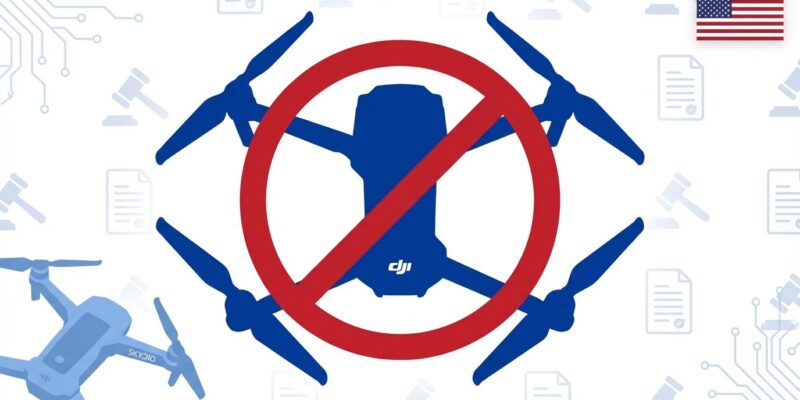
The Trump administration announced this week a ban on foreign-made drones, effectively blocking sales of new DJI models in the United States. DJI, the Chinese company commanding roughly 70% of the global consumer drone market, can no longer sell its industry-leading Mavic, Phantom, and Matrice series to American buyers. The policy cites national security concerns about Chinese-manufactured hardware potentially transmitting data to the Chinese government.
This ban disrupts thousands of developers, businesses, and first responders who built workflows around DJI’s best-in-class hardware. Unlike smartphones or laptops where alternatives abound, the drone market has no direct US-made equivalent matching DJI’s combination of capability and affordability.
Developers and Businesses Lose Best-in-Class Hardware
DJI drones power workflows across industries. Robotics developers test computer vision algorithms on DJI Mavic drones costing $1,000-$1,500. US alternatives like Skydio X2 run $10,000-$20,000 for equivalent enterprise features. That’s not a minor budget adjustment—it breaks project economics.
Infrastructure companies inspecting bridges and power lines rely on DJI thermal drones. Power utilities use them to detect failing insulators on high-voltage lines before catastrophic failures occur. Skydio alternatives cost $3-4K more and deliver inferior thermal imaging quality. Real estate photographers face aging DJI fleets with no affordable replacement path.
The hardware ban forces immediate economic decisions businesses can’t absorb. Developers mid-project with DJI equipment now face sunk costs and workflow redesign. This isn’t theoretical disruption—it hits budgets and timelines directly.
Security Concerns or Protectionism?
The ban cites security concerns about DJI transmitting telemetry and video data to Chinese servers, potentially accessible by the Chinese government. The technical reality proves more nuanced. DJI does collect flight data, but users can disable transmission. Security audits have found vulnerabilities, but competitors face similar issues. DJI even offers a “government edition” with data collection turned off entirely.
The US military banned DJI drones in 2017. DHS warned about security risks in 2019. Yet no public evidence shows DJI data being exploited or misused. Security researchers note that similar vulnerabilities exist in other IoT devices—routers, cameras, smart home equipment—not subject to blanket bans.
This raises the core question: Is this legitimate security policy or protectionism for US manufacturers facing superior Chinese competition? The answer matters. If security concerns are valid, developers shouldn’t use Chinese hardware. But if this is primarily economic policy, it sets a precedent for future restrictions on cameras, networking gear, and other hardware categories.
US Alternatives Can’t Match DJI Capabilities
The primary US alternative is Skydio, which excels at autonomous flight and obstacle avoidance but lags DJI in camera quality, battery life, and price. DJI Mavic 3 offers 46-minute flight time and a 4/3-inch camera sensor for $1,599. Skydio 2+ provides 27 minutes and a smaller sensor for $1,099.
The enterprise gap is worse. Skydio X2 costs $10,000-$20,000 versus DJI Matrice at $6,000-$10,000. Skydio wins on obstacle avoidance—its AI-based system with six cameras outperforms DJI. But developers aren’t just losing a brand. They’re losing technical capabilities: longer flight times for testing, better cameras for inspection work, and lower prices for budget-constrained projects.
Shorter battery life means fewer test flights per charge. Smaller sensors deliver lower image quality for inspection applications. Higher prices strain already tight budgets. The US alternative exists but comes with real trade-offs developers must absorb.
Part of Accelerating Tech Decoupling
The drone ban follows a pattern. TikTok faces forced sale or ban. Huawei was banned from US 5G networks in 2019-2020. Export controls on advanced chips to China accelerated from 2022-2025. Each restriction cites national security. Each pushes US and Chinese tech ecosystems further apart.
For developers, the question becomes: What’s next? Cameras? Networking equipment? Other IoT hardware? Building on Chinese hardware or software platforms now carries increasing policy risk. Diversifying dependencies shifts from technical best practice to risk management strategy.
Tech bifurcation is accelerating. Developers need to plan for a world where US and Chinese tech ecosystems operate separately, with limited crossover.
What This Means for Developers
- DJI sales blocked—existing devices’ future uncertain as firmware updates, app store access, and parts supply remain unclear
- US alternatives cost 2-3x more with capability gaps in battery life, camera quality, and price positioning
- Plan for tech bifurcation—diversify hardware dependencies to reduce policy risk exposure
- Security justification questionable—DJI offers government edition with data disabled, yet ban proceeds
- More restrictions ahead—this pattern suggests additional Chinese hardware categories face similar scrutiny