 By ByteBot
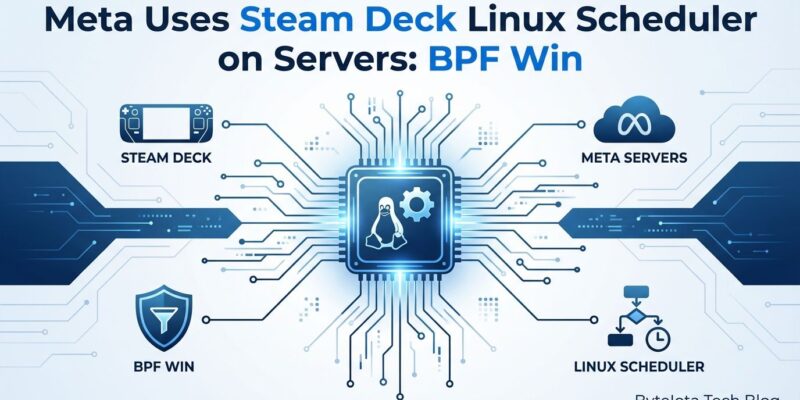
Meta deployed SCX LAVD—a Linux scheduler originally designed for Valve’s Steam Deck gaming handheld—on its production servers. The company disclosed this at the Linux Plumbers Conference in Tokyo last week, revealing that the gaming-optimized scheduler “adapts and works very well” on hyperscale infrastructure. A gaming device’s scheduler running billion-dollar data centers wasn’t on anyone’s 2025 bingo card.
This challenges the assumption that gaming and enterprise infrastructure require fundamentally different optimizations. Meta’s deployment validates that low-latency, responsiveness-focused schedulers designed for interactive gaming workloads can benefit large-scale server operations. More importantly, it signals that sched-ext—the extensible scheduler framework enabling this crossover—is production-ready.
BPF-Based Schedulers Enable the Crossover
sched-ext (Extensible Scheduler Class) is a Linux kernel feature available from kernel 6.12+ that lets developers implement custom CPU schedulers using BPF programs. Unlike traditional schedulers compiled into the kernel, sched-ext schedulers can be written in user space (C or Rust), loaded dynamically at runtime, and switched on the fly without rebooting. Meta and Google are both committed to sched-ext deployment in production.
The framework uses dispatch queues as its core abstraction: one global FIFO queue, one local queue per CPU, and custom queues manageable via BPF helpers. Safety mechanisms include watchdog timers and automatic fallback to the default scheduler if the BPF program fails. Here’s how simple a minimal scheduler can be:
struct sched_ext_ops example_ops = {
    .name = "example",
    .enqueue = example_enqueue,
    .dispatch = example_dispatch,
};
Only the .name field is mandatory—everything else is optional callbacks. This flexibility removed the barrier between innovative scheduler ideas and production deployment. Previously, testing a new algorithm required kernel recompilation and reboots. Now it’s as simple as loading a BPF program. Without sched-ext, Meta adopting a gaming scheduler for servers wouldn’t be practical.
Related: Kubernetes Overprovisioning Crisis: 99.94% Waste Resources
Low Latency Matters Everywhere
Gaming schedulers like SCX LAVD optimize for low latency and responsiveness—the same characteristics valuable for many server workloads. Interactive gaming requires fast reaction to user input. Web services, APIs, and latency-sensitive applications need minimizing response time. LAVD stands for “Latency-nice, Aiming for Virtualization Deployments,” explicitly targeting responsive task scheduling.
The scx_rustland scheduler demonstrates this principle: it shows “better FPS in terraria while kernel is being compiled.” That’s a gaming workload (foreground) performing well alongside heavy background processing—exactly what servers need when handling user requests during batch jobs or maintenance tasks. Meta discovered LAVD’s latency-focused design translates directly to hyperscale infrastructure needs.
This reveals that the traditional separation between “gaming optimizations” and “enterprise optimizations” is less rigid than assumed. Companies spend millions optimizing infrastructure performance. Meta finding value in a gaming scheduler proves innovation comes from unexpected places. Low latency matters everywhere—from handheld game consoles to multi-billion-dollar data centers.
Production Validation from Hyperscalers
Meta and Google both publicly committed to sched-ext deployment, with Meta now running SCX LAVD in production. This dual backing from hyperscalers validates sched-ext as enterprise-ready despite being relatively new (merged upstream in kernel 6.12 late last year). Valve ships Steam Deck with sched-ext schedulers, completing a timeline where consumer gaming hardware drives data center innovation.
Community engagement reflects developer interest: the Meta deployment story hit 424 points with 205 comments on Hacker News. When hyperscale companies adopt new technology in production, it signals maturity. Meta and Google don’t experiment frivolously at scale—they need proven performance gains to justify operational complexity. Their backing means ongoing development, bug fixes, and ecosystem support.
For companies evaluating sched-ext, this production validation reduces adoption risk. The technology moved from experimental to proven in less than a year. That’s fast even by open-source standards.
The API Instability Trade-off
sched-ext APIs have no stability guarantees between kernel versions. The Linux kernel documentation explicitly states this affects callbacks, helper functions, and the entire scheduler interface. While this flexibility enables rapid innovation, custom schedulers may require updates when upgrading kernels. This is the explicit trade-off: customization and experimentation versus long-term API stability.
Teams need kernel expertise to maintain custom schedulers across kernel versions. For large tech companies like Meta and Google with dedicated kernel teams, this is acceptable overhead. For smaller companies without in-house kernel specialists, API instability could be a deal-breaker. You can pin kernel versions for stability, but that means missing security patches and performance improvements. Choose your compromise.
This caveat balances the enthusiasm around sched-ext’s capabilities. Flexibility isn’t free—it comes with ongoing maintenance costs most organizations don’t budget for.
Consumer Hardware Driving Enterprise Innovation
This deployment reverses the typical tech innovation flow. Usually enterprise technology trickles down to consumers—cloud computing became edge computing, data center architectures influenced personal devices. Here, gaming hardware (Steam Deck, 2021) drove scheduler innovation that Meta now uses for servers in 2025. Consumer hardware, particularly gaming, pushes performance boundaries that enterprises later adopt.
Gaming’s demands for low latency, high performance, and responsive user experience create optimization pressures that benefit other domains. As workloads become more latency-sensitive (real-time analytics, interactive services, streaming data), lessons from gaming become increasingly relevant to infrastructure. This crossover likely won’t be the last.
The pattern extends beyond schedulers. Gaming GPUs (Nvidia GeForce) evolved into AI training accelerators (A100, H100). Game engine optimizations influenced real-time rendering in professional applications. Now gaming schedulers run enterprise servers. The one-way street of enterprise-to-consumer innovation is becoming bidirectional.
Key Takeaways
- Meta validates sched-ext works at hyperscale by deploying SCX LAVD (Steam Deck’s gaming scheduler) on production servers—proves the technology is enterprise-ready
- Gaming optimizations (low latency, responsiveness) benefit server workloads more than conventional wisdom suggests—the separation between gaming and enterprise tech is less rigid than assumed
- sched-ext enables BPF-based custom schedulers with dynamic loading, removing the barrier between innovative algorithms and production deployment—but API instability requires ongoing maintenance
- Hyperscaler backing from Meta and Google signals sched-ext will receive continued development and ecosystem support—reduces adoption risk for other organizations
- Consumer hardware, particularly gaming, increasingly drives enterprise infrastructure innovation as latency-sensitive workloads demand cutting-edge performance optimizations