 By ByteBot
Alphabet just paid $4.75 billion for Intersect Power, and it’s not buying another AI model or chip maker—it’s buying gigawatts. The December 22, 2025 acquisition signals that the AI race bottleneck isn’t compute capacity or algorithms anymore. It’s electricity. Google needs 10.8 gigawatts of power by 2028, and the grid can’t deliver it fast enough, so they bought the energy company outright.
What Alphabet Actually Bought
Intersect Power isn’t a typical tech acquisition target. Founded in 2016, the company builds large-scale solar, wind, and battery storage projects co-located with data center operations. Alphabet’s $4.75 billion in cash plus debt assumption buys control of a 10.8 gigawatt power pipeline expected online by 2028—that’s 20 times the Hoover Dam’s output.
The assets include 2.2 gigawatts of operating solar capacity, 2.4 gigawatt-hours of battery storage, and $15 billion worth of infrastructure either operating or under construction. Google already owned a minority stake from an $800 million funding round it led with TPG Rise Climate in December 2024. Now it’s taking full ownership, minus Intersect’s existing Texas and California operating assets, which stay independent.
Intersect’s CEO Sheldon Kimber continues leading the company as a separate Alphabet brand. The deal closes in the first half of 2026, subject to standard regulatory approval.
Why Energy Is the Real Bottleneck
The numbers expose the problem. Global data center power consumption sits at 55 gigawatts today. Goldman Sachs projects that jumps to 134 gigawatts by 2030. In the US specifically, demand climbs from 35 gigawatts in 2024 to 78 gigawatts by 2035. Individual mega data centers now require 2 gigawatts each—Stargate’s planned facilities target 5 gigawatts per site.
Training workloads drive the heaviest consumption. RAND estimates single training locations could demand 1 gigawatt by 2028 and 8 gigawatts by 2030 if current scaling trends hold. The grid infrastructure can’t absorb that growth. Connecting a new data center to the power grid takes 5 to 7 years in some regions—transmission upgrades, substation expansions, environmental reviews, permitting. Meanwhile, physically constructing a data center takes 1 to 2 years.
That timing gap is the strategic problem. You can build the data center, but you can’t turn it on without power. Seventy-two percent of surveyed data center operators cite power availability as “extremely challenging.” Northern Virginia, Silicon Valley, and Singapore face acute constraints. Virginia’s data center power demand jumped from 9.3 gigawatts in 2024 to 12.1 gigawatts in 2025. Singapore has less than 4 megawatts of available capacity left.
Intersect’s Power-First Advantage
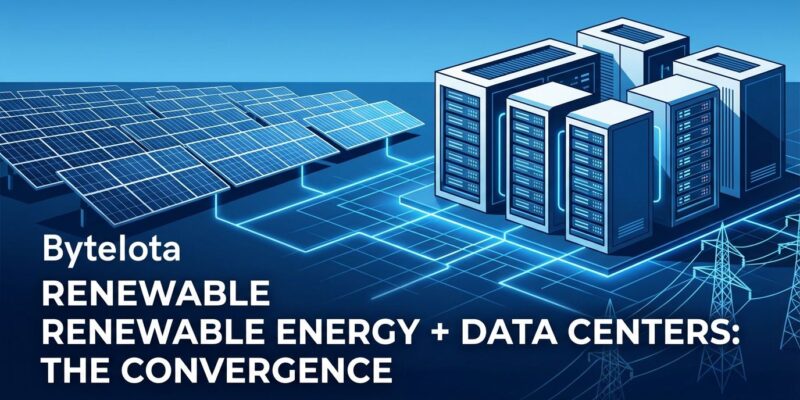
Intersect’s business model solves the timing problem by flipping the sequence. Instead of picking a data center location and then waiting years for grid connection, Intersect builds renewable energy generation first—solar farms and battery storage. Then it co-locates the data center campus right alongside the power infrastructure. The data center comes online with its own dedicated clean energy from day one, bypassing the grid interconnection queue entirely.
The first project under the Google partnership is in Haskell County, Texas: 840 megawatts of solar photovoltaic capacity plus 1.3 gigawatt-hours of battery storage. It goes operational in 2026, fully complete by 2027. That’s a 3 to 5 year time-to-market advantage compared to the traditional approach.
Everyone’s Chasing Power Now
Alphabet isn’t alone in recognizing energy as the limiting factor. Microsoft signed an agreement to restart Three Mile Island’s Unit 1 nuclear reactor, targeting 2028 for commercial operation. Microsoft’s committing $80 billion to AI infrastructure in fiscal 2025, with over half earmarked for the US. Amazon inked a long-term deal with Talen Energy to draw nearly 2 gigawatts from Pennsylvania’s Susquehanna nuclear plant through 2042. Meta raised its 2025 capital expenditure guidance to $64-72 billion, partnering with solar developers for its South Carolina data center and hunting nuclear options.
Combined, Alphabet, Microsoft, Amazon, and Meta invested approximately $200 billion in 2024. Analysts expect a 40% increase in 2025, with significant portions directed to energy infrastructure.
The key difference: Alphabet owns the energy company. Microsoft and Amazon have power purchase agreements—contractual commitments to buy electricity, but they don’t control the infrastructure. Alphabet’s vertical integration provides more flexibility, faster deployment timelines, and direct control over capacity expansion.
What This Means for Developers
Cloud service availability now correlates directly with regional power infrastructure. Data center capacity in Northern Virginia, Silicon Valley, and other power-constrained hubs faces hard limits. Developers can expect cloud providers to prioritize power-abundant regions—Texas, the Midwest, the Southeast—for new capacity. Existing constrained regions may see service limits on high-compute offerings, longer wait times for GPU instances, or premium pricing.
Workload placement strategies need to factor in power availability. If your preferred cloud region hits power capacity limits, multi-region architectures become more critical. Pricing disparities could emerge between energy-abundant and energy-scarce zones as providers pass through power costs.
The Bigger Shift
This acquisition marks a phase change in the AI industry. Competitive advantage is migrating from algorithms and chip architecture down to physical infrastructure—specifically, energy infrastructure. AI companies are becoming energy companies because gigawatts now matter more than GPUs. The grid requires $720 billion in investment through 2030 just to meet projected demand, and hyperscalers aren’t waiting for utilities to catch up.
Expect more acquisitions. AWS and Azure face the same power constraints. Whether they pursue similar vertical integration through acquisitions or stick with power purchase agreements determines their competitive positioning over the next 5 years. Smaller cloud providers without energy infrastructure access face a structural disadvantage. The AI race is now an energy race, and Alphabet just secured a 10.8 gigawatt head start.