 By ByteBot
Larian Studios CEO Swen Vincke thought transparency would help. He explained exactly how his team uses AI: early ideation only, rough outlines replaced with original art, nothing in final games. He pointed to hiring 15 more concept artists in April 2025. The response was immediate backlash. Fans called it betrayal. A former Baldur’s Gate 3 artist publicly urged the company to reconsider. The evidence didn’t matter.
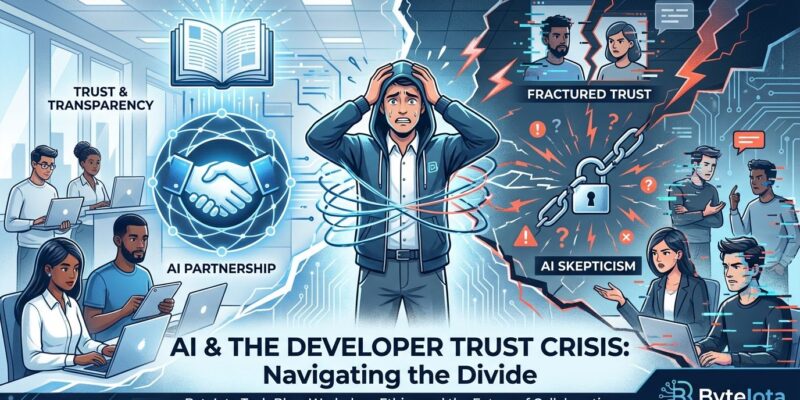
This December 2025 controversy isn’t about whether AI belongs in game development. It reveals something more fundamental: nobody trusts each other’s AI boundaries anymore. And that trust crisis is spreading from gaming straight into software development.
When Evidence Stops Mattering
Look at what Larian actually did. The studio employs 72 artists, including 23 concept artists. In April 2025, when they needed more capacity, they hired 15 additional concept artists. They have open positions for Lead Concept Artist and Senior Character Concept Artist roles right now. This is not a company replacing artists with AI.
Vincke explained the AI use clearly: “We use AI tools to explore references, just like we use Google and art books. At the very early ideation stages we use it as a rough outline for composition which we replace with original concept art.” He promised nothing AI-generated would appear in the upcoming Divinity game.
None of it worked. The gaming community reaction was swift and harsh. The backlash reveals a pattern: once trust collapses, no amount of data or explanation rebuilds it. The problem isn’t lack of information. It’s that people stopped believing the information they receive.
This Is a Power Problem, Not a Technology Problem
Game Developer magazine diagnosed the real issue: this is about leadership and power dynamics. Developers are “forced to watch as people who don’t have to use these tools for complex tasks decide their fate.” Leaders like Vincke make decisions about AI adoption. Workers implement those decisions. Fans discover them afterward.
The sequence matters. Vincke claimed workers were “more or less OK” with AI use. Bloomberg reported that developers inside Larian had pushed back. Former employees publicly corroborated that account. The gap between executive messaging and worker reality became visible.
Consider the environment. International employees relocate for Larian positions. The hiring process involves six-month timelines and twelve interviews. When management announces an AI policy after the decision is made, how much real dissent is possible? One former artist’s public statement—”show your employees some respect”—suggests the internal climate was less accepting than leadership portrayed.
Software development teams face identical dynamics. Companies mandate AI tools like Copilot. Engineers who resist for quality or ethical reasons face management pushback. When projects fail, teams hear they didn’t “embrace AI” enough. The tools make work slower, but the mandate stands. Layoffs follow anyway.
Why Transparency Backfires
Larian’s mistake wasn’t lack of transparency. It was assuming transparency solves a trust problem created by misaligned incentives.
Companies have financial incentive to expand AI use. Every task AI handles is a cost reduction opportunity. Artists and developers have job security incentive to resist AI expansion. Fans have quality incentive to reject what they call “AI slop.” These incentives point in opposite directions.
History reinforces the distrust. Companies claim “AI is just a tool” and then reduce headcount. “Temporary” AI use becomes permanent. “Early stages only” expands into production. Past promises broken make current promises suspect. When Larian says AI stays in ideation, people hear the beginning of a predictable arc toward broader adoption.
The data backs the sentiment. Stack Overflow’s 2025 Developer Survey found only 33% of developers trust AI tool accuracy, while 46% actively distrust it. Positive sentiment toward AI dropped from 70% in 2023-2024 to 60% in 2025. Transparency emerged as the top ethical concern, cited by 32.1% of companies—double the 15.9% from 2024.
Transparency without structural change can’t fix misaligned incentives. Vincke provided hiring numbers and usage details. The community assumed he was lying or would change course later. That’s what misaligned incentives predict.
The Industry Pattern: Use It Quietly
Game industry voices claim “every game company is now using AI.” Other studio heads contradict that, insisting many avoid generative AI entirely. The split reveals a strategic calculation. After watching Larian’s backlash, most companies will choose silence over transparency.
The pattern already exists. Steam requires AI disclosure since January 2024. By July 2025, only 7% of games disclosed AI use. Either 93% of games avoid AI entirely, or most developers decided disclosure carries more risk than benefit. The Alters shipped with visible AI prompts in June 2025 and faced immediate backlash. The lesson is clear: admitting AI use is riskier than using it quietly.
Survey data shows players want transparency. An ESA survey found 70% of players want to know how AI is used in games. An April 2025 Ipsos EU survey found 61% of players aged 18-35 prefer certified games over those that “hide AI use.” Yet when companies provide that transparency, they face accusations of betrayal. The contradiction is real: people demand openness and then punish companies that deliver it.
Software development follows the same pattern. Developers who admit using AI assistants face skepticism about code quality. Those who use the tools quietly face no backlash until discovered. The incentive structure pushes toward opacity, regardless of what people claim to want.
What Would Actually Work
Neither more transparency nor more hiring data solves this. The trust problem requires structural solutions, not better communication.
Auditable boundaries would help. Third-party verification of AI scope, not just company promises. Technical constraints built into systems that limit what AI can touch, provable through inspection. These are checkable claims, not verbal assurances.
Worker consultation before implementation, not announcement after decisions are made. Actual input with power to shape or block AI adoption, not performative listening sessions. Job security guarantees tied contractually to AI use levels. Binding commitments, not good intentions.
Nobody is doing this yet. Larian announced a post-holiday AMA where departments will answer questions. That’s reactive communication after backlash, not structural accountability before adoption. The gaming community will attend, ask pointed questions, and likely remain unconvinced. Without institutional changes, more words won’t rebuild trust.
Software companies need the same structures. Developer consultation before AI mandates. Job security tied to AI scope with contractual weight. Auditable limits on AI-generated code percentage. These changes shift power dynamics, which is what the trust crisis actually requires.
Both Sides Are Wrong
The anti-AI position ignores evidence. Larian hired more artists. The company is actively recruiting concept artists now. Calling it betrayal when the headcount data contradicts that narrative is unfair. The assumption that any AI use inevitably leads to job losses doesn’t match Larian’s actual behavior.
The pro-AI position ignores power dynamics. Vincke saying workers were “more or less OK” when former employees publicly contradicted that claim exposes the gap. Deciding AI policy without genuine consultation and then defending it with hiring statistics doesn’t address the real complaint. Workers want input before adoption, not justification after.
The real problem sits between these positions. Misaligned incentives plus power asymmetry plus history of broken promises creates a trust collapse that transparency can’t fix. Until the industry addresses those structural issues, every company that admits AI use will face the same backlash Larian did. And companies are learning the lesson: stay quiet, avoid disclosure, wait until competitors face the backlash first.
That’s not a functional equilibrium. It’s a race to opacity that serves nobody. Developers keep jobs but lose agency over technology decisions. Companies use AI but face discovery risk. Fans get the AI use they oppose, just without disclosure. Everyone ends up in a worse position.
The Trust Crisis Goes Beyond Gaming
Larian’s controversy matters because it’s not unique to game development. Software teams face the same dynamic. Management mandates AI assistants. Developers comply or face consequences. Individual productivity gains become justification for team size reductions. Trust erodes as the pattern repeats.
Forrester found only 15% of businesses saw profit margins improve from AI. BCG found only 5% saw widespread value. The gap between AI hype and actual ROI is measurable. Yet adoption continues, driven by competitive pressure and fear of falling behind. That pressure flows downward to workers who must adopt tools that may not work well and may threaten their jobs.
The trust crisis will define AI adoption success more than the technology itself. Better AI tools won’t matter if nobody trusts the people deploying them. Faster models won’t help if workers sabotage adoption out of self-preservation. More capability means nothing if the institutional framework breeds resentment and resistance.
Larian tried transparency. It didn’t work because transparency addresses information problems, not trust problems. The industry needs to try something harder: structural accountability that aligns incentives and gives workers actual power over technology that affects their jobs. Until that happens, every AI announcement will trigger the same backlash, and companies will learn to stay quiet instead.