 By
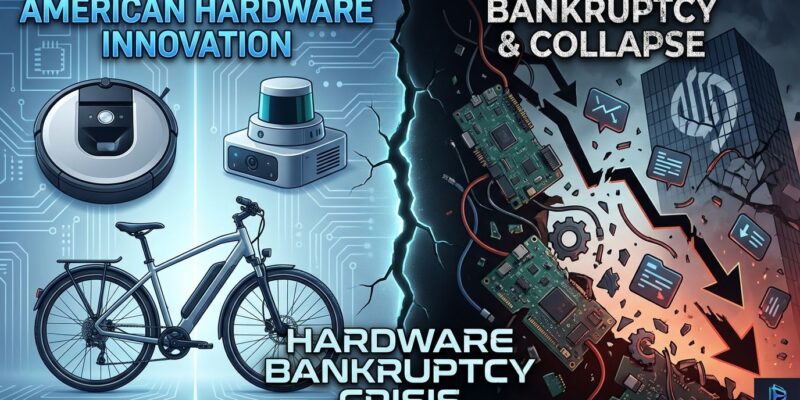
By Three major hardware companies — iRobot (Roomba vacuum maker), Luminar Technologies (automotive lidar sensors), and Rad Power Bikes (electric bicycles) — all filed for Chapter 11 bankruptcy within one brutal week in mid-December 2025 (Dec 14-17). This wasn’t coincidence. All three share the same fatal vulnerabilities: dependency on Chinese manufacturing, crushing tariff pressures (18-25% cost increases), failed major deals, and single-product business models that collapsed when geopolitical tensions mounted.
The outcomes tell the story: iRobot is being acquired by its Chinese manufacturer Shenzhen Picea Robotics, Luminar lost 90% of projected revenue when Volvo cut orders, and Rad Power owes $73M with sales down 51% in two years. Hardware’s “easy money” era is over.
iRobot: FTC Blocks Amazon, Chinese Manufacturer Wins
iRobot filed bankruptcy on December 14-15, 2025, and is being acquired by Shenzhen Picea Robotics — its Chinese manufacturer — after the FTC blocked a $1.7B Amazon acquisition deal in January 2024. Founder Colin Angle directly blames regulators for the outcome, telling TechCrunch “it felt so wrong” and accusing the FTC of “putting the consumer robot industry in a box, gift wrapping it, and handing it to someone else [China].”
The timeline exposes the damage: Amazon and iRobot signed the merger in August 2022, but after an 18-month FTC investigation, regulators blocked the deal in January 2024 over monopoly concerns. iRobot immediately cut 31% of its workforce (350 employees). Without the Amazon lifeline, the company couldn’t compete with low-cost Chinese manufacturers like Ecovacs and Roborock, which had already captured market share while iRobot was distracted fighting regulators. By December, the company was bankrupt.
Angle says regulators treated blocked deals “like trophies” on their office doors while ignoring market realities. The irony is brutal: the FTC blocked Amazon to prevent monopoly concerns, but the result was Chinese ownership instead of American. A 35-year-old company that sold 50 million robots ends up owned by Shenzhen Picea Robotics.
Luminar: 90% Contract Cut Collapses Business
Luminar Technologies filed bankruptcy on December 15, 2025, after its largest customer Volvo cut lidar sensor orders by 90% in October 2025. The company had bet everything on autonomous vehicles going mainstream by 2025-2026, with contract projections from Volvo alone growing from 39,500 sensors (2020) to 1.1 million sensors (2022). When Volvo made lidar optional instead of standard equipment and the autonomous vehicle timeline slipped, Luminar’s business model evaporated.
Volvo claimed Luminar “failed to meet its contractual obligations,” while Luminar countered that Volvo breached their 2020 agreement. Meanwhile, other customers abandoned ship: Polestar couldn’t integrate the sensors into their software, and Mercedes-Benz terminated their contract in November 2024. The bankruptcy filing listed $100M-$500M in assets against $500M-$1B in liabilities.
The insolvency analysis found Luminar “lost money on every lidar sold” because volumes never materialized. This is classic customer concentration risk: one customer represented the majority of projected revenue, and when they walked away, the company had no backup plan. Luminar is now selling its semiconductor division to Quantum Computing Inc. for $110M cash and liquidating the rest.
Rad Power: Tariff Trap Crushes E-Bike Maker
Rad Power Bikes filed bankruptcy on December 16-17, 2025, owing $72.8M against just $32.1M in assets. The Seattle e-bike maker’s largest debts tell the story: $8.4M to U.S. Customs for disputed tariffs and $8M+ to Chinese manufacturers. Revenue collapsed 51% in two years — from $130M (2023) to $104M (2024) to just $63M (2025 through mid-December).
Once valued at $1.65 billion in 2021, Rad Power exemplifies how tariff pressures and Chinese supply chain dependencies can destroy hardware startups. The company was locked into Chinese suppliers for cost competitiveness, but when tariffs hit (10-50% on Chinese electronics), they couldn’t absorb the cost increases or pass them to consumers without destroying demand. Geopolitical tensions turned their competitive advantage into a fatal vulnerability.
Additional pressures mounted: CPSC issued lithium-ion battery safety warnings, funding rounds failed, and shipping costs spiked. The company plans to sell within 45-60 days. Another American hardware brand heading for likely Chinese ownership or liquidation.
The Pattern: Hardware Startup Model Is Broken
These aren’t three isolated failures. All three companies share identical vulnerabilities that expose systemic problems in hardware startups: dependency on Chinese manufacturing for cost competitiveness, single-product businesses with no recurring revenue, major deals that failed (iRobot-Amazon blocked, Luminar-Volvo cut 90%, Rad Power funding collapsed), and tariff exposure (18-25% cost increases on Chinese electronics).
Industry analysts are blunt: “The era of venture capital freely funding hardware dreams may be closing.” Future hardware companies must be built for resilience, not hypergrowth. That means diversifying suppliers across minimum two countries (even if 20-30% more expensive), building recurring revenue streams (subscriptions, consumables, services) targeting 15-25% of total sales, and limiting customer concentration (no single customer >30% of bookings).
The fact that all three filed within four days (December 14-17) isn’t coincidence — it signals a systemic crisis. Hardware startups built on cheap Chinese manufacturing and one-time sales are fundamentally broken in the current environment. Only premium brands like Apple (which maintain massive margins despite Chinese manufacturing) or recurring revenue models like Peloton (monthly subscriptions cushion hardware losses) can survive when tariffs eliminate thin margins.
American Innovation, Chinese Ownership
The pattern is now clear: U.S. companies do R&D and branding, Chinese manufacturers take ownership when tariffs and geopolitical pressures mount. iRobot — 35 years old, 50 million robots sold — ends up owned by Shenzhen Picea Robotics. Luminar’s assets are being sold off. Rad Power is seeking buyers.
Colin Angle’s warning deserves attention: blocking mergers for reasons unrelated to legitimate antitrust concerns creates “risk factored into the willingness to invest, the valuation of deals, and the rate of new company formation.” If founders can’t exit via acquisition because regulators will block deals, will they start risky hardware ventures at all?
The unintended consequence of aggressive FTC enforcement and tariff policies may be dampening American entrepreneurship while strengthening Chinese competitors. These three bankruptcies aren’t just about corporate failures — they’re about whether American hardware innovation can survive in an environment of regulatory blocks and geopolitical trade wars. Right now, the answer looks grim.