 By ByteBot
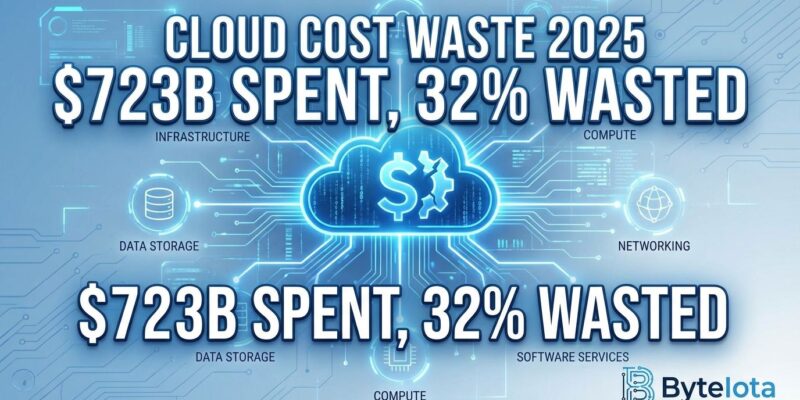
Global cloud spending will hit $723.4 billion in 2025—a 21.4% jump from 2024—yet organizations continue wasting 27-32% of their budgets according to Flexera’s 2025 State of the Cloud report. That’s up to $231 billion thrown away annually. The paradox: despite years of FinOps evangelism and cost optimization tools, waste has barely budged from 35% in 2023 to 32% in 2025. A mere 3 percentage points of improvement while spending exploded by hundreds of billions.
The $231 Billion Question: Why FinOps Isn’t Working
The numbers tell a brutal story. 84% of organizations identify managing cloud spend as their top challenge. Furthermore, 75% report waste is INCREASING, not decreasing. 42% of CIOs cite waste as their biggest cloud problem. Consequently, here’s the contradiction: IDC predicted 80% of organizations would adopt FinOps by 2023. Yet waste persists at near-identical levels.
The gap isn’t between FinOps adoption and reality. Instead, it’s between FinOps ADOPTION and FinOps MATURITY. Organizations have dashboards, tools, and FinOps titles on business cards. However, what they lack is FinOps culture—the cross-functional collaboration, distributed cost ownership, and organizational discipline that actually reduces waste. You can’t buy your way out of this problem with another vendor platform.
Moreover, the tools themselves create part of the problem. 59% of organizations use three or more cost management platforms, fragmenting visibility rather than unifying it. By the time teams see cost spikes in their dashboards, the money is already gone. In fact, 78% detect anomalies only after hours have passed. Retrospective reporting doesn’t prevent waste—it just documents the damage.
Paying for 100% Capacity, Using Only 15%
Here’s the efficiency scandal nobody wants to talk about: average CPU utilization in cloud environments sits at 15-20% according to IDC research. That’s not a technical limitation of cloud infrastructure. Rather, that’s organizational failure. You’re paying for 100% capacity and using one-fifth of it. The remaining 80-85% burns money while contributing zero business value.
The visibility crisis compounds the problem. 70% of organizations don’t know where their cloud budget actually goes. Additionally, over 20% admit they have little-to-no idea how business costs relate to cloud spending. You can’t optimize what you can’t see, and most teams can’t see anything beyond total monthly bills.
Related: Kubernetes Overprovisioning Crisis: 99.94% Waste Resources
The root causes are systemic: teams over-provision “to be safe,” nobody shuts down dev/test resources after hours, there’s no accountability for resource lifecycle management, and tagging policies exist on paper but not in practice. Consequently, idle instances accumulate, over-sized VMs run forever, and unattached storage volumes pile up. The waste isn’t mysterious—it’s the predictable result of zero governance.
FinOps Delivers 30% Savings—For the 20% Who Do It Right
FinOps isn’t failing. Instead, organizations are failing AT FinOps. The data proves it works: mature FinOps practices deliver 25-30% cost savings according to IDC. Furthermore, Deloitte reports 30-40% reductions. Companies investing in FinOps education see 50% higher engagement in cost-saving initiatives. The FinOps Foundation framework provides clear guidance: establish visibility (INFORM phase), optimize usage (OPTIMIZE phase), implement governance (OPERATE phase).
However, most organizations stop at visibility. They build dashboards, generate reports, hold quarterly cost reviews. Then nothing changes. Why? Because FinOps requires cultural transformation, not just technical implementation. Finance, engineering, and product teams must collaborate in near real-time. Moreover, engineers must take ownership of costs from architecture design through operations. Rate optimization must be centralized while cost ownership is distributed. That’s hard organizational work that can’t be automated away.
Take Reserved Instances and Savings Plans—proven strategies for reducing compute costs. AWS advertises up to 75% savings. Similarly, Azure offers 72% discounts plus an additional 40% Hybrid Benefit for Windows workloads. GCP Committed Use Discounts deliver up to 57% savings. The real-world average? 40-60%. Not because the tools don’t work, but because perfect utilization is impossible. Workloads change, forecasts miss, and unused commitments become sunk costs. Therefore, the gap between vendor marketing and operational reality reflects the complexity FinOps must navigate.
Related: Monolith vs Microservices 2025: When Amazon Cuts Costs 90%
AI Costs Are Out of Control (And 5 Strategies That Work)
And here’s the kicker: it’s getting worse. CIOs underestimate AI infrastructure costs by 30% according to CIO.com research. GPU and TPU instances cost $1-8 per hour with highly unpredictable consumption patterns. AI workloads require specialized hardware, massive memory, and energy-intensive cooling. Consequently, budget forecasting for AI is fiction when actual costs miss projections by a third.
Therefore, what actually works? The strategies with proven ROI aren’t sexy or new—they’re discipline and governance:
Right-sizing based on actual utilization. Target 50-70% CPU utilization instead of the current 15-20%. This alone recovers the capacity you’re already paying for. Monitor actual usage for 30 days, downsize over-provisioned instances, implement auto-scaling for variable workloads.
Reserved Instances and Savings Plans for baseline workloads. Commit to 1-3 year terms for predictable, steady-state usage. Expect 40-60% real-world savings, not the advertised 72-75%. Analyze before committing—unused reservations become sunk costs.
Cost allocation and tagging. Tag every resource with team, project, environment, and cost center. Enable chargeback to business units. You can’t create accountability without attribution. Untagged resources should fail deployment—make it a policy, not a suggestion.
Automated shutdown policies for non-production. Dev and test environments don’t need to run nights and weekends. Auto-shutdown after 6 PM and on weekends typically saves 50-70% on non-production workloads. This is operational discipline, not technical innovation.
AI-powered optimization tools. Platforms like AWS Cost Explorer, Azure Advisor, and Google Cloud Recommender provide automated recommendations. Furthermore, third-party tools from CloudHealth, Spot.io, and ProsperOps add ML-driven optimization. However, tools without organizational commitment deliver recommendations that nobody implements. The optimization gap isn’t technical—it’s cultural.
Key Takeaways
Cloud cost waste at 27-32% isn’t a technical problem requiring better tools. Rather, it’s organizational failure requiring better discipline. The evidence is overwhelming:
- Visibility first—you can’t fix what you can’t see. 70% of organizations don’t know where money goes.
- FinOps works when done right: 25-30% savings with mature practices. Most organizations have FinOps adoption without FinOps maturity.
- 15-20% CPU utilization means paying for 5-6x needed capacity. This isn’t cloud’s fault—it’s yours to fix.
- AI infrastructure costs are underestimated by 30%. Budget with 40% buffers and track ML workloads separately.
- Real-world RI/SP savings: 40-60%, not the advertised 72-75%. Perfect utilization is impossible; optimize for achievable results.
The $231 billion question isn’t whether FinOps works. Rather, it’s whether organizations will commit to the cultural change required to make it work. Dashboards don’t reduce waste. Discipline does.