 By ByteBot
Anthropic shipped native Language Server Protocol (LSP) support for Claude Code on December 20, bringing go-to-definition, find references, and hover documentation to an assistant that previously relied entirely on AI inference for code navigation. The feature landed as Hacker News lit up with 222 upvotes, two days after Cursor—valued at $29 billion—acquired code review startup Graphite. The timing reveals what’s really happening: AI coding tools are in an arms race, and LSP support just became table stakes.
What LSP Actually Gives You
LSP adds the bread-and-butter IDE features developers expect from any coding tool. Go-to-definition jumps to symbol definitions without grep. Find references locates every usage of a function or variable. Hover documentation shows type hints on mouseover. Diagnostics catch errors in real time.
Claude Code’s implementation requires flipping an ENABLE_LSP_TOOLS=1 environment variable. Pre-built plugins exist for TypeScript (vtsls), Python (pyright), and Rust (rust-analyzer), with a marketplace covering 10+ languages—Go, Java, C/C++, C#, PHP, Kotlin, Ruby, HTML/CSS. This closes the feature gap with Cursor and GitHub Copilot, both of which have had LSP baked in from the start.
The practical win is token efficiency. Deterministic LSP lookups beat burning context on LLM-generated navigation. Developers on Hacker News reported faster refactoring and more reliable variable renaming across codebases—mechanical tasks where probabilistic models waste time.
But LSP Reveals an Awkward Truth
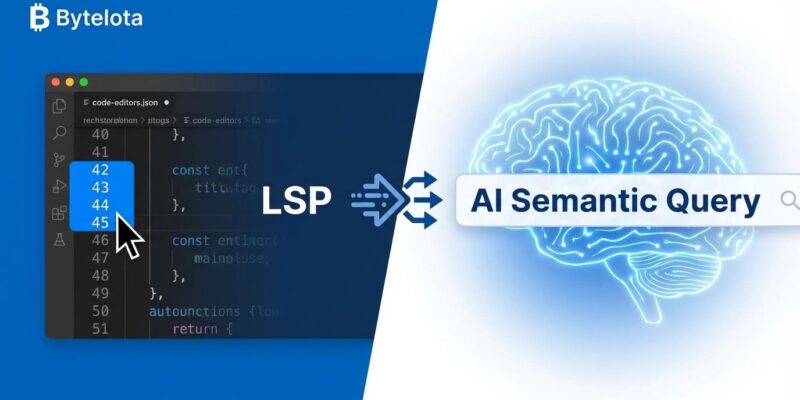
José Valim, creator of Elixir, called out the limitation immediately: “LSP APIs are awkward for agentic usage because they require passing file:line:column, you can’t simply ask ‘tell me where Foo#bar is defined.'”
He’s right. LSP was designed for humans clicking on line 47, column 12. Agents want semantic queries—”where is this function?”—not coordinate-based APIs. Claude Code now has feature parity, but it’s bolting on a paradigm built for cursor clicks, not conversational queries.
Hacker News developers echoed this tension. Some called the marketplace “half-baked.” Others noted uncertainty about when the agent actually uses LSP versus falling back to LLM inference. The community is already building semantic layers on top—projects like refact-lsp add AST and vector database indexes designed for agentic workflows.
The question isn’t whether LSP helps. It does. The question is whether we’re building the right abstractions for AI-native development, or just retrofitting old tools onto fundamentally new workflows.
Cursor Sets the Pace
Cursor acquired Graphite for over $290 million on December 19. CEO Michael Truell explained the move: “Code review is increasingly becoming a bottleneck to teams moving even faster.” Cursor isn’t just adding features—it’s building a full development workflow from IDE to code review to deployment.
GitHub Copilot owns the IDE-native approach, with extensions for VS Code and JetBrains preserving developers’ existing setups. Cursor went further, forking VS Code entirely and making AI central. Claude Code differentiated with a terminal-first approach and a 200,000-token context window.
Now Claude Code has LSP, Cursor is buying up the stack, and Copilot keeps tightening its grip on established IDEs. The strategies diverge, but the pattern is clear: everyone is converging toward “AI-native IDE with full traditional tooling.”
What Developers Get Now
If you’re using Claude Code, the marketplace makes installation straightforward. Set ENABLE_LSP_TOOLS=1, add the marketplace, and install language servers for Python, TypeScript, or Rust. Navigation speeds up. Refactoring gets more reliable. Type information appears on hover.
The trade-off is added complexity. LSP plugins require configuration, and early adopters report non-blocking permission prompts that interrupt workflow. But for teams already invested in Claude Code’s terminal-first paradigm, LSP fills a gap that was blocking broader adoption.
The Real Question: What Do AI Agents Actually Need?
LSP makes Claude Code competitive. It doesn’t answer whether we’re building the right primitives. José Valim’s critique points to a deeper problem: agents need semantic queries, not coordinate-based lookups. Research on agentic programming suggests that traditional IDE paradigms may not translate cleanly to AI workflows.
Short-term, LSP gives feature parity. Long-term, we might need protocols designed for agents from the ground up—semantic search, AST traversal, vector database indexing. The community is already experimenting. Watch for new abstractions emerging in 2026.
Claude Code caught up on features. The harder question is whether “catching up” means winning, or whether AI-native development demands rethinking the tools entirely.