 By ByteBot
Kubernetes clusters are running at just 10% CPU utilization. That’s down from 13% last year. Everyone knows Kubernetes is wasteful. The shocking part? We’re getting worse at it.
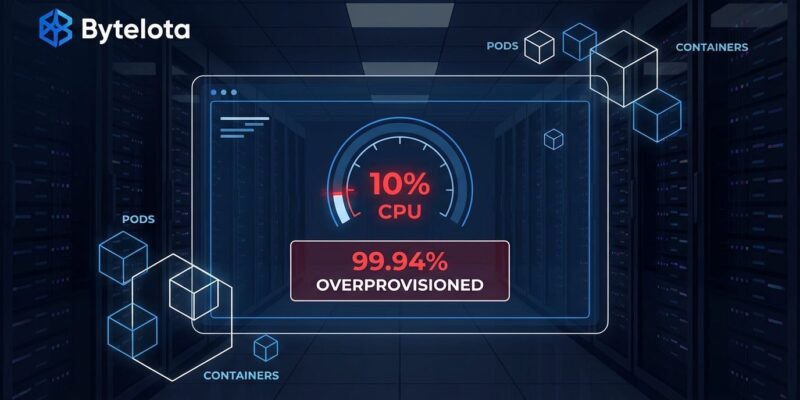
Cast AI’s 2025 Kubernetes Cost Benchmark Report analyzed over 2,100 clusters across AWS, GCP, and Azure. The findings: 99.94% of Kubernetes clusters are overprovisioned. Average CPU utilization sits at 10%—a three-percentage-point decline from 2024. Memory utilization fares slightly better at 23%, but the gap between provisioned and requested resources remains massive: 40% for CPU, 57% for memory.
This isn’t a knowledge problem. It’s not a tooling problem. The problem is getting worse despite widespread awareness and mature automation tools. That tells you something.
The Real Cost: Billions Wasted, Carbon Emissions Soaring
The average Kubernetes cluster wastes between $50,000 and $500,000 annually. Scale that across the industry and you’re looking at billions in unnecessary cloud spend. The Harness FinOps in Focus 2025 report projects $44.5 billion in total cloud waste for 2025, with Kubernetes contributing significantly to that figure. Eighty-two percent of Kubernetes workloads are overprovisioned, and 65% use less than half their requested resources.
The financial waste is bad enough. The environmental impact is worse. Data centers already contribute 4% of global greenhouse gas emissions, with projections suggesting they’ll consume 3-13% of global electricity by 2030. When your cluster runs at 10% CPU utilization, 90% of its compute emissions are pure waste. Powering down just 15 unused servers prevents roughly 1,000 kg of CO2 emissions monthly—equivalent to driving 1,000 miles. Up to 50% of provisioned resources go unused and could be powered down entirely.
Why It Happens: The Root Causes
If the solution were technical, we’d have fixed this by now. The tools exist. The problem is systemic.
The FinOps-Developer Disconnect: Fifty-two percent of engineering leaders cite the disconnect between FinOps and development teams as the primary driver of wasted spend. FinOps teams focus on cost optimization. Developers focus on reliability and performance. They speak different languages, track different metrics, and operate under different incentives. FinOps identifies the waste but can’t act without developer buy-in. The waste persists in that organizational gap.
Fear-Driven Overprovisioning: Nobody gets fired for over-requesting resources. You do get fired for production outages caused by resource constraints. That asymmetry drives developers to pad resource requests with safety margins. The “better safe than sorry” mentality dominates. Once those requests are set, they’re rarely revisited. Ironically, 5.7% of containers still exceed their requested memory and trigger OOM errors despite the overall overprovisioning—revealing how poorly calibrated these requests actually are.
The Visibility Gap: Only 43% of organizations have real-time visibility into idle resources. Only 39% can identify orphaned resources. Only 33% can detect over- or under-provisioned workloads. The result? Fifty-five percent of purchasing decisions are based on guesswork. Without automation, it takes an average of 31 days just to identify waste and another 25 days to rightsize overprovisioned resources. By the time you spot the problem, you’ve accumulated another month of wasted spend.
Kubernetes Complexity Enables Waste: Kubernetes abstracts away the real costs. Developers don’t see the dollar signs or carbon footprint attached to their resource requests. The scheduler only sees requests, not actual usage, so even “optimized” bin packing wastes resources if those requests are inflated. Generic values get copy-pasted across deployments. Only 7% of workloads have accurate resource requests and limits configured. That’s not a technology failure—it’s a people and process failure.
Solutions Exist But Aren’t Adopted
Mature automation tools can cut Kubernetes waste by 59-77%. Vertical Pod Autoscaler (VPA) adjusts resource requests and limits based on actual usage. Goldilocks provides safe VPA recommendations and has delivered proven cost savings—one case study cited $300,000 in annual savings. Horizontal Pod Autoscaler (HPA) scales pod counts based on metrics. Karpenter optimizes node-level autoscaling and terminates underutilized nodes. Cluster Autoscaler handles bin-packing optimization.
These tools are mature, proven, and many are open source. The Kubernetes documentation covers them extensively. Eighty-six percent of developers believe AI will enhance their ability to optimize costs. Yet only 7% of workloads are properly configured, and CPU utilization declined from 13% to 10% year-over-year.
The gap between available solutions and actual adoption reveals the real problem. It’s not a technology gap—it’s an adoption, culture, and priority gap. The pain of waste doesn’t yet exceed the effort required to fix it. For most organizations, waste is still “cheaper” than optimization.
What This Reveals About Cloud-Native Culture
Kubernetes overprovisioning is a symptom of cloud-native development culture optimizing for speed over efficiency. “Move fast and break things” evolved into “move fast and overprovision everything.” Cloud abstraction hides the true costs—both financial and environmental—from the engineers making resource decisions. We’ve made Kubernetes so complex that waste became the default, not the exception.
The data shows a stark divide: 7% of workloads are configured correctly, representing organizations that prioritize efficiency. The other 99.94% represent everyone else. That gap isn’t closing. It’s widening.
This won’t change until the economic pain exceeds the effort required to optimize. Cloud costs will need to bite harder. Energy regulations targeting data center consumption could force the issue. Recession-driven cost pressure might accelerate adoption of optimization tools. But relying on “awareness” or “best practices” clearly isn’t working. The trend is moving in the wrong direction.
The Bottom Line
The Cast AI 2025 report doesn’t just document waste—it documents a worsening trend despite perfect information and available solutions. That’s not a technical problem. That’s an economic and organizational problem.
Organizations that fall into the 7% aren’t smarter or more technically capable. They’ve aligned incentives, bridged the FinOps-developer gap, invested in automation, and made efficiency a priority rather than an afterthought. The other 99.94% are waiting for the pain to exceed the effort. Based on current trends, they’ll be waiting a while longer.