 By ByteBot
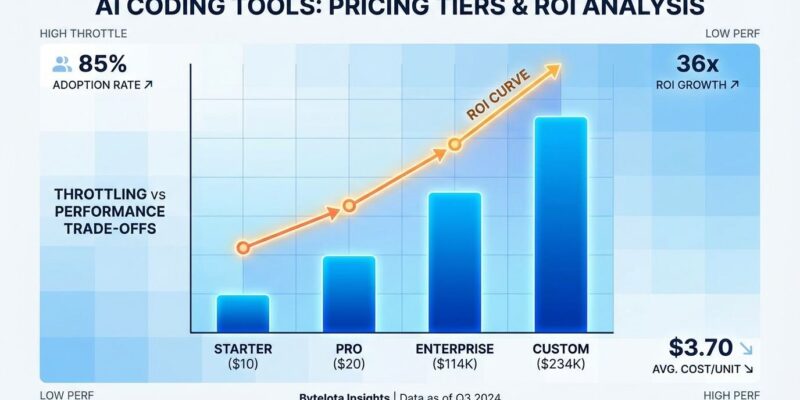
Eighty-five percent of developers use AI coding tools in 2025, but pricing is chaos. GitHub Copilot costs $10/month, Cursor charges $20/month, and pay-as-you-go models can spike to $200-300 during heavy refactoring. For enterprise teams with 500 developers, annual costs range from $114,000 (GitHub Copilot Business) to $234,000+ (Tabnine Enterprise).
Here’s the catch: all 15 major tools offer identical features—WCAG compliance, performance optimization, security detection, test generation. Pricing differences don’t reflect what tools do. They reflect performance benchmarks and hidden costs like request throttling.
Individual Tiers: $10-20/Month, But Watch the Throttling
Most developers pay $10-20/month for AI coding assistants, but request limits create hidden productivity costs. GitHub Copilot Pro ($10/month) allows 300 requests monthly, Cursor ($20/month) provides 500 requests then throttles to what users describe as “slow/annoying,” and Claude Desktop ($18/month) offers unlimited with message resets.
The critical insight: paid tiers don’t block when you exceed limits—they throttle. One developer described waiting during Cursor’s throttled periods as worse than being “stuck in a never-ending Zoom call.” This productivity blocker is the hidden tax many miss when comparing monthly costs.
Subscription prices look transparent, but Cursor’s $20/month becomes nearly unusable after 500 requests, while Claude Desktop’s $18/month delivers what users call a “ridiculous amount of usage” without throttling. The real cost isn’t the subscription—it’s lost productivity when limits hit during critical work.
Enterprise Economics: $114K-$234K Annually, Negotiate Hard
For a 500-developer team, AI coding tools cost $114,000-$234,000 annually at list prices. However, volume discounts of 20-40% and annual contract savings of 10-20% are standard, not exceptional.
GitHub Copilot Business leads at $19/user/month ($114k/year), Cursor Team costs $40/user/month ($192k/year), and Tabnine Enterprise exceeds $234k/year. But enterprises paying list prices leave massive savings on the table. Negotiating can reduce a $192k Cursor contract to $115k-$154k.
Engineering managers often budget based on list prices ($15-40/user/month) without realizing these are starting points. A 500-developer team choosing Cursor at list price ($192k) versus negotiated GitHub Copilot ($91k) wastes $101k annually—enough to hire two additional engineers. With AI budgets averaging $85,521/month in 2025 (up 36% from 2024), knowing negotiation leverage is essential.
Pay-As-You-Go: $5-15/Month or $200-300/Month?
Bring-your-own-API tools like Aider and Cline offer pay-as-you-go pricing that can cost $5-15/month for light usage or spike to $200-300/month during heavy refactoring. Unlike subscriptions with throttling, BYO-API tools deliver full speed but create unpredictable costs.
One developer warns: “LLM bills expand to fill the credit limit available.” Another reports intensive sessions hit “£20/hour” rates. The trade-off is clear: predictable costs with productivity blockers versus variable costs with full performance.
Many developers assume pay-as-you-go is always cheaper than subscriptions, but intensive work can cost 10-15× more. A $20/month Cursor subscription (with throttling) versus a $200-300/month BYO-API bill (without throttling) is the real choice. Developers need cost control strategies: set API usage caps, monitor dashboards, and understand when fixed subscriptions deliver better value despite request limits.
ROI Reality: $3.70 Per Dollar, But Can You Track It?
AI coding tools deliver $3.70 average return per dollar invested, with top performers achieving $10.30 returns. For individual developers, net benefit reaches $4,386 annually—for a 50-person team, that’s $219,300 in value.
Time savings average 2-3 hours/week (baseline), with top users reaching 6+ hours/week. Code output increased 76% (from 4,450 to 7,839 lines) between March-November 2025. Feature delivery is 15-25% faster, and test coverage increased 30-40%.
However, only 51% of organizations can track AI ROI effectively, despite 91% claiming confidence. A $10/month subscription ($120/year) delivering $4,386 in value is a 36× return—hard to argue against. But without measurement, teams can’t prove value or identify low-adoption developers. The hidden cost isn’t the tool price—it’s not measuring whether it delivers promised productivity gains.
Free Tiers Are Evaluation-Only
Free tiers exist (GitHub Copilot Free, Gemini AI Studio, Antigravity preview), but they’re designed to convert to paid, not sustain real work. GitHub Copilot Free offers 50 agentic requests/month—one developer calls this “the AI equivalent of Costco giving you half a sausage on a toothpick and calling it lunch.”
Gemini AI Studio provides genuinely generous limits (1M token context, soon 2M), but requires manual copy-pasting instead of IDE integration. Free tiers are for evaluation, not production.
A professional developer coding 40 hours/week needs hundreds of requests monthly—50 requests lasts days, not weeks. The better strategy: use free tiers for evaluation (1-2 weeks), then upgrade to $10-15/month paid tiers when limits block productivity. Time spent working around free tier limits costs more than the subscription.
Key Takeaways
- Individual tier throttling is the hidden cost: $10-20/month subscriptions throttle after 300-500 requests, killing productivity. Claude Desktop’s $18/month unlimited (with message resets) offers best value for full-time developers.
- Enterprise teams: negotiate 20-40% volume discounts and 10-20% annual contract savings. A 500-dev team can save $34k-$101k annually by negotiating instead of accepting list prices ($114k-$234k).
- Pay-as-you-go risk: BYO-API tools cost $5-15/month for light usage but can spike to $200-300/month during intensive work. Set usage caps and monitor API dashboards to avoid surprise bills.
- ROI is strong ($3.70 average, $10.30 top performers), but only 51% can track it. Measure time savings (target: 2-3 hours/week minimum) and code output to justify spend and identify low-adoption developers.
- Free tiers are evaluation tools: GitHub Copilot Free’s 50 requests/month lasts days for full-time developers. Use for 1-2 week trials, then upgrade to paid when limits block work.
With 85% of developers already using AI coding assistants, the question isn’t whether to adopt—it’s how to pay smartly. Understand request limits, negotiate enterprise contracts, and track ROI to avoid overpaying for productivity that throttling takes away.