 By ByteBot
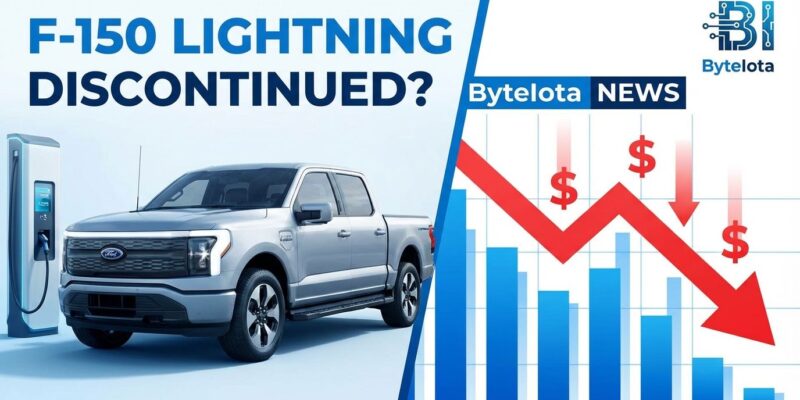
Ford ended production of the all-electric F-150 Lightning on December 15, 2025, taking a $19.5 billion charge on its EV assets—the biggest retreat from pure electric vehicles by a major automaker. CEO Jim Farley bluntly admitted “these really expensive $70k electric trucks will never make money” after Ford’s Model e division lost $5.1 billion in 2024, including $130,000 per vehicle in Q1 alone. The next-generation Lightning will be an Extended Range Electric Vehicle (EREV) with a gas generator, offering 700+ miles of range instead of the current 320 miles.
This isn’t one truck dying. It’s the auto industry’s most expensive admission that pure EV economics don’t work for large vehicles—not yet, maybe not ever.
The Real Cost: Losing $130,000 Per Truck
Ford’s Model e division burned through $5.1 billion in 2024, up from $4.7 billion in 2023. In Q1 2024 alone, Ford lost approximately $130,000 on every electric vehicle it sold—$1.3 billion in losses on roughly 10,000 EVs. By Q4, the losses “improved” to $37,000 per EV, still catastrophically unsustainable. Ford projects another $5 to $5.5 billion loss for 2025.
These numbers aren’t rounding errors or typical launch-phase investments. They represent structural unprofitability. Farley’s December admission—”these large EVs will never make money”—contradicts years of EV optimism from Detroit and Wall Street. The $19.5 billion writedown is Ford admitting it bet wrong on pure electric trucks and paying the price.
For anyone tracking infrastructure economics, this is familiar. Burn rates that “scale will fix” often don’t fix. Ford tried for four years. The unit economics stayed broken.
When the Tax Credits Stopped, So Did Sales
Despite leading the electric pickup market through Q3 2025 with 23,024 units sold—beating Tesla’s Cybertruck (16,097 units) and Rivian’s R1T (5,857 units)—the Lightning couldn’t sustain demand without subsidies. Sales collapsed 72% in November 2025 when the $7,500 federal EV tax credit expired.
The math exposes the dependency: $70,000 sticker price vs $62,500 with credit. Customers weren’t buying EVs—they were buying $7,500 discounts. When full pricing hit, demand evaporated. Market leadership means nothing when your business model requires perpetual government support.
Related: AI Data Center Costs: 267% Electricity Spike, Senators Investigate
This is the subsidy addiction lesson playing out in hardware. If you need credits to close the sale, you don’t have product-market fit at real pricing. The 72% drop proves Ford’s EV strategy was built on subsidies, not sustainable demand.
Ford’s Answer: Gas Generators and 700-Mile Range
The next-generation F-150 Lightning will be an Extended Range Electric Vehicle (EREV) with 700+ miles of total range, more than double the current 320 miles. Unlike traditional hybrids, the EREV uses 100% electric motors for propulsion. The gas generator exists solely to charge the battery, never driving the wheels.
Ford saves $6,000 per vehicle by using a smaller battery while eliminating range anxiety—the fundamental problem that killed the pure EV Lightning. The EREV offers 100-200 miles of electric-only range (versus a plug-in hybrid’s 20-40 miles), then switches to generator mode for long hauls. Electric performance, gas resilience.
This is Ford admitting 320 miles wasn’t enough. Range anxiety is real, not just customer perception. The EREV addresses the core technical limitation—battery weight and cost versus usable range—while maintaining electric torque and acceleration. It’s pragmatic engineering after four years of ideological purity failed.
Best-Selling Electric Truck, $5 Billion Hole
The Lightning led the U.S. electric pickup market with a 35% share in Q2 2025. It outsold every competitor. Ford had the brand (F-150 is America’s best-selling vehicle for 40+ years), the product, and the market position. None of it mattered.
Leadership position plus $5.1 billion annual loss proves unit economics beat market share every time. Silicon Valley learned this with Uber, WeWork, and food delivery. Detroit is learning it with EVs. Growth at all costs fails when costs are $130,000 per unit sold.
The entire electric pickup segment contracted 19% in Q2 2025. Tesla’s Cybertruck fell 38% year-over-year. Rivian’s R1T dropped 32.5%. Every player is struggling because the market isn’t there at realistic pricing. Ford called it first.
China Bet on Hybrids While US Chased Purity
While U.S. automakers pushed pure EVs, China embraced Extended Range Electric Vehicles and sold 1.2 million units in 2024—a 79% year-over-year increase. Li Auto, a leading Chinese EREV brand, posted substantial growth while American EV makers hemorrhaged money. The global EREV market is projected to grow from $1.39 billion in 2024 to $4.3 billion by 2035.
China identified the pragmatic solution three years before Ford’s $19.5 billion admission. EREVs deliver electric performance with gas backup, addressing range anxiety without betting everything on battery technology that isn’t economically viable yet for large vehicles. Pragmatism beat perfectionism.
Ford, Hyundai, and others are now pivoting to EREVs with 18 models expected in the U.S. market by 2028. That’s the market validating what China proved in 2022: hybrid architectures win when pure solutions have fatal tradeoffs. Ford’s writedown is tuition on reading markets correctly.
Key Takeaways
- Ford took a $19.5 billion charge ending F-150 Lightning production—the largest EV retreat by a major automaker, with CEO Jim Farley admitting large electric trucks “will never make money”
- Model e division lost $130,000 per EV in Q1 2024 and $5.1 billion for the full year, proving market leadership means nothing without unit economics
- Sales collapsed 72% when the $7,500 federal tax credit expired, exposing subsidy-dependent demand rather than genuine product-market fit
- Next-generation Lightning will be an EREV with 700+ mile range and $6,000 cost savings per vehicle, admitting range anxiety is real and 320 miles failed
- China sold 1.2 million EREVs in 2024 (79% growth) while U.S. automakers lost billions on pure EVs—pragmatic hybrids beat ideological purity
The EV revolution’s timeline was fiction built on subsidies and optimism. Ford’s $19.5 billion lesson: hardware economics don’t bend to hype cycles. Hybrids are the reality.