 By
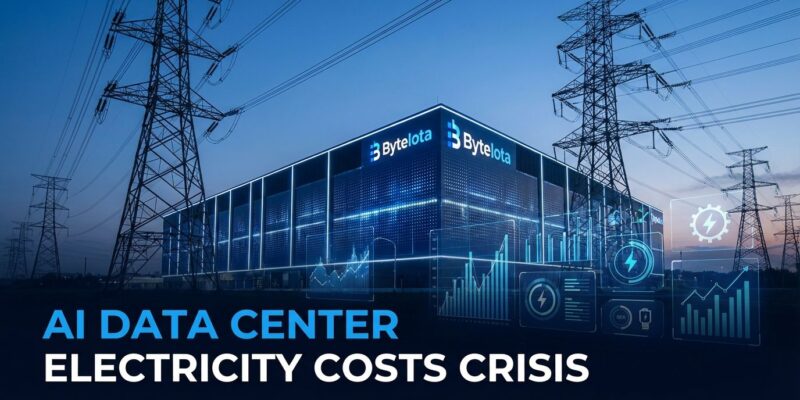
By On December 17, 2025, Senators Elizabeth Warren, Richard Blumenthal, and Chris Van Hollen launched an investigation into whether AI data centers are driving up residential electricity costs, demanding answers from Amazon, Google, Meta, Microsoft, CoreWeave, Digital Realty, and Equinix by January 12. Electricity costs surged 267% over five years in areas near significant data center activity, according to the Bloomberg investigation. Meanwhile, PJM Interconnection capacity prices jumped 500%—from $2.2 billion to $14.7 billion—with data centers responsible for 63% ($9.3 billion) of the increase, according to the grid’s independent market monitor.
The core question: Are you subsidizing Amazon and Google’s AI race through your electricity bill?
The Subsidy Problem: You’re Paying for Big Tech’s Infrastructure
Here’s what’s actually happening. PJM—the grid operator serving 65 million people across 13 states including Virginia, Illinois, Ohio, and New Jersey—runs capacity auctions to ensure adequate power supply. When capacity prices surge 500% in one year, utilities pass those costs to all customers. However, data centers, which drove 63% of that increase, often negotiate confidential special deals that don’t cover their full infrastructure costs. Residential customers pick up the tab.
The numbers are concrete. Baltimore residents saw bills jump $17/month after the PJM capacity auction. Washington D.C. (Pepco) customers saw $21/month increases, with roughly half attributed to capacity market spikes. In Virginia, Dominion Energy projects average residential bills will more than double to $315/month in 15 years—primarily due to data centers. Virginia has the highest concentration of data centers globally, and its residential customers will pay 55% of $7.6 billion in transmission infrastructure upgrades that primarily serve those facilities.
Harvard Law School research confirms the pattern: utilities subsidize data center growth by shifting costs to other ratepayers, with residential customers bearing two-thirds of transmission costs designed for data center infrastructure. Indiana Michigan Power estimates $17 billion in new power plants needed to meet data center demand. Those costs get socialized across all customers, not just the data centers creating the demand.
A Single Data Center = 100,000 Homes. Do the Math.
Data centers consume power at scales that dwarf residential use. A single large hyperscale facility draws 20-100+ megawatts continuously—equivalent to 15,000-75,000 homes. The largest facilities exceed 650 megawatts, enough to power 500,000 homes. AI-specific data centers consume even more: the International Energy Agency estimates a typical AI data center uses power equivalent to 100,000 homes.
The Department of Energy projects data centers will consume 6.7-12% of total US electricity by 2028, up from 4.4% in 2023. That’s a doubling or tripling in just five years, driven by AI training and inference workloads. Training GPT-3 alone consumed 1,287 megawatt-hours—enough to power 130 US households for an entire year. GPT-4’s training consumed 50 gigawatt-hours, enough to power San Francisco for three days, at a cost exceeding $100 million.
Virginia, Illinois, Ohio, NJ: Where Bills Are Surging 13-20%
Residential electricity bills are surging in states with high data center concentration, far above the 6% national average. Virginia saw year-over-year increases of 13%, Illinois 16%, Ohio 12%, and New Jersey roughly 20%. These aren’t abstract policy numbers—they’re real money out of tech workers’ paychecks in NoVA, Chicago, Columbus, and Newark.
The disparity gets worse when you compare residential and commercial rates. In Portland’s Hillsboro suburb—home to 15 major data centers—residential rates climbed 8 cents per kilowatt-hour over the past decade. Large commercial users saw rates increase just 2 cents over the same period. Nearly all load growth came from commercial customers (data centers), yet residential customers bore the majority of infrastructure cost increases. That’s the subsidy in action.
Related: Logging Infrastructure Cost Crisis: $140K Waste + 15% Budgets
Regulators Fight Back—While Tech Invests in Nuclear
States are scrambling to create new rate structures to prevent residential customers from subsidizing data centers. Indiana’s Utility Regulatory Commission now requires customers with 70+ megawatts at a single site to sign 12-year contracts, pay 80% minimum demand charges, and provide collateral if credit ratings are insufficient. Virginia proposed a new rate class specifically for large power users to demonstrate they’re paying fair rates. California’s SB 57 would require data centers to prepay expected energy consumption, ensuring grid investments are fully recovered from those creating the demand.
Meanwhile, tech companies are investing billions to escape the grid conflict they created. Amazon signed deals for four small modular reactors (SMRs) plus a partnership with Dominion Energy for 300+ additional megawatts. Google partnered with Kairos Power for up to seven SMRs delivering 500 megawatts total. Microsoft committed $1.6 billion to restart Three Mile Island’s Unit 1, now rebranded as the Crane Clean Energy Center, with a targeted 2028 reopening. The irony: big tech is spending billions on nuclear power to avoid the residential cost conflict their grid dependence created.
The regulatory response highlights a transparency problem. Most data center-utility contracts are confidential, making it impossible for residential customers to know whether they’re subsidizing Amazon’s AI training or Google’s data centers. Bloomberg’s investigation found that “how much a data center coming to your town will affect your electricity bill often depends on whatever deal the tech firm struck with the local utility”—and you’re not allowed to know the terms.
What’s Next: January 12 Deadline
The seven companies targeted by the Senate investigation must respond by January 12, 2026 with detailed answers about electricity arrangements, energy usage projections through 2030, and steps taken to prevent passing costs to neighbors. So far, only Digital Realty commented publicly, saying they “look forward to working with all elected officials.” Microsoft, Meta, and CoreWeave declined comment.
Senator Warren’s letter frames the stakes clearly: “Utility companies have spent billions of dollars updating the electrical grid to accommodate the unprecedented energy demands of AI data centers and appear to recoup the costs by raising residential utility bills. Through these utility price increases, American families bankroll the electricity costs of trillion dollar tech companies.” Expect more developments when companies respond in January 2026.
Key Takeaways
- PJM capacity prices surged 500% ($2.2B → $14.7B), with data centers responsible for 63% ($9.3B) of the increase—costs passed to residential customers through higher bills ($17-21/month in Baltimore and D.C.).
- Data centers consume power equivalent to hundreds of thousands of homes: A single large facility draws 20-100+ MW (15,000-75,000 homes), and the DOE projects data centers will hit 6.7-12% of total US electricity by 2028, up from 4.4% in 2023.
- Residential bills are surging in data center hubs far above the 6% national average: Virginia +13%, Illinois +16%, Ohio +12%, New Jersey +20% year-over-year, while commercial users see minimal increases.
- States are creating new rate structures to prevent subsidies, but transparency remains a problem: Indiana, Virginia, and California implementing tariffs requiring data centers to pay full infrastructure costs, but most utility contracts remain confidential.
- Tech companies are investing billions in nuclear SMRs to escape the grid conflict they created: Amazon, Google, and Microsoft collectively committing to over 1,000 MW of new nuclear capacity to secure their own power and avoid residential cost conflicts.
The January 12 deadline will reveal whether tech companies acknowledge the cost burden on residential customers—or continue defending confidential deals that hide the true subsidy. This is an ongoing story with real money at stake for anyone paying an electricity bill in Virginia, Illinois, Ohio, or New Jersey.